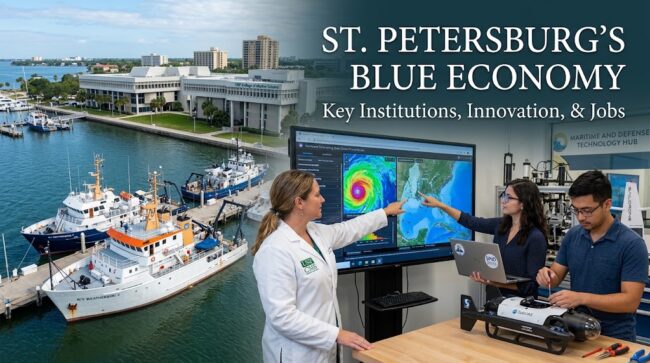
Quick Answer: St. Petersburg’s blue economy is the largest marine science cluster in the southeastern United States, concentrated around Bayboro Harbor in the St. Petersburg Innovation District. Anchored by the USF College of Marine Science, it includes more than 30 federal and state agencies, research institutions and private firms, employs roughly 1,900 marine science workers and contributes about $540 million a year to the local economy. In 2026 the cluster is recovering from a May fire that destroyed USF’s main marine lab and awaiting a November referendum that would allow a 50,000-square-foot Center for Coastal Resilience at the Port of St. Petersburg.
Key Takeaways
- The cluster is built on public anchors: USF, NOAA, USGS, the Florida Fish and Wildlife Research Institute and the Florida Institute of Oceanography all sit within a few blocks of each other.
- The Maritime and Defense Technology Hub at the port is the private-sector on-ramp, with tenants such as Saildrone and SubUAS working on autonomous ocean systems.
- A lightning-sparked fire on May 2, 2026 severely damaged USF’s 80,000-square-foot Marine Science Laboratory; rebuilding funding is being sought in the 2027 legislative session.
- St. Petersburg voters will decide on Nov. 3, 2026 whether to allow 25-year leases at the port, the step needed to build the Center for Coastal Resilience.
What Is the Blue Economy in St. Petersburg?
The traditional blue economy is fishing, shipping, boat building and coastal tourism. St. Petersburg’s version is what the Innovation District calls the “New Blue Economy,” a knowledge economy that looks to the ocean for data and technology rather than extraction. Marine science and data analytics are two of the city’s Grow Smarter target industries, and they converge in St. Pete in ways few other cities can match: hurricane forecasting, coastal flood modeling, autonomous ocean vehicles, fisheries science and water quality monitoring, all within walking distance of downtown.
Councilmember Gina Driscoll has compared the district to North Carolina’s Research Triangle, calling it the marine science version. The pieces are already in place; what the city is working on now is space, resilience and branding.
Key Institutions and Companies
| Organization | Type | Core Specialty | Location |
|---|---|---|---|
| USF College of Marine Science | Academic | Top-10 graduate oceanography program; hurricane, flood and ocean circulation research; Florida Flood Hub | Bayboro Harbor |
| FWC Fish and Wildlife Research Institute | State | Fisheries, red tide, marine wildlife and habitat research | 8th Ave SE |
| NOAA Fisheries Southeast Regional Office | Federal | Fisheries management, protected species, Gulf and South Atlantic | Innovation District |
| USGS St. Petersburg Coastal and Marine Science Center | Federal | Coastal change, storm impacts, sea-level science | Innovation District |
| Florida Institute of Oceanography | State consortium | Operates research fleet incl. R/V Weatherbird II and R/V W.T. Hogarth for 30+ Florida institutions | Port of St. Petersburg |
| Maritime and Defense Technology Hub | Public-private | Shared workspace for marine tech and defense startups and contractors | Port of St. Petersburg |
| Saildrone | Private | Autonomous surface vehicles for ocean data; partnership with USF CMS | The Hub |
| SubUAS | Private | Hybrid aerial-underwater drone technology | The Hub |
| St. Petersburg Innovation District | Nonprofit | Convenes 30+ member organizations; annual Science Festival and State of Science event | Downtown waterfront |
| U.S. Coast Guard Sector St. Petersburg | Federal | Maritime safety and security for West Central Florida | Bayboro Harbor |
The Innovation District marked its 10th anniversary in 2026 and adopted its first master plan, a road map for how the waterfront research campus grows over the next decade. The annual St. Petersburg Science Festival and FWC’s MarineQuest drew roughly 10,000 people to the waterfront in February, with exhibitors including USGS and General Dynamics.
Jobs and Economic Impact
The Innovation District reports about 1,900 marine science employees within its footprint generating roughly $540 million in annual economic activity. Those are largely degreed positions: oceanographers, data scientists, marine engineers, fisheries biologists and the robotics specialists that autonomous-systems firms recruit. USF’s College of Marine Science is a graduate-only program, which means the pipeline into the cluster starts at the master’s and PhD level.
The broader working waterfront, including marine repair, yacht services and the municipal marina, employs several thousand more across Pinellas County in trades roles that face a separate labor shortage. Both segments are growing, but they draw from entirely different talent pools.
What Happened at USF’s Marine Lab?
On May 2, 2026, a lightning strike ignited a roof fire at USF’s Marine Science Laboratory on Bayboro Harbor. It took 200 firefighters and 60 vehicles to extinguish a blaze that severely damaged the 87-year-old, 80,000-square-foot building and destroyed decades of research samples and data. Because the fire hit as the Legislature was finalizing the 2026-27 budget, no emergency state funds could be allocated; USF President Moez Limayem said the university would return to lawmakers in the 2027 session while working through insurance.
Researchers kept the college’s Gulf monitoring buoys operating within a week, in part because the Ocean Circulation Lab’s infrastructure was housed elsewhere. That subsurface temperature data feeds hurricane intensity forecasts, and its continuity through the 2026 season mattered to the entire Gulf Coast. The community raised more than $400,000 and the USF Foundation launched a Marine Science Operating Fund. Recovery is expected to be a multi-year facility challenge.
The Center for Coastal Resilience and the November Ballot
The Maritime and Defense Technology Hub filled quickly after opening, and the city wants a sequel. The Center for Coastal Resilience, formerly called Hub 2.0, would be a 50,000-square-foot facility replacing the port’s surface parking lot, housing resilience-focused agencies, academic labs and startups. The city charter requires voter approval for waterfront leases longer than five years, so a referendum authorizing 25-year port leases is on the Nov. 3, 2026 general election ballot alongside a $600 million storm-resilience bond and several other city questions.
If the lease question passes, the city can sign the long-term tenant commitments needed to finance construction. If it fails, the district’s growth constraint, which is space, remains unsolved.
What This Means for St. Pete Businesses
Commercial real estate. Lab and flex space is the scarcest asset downtown. The USF fire displaced hundreds of researchers into borrowed offices, and Hub demand already exceeded supply before that. Owners of office and light-industrial space near the Innovation District and along 4th Street South have a tenant class that pays for wet-lab capability.
Contractors and engineers. The USF rebuild, the Center for Coastal Resilience and the $2.7 billion SPAR resilience program together represent a decade of waterfront construction and specialty engineering work.
Professional services. Federal contracting, grant administration, IP and technology transfer, and defense-adjacent compliance are underserved locally relative to the volume of research dollars flowing through the district.
Employers outside marine science. The hurricane-forecasting, flood-modeling and coastal-data expertise sitting in St. Pete is directly relevant to insurers, utilities, developers and lenders across Florida. Most of them have never walked through the district’s doors.
Brian’s Take
St. Petersburg has a genuine, hard-to-replicate asset here and has undersold it for years. The federal agencies are not leaving, USF’s program is nationally ranked, and the private autonomous-systems firms chose this port over dozens of others. The two risks are self-inflicted. First, the fire exposed how much of the cluster’s institutional memory sat in one 87-year-old building; the rebuild needs to be treated as a state economic-development priority, not a university facilities line item. Second, the November lease referendum is the kind of low-profile ballot question that fails when nobody explains it. The business community that would benefit most from a second hub should be making that case now. Get those two things right and the Research Triangle comparison stops being aspirational.
Frequently Asked Questions
What is the St. Petersburg Innovation District? A nonprofit-led waterfront district south of downtown that brings together USF St. Petersburg, federal and state marine agencies, Johns Hopkins All Children’s Hospital, Bayfront Health, the port and the Maritime and Defense Technology Hub.
How big is St. Pete’s marine science sector? About 1,900 marine science employees and roughly $540 million in annual economic contribution within the Innovation District, across more than 30 organizations.
Is the USF College of Marine Science still operating after the fire? Yes. Research, field work and graduate programs continued from temporary spaces, and ocean monitoring resumed within days. The main laboratory building requires a multi-year rebuild.
What is the Maritime and Defense Technology Hub? A city-backed facility at the Port of St. Petersburg leasing dedicated and shared space to marine technology and defense-related companies, with tenants required to engage in internships, mentoring and technical exchange.
What is on the November 2026 ballot for the port? A referendum authorizing leases of up to 25 years at the Port of St. Petersburg, which would enable the proposed Center for Coastal Resilience.
Sources and Further Reading
- St. Petersburg Innovation District, Marine Science news and “What the New Blue Economy Means for St. Pete” — https://www.stpeteinnovationdistrict.com/blog-categories/marine-science
- St. Pete Catalyst, “Blue tech boom: Resilience center appears headed for ballots,” Jan. 23, 2026 — https://stpetecatalyst.com/blue-tech-boom-resilience-center-appears-headed-for-ballots/
- Tampa Bay Times, “St. Petersburg voters may decide on longer port lease to grow tech hub,” Feb. 26, 2026 — https://www.tampabay.com/news/2026/02/26/st-petersburg-voters-may-decide-longer-port-lease-grow-tech-hub/
- SECOORA, “Rebuilding the Future: USF’s College of Marine Science Recovers from Historic Blaze,” June 29, 2026 — https://secoora.org/rebuilding-the-future-usfs-college-of-marine-science-recovers-from-historic-blaze-one-day-at-a-time/
- USF College of Marine Science, “After devastating fire, USF marine scientists race to keep ocean monitoring on track,” June 2, 2026 — https://www.usf.edu/marine-science/news/2026/after-devastating-fire-usf-marine-scientists-race-to-keep-ocean-monitoring-on-track.aspx
- Florida Politics, “St. Petersburg approves ballot language for $600M infrastructure bond,” July 24, 2026 — https://floridapolitics.com/archives/809332-st-petersburg-approves-ballot-language-for-600m-infrastructure-bond/
StPetersburgBusinessNews.com is part of the Florida Authority Network, a portfolio of Florida business and industry news publications combining human analysis with intelligent curation of public data. Businesses interested in coverage across the network can call 813-409-4683.