Quick Answer
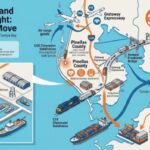
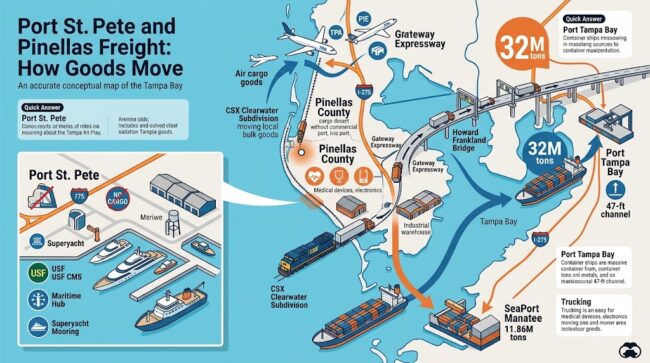
Port St. Pete is not a cargo port. It is a small, city-owned research and superyacht facility. Pinellas County manufacturers ship most ocean freight through Port Tampa Bay and SeaPort Manatee, move goods by truck over I-275, the new Howard Frankland Bridge and the Gateway Expressway, and use the CSX Clearwater Subdivision for local rail freight.
Pinellas Freight Network at a Glance
| Asset | Role for Manufacturers | Key Figure |
|---|---|---|
| Port St. Pete | Research vessels, superyachts | 23-ft depth, 1,200-ft wharf |
| Port Tampa Bay | Main container and bulk gateway | 32M tons (FY2025) |
| SeaPort Manatee | Bulk, breakbulk, containers | 11.86M tons, record (FY2025) |
| Howard Frankland Bridge | Main truck link to Tampa | ~250,000 vehicles/day |
| Gateway Expressway | Mid-county truck connector | Ties into I-275 and bridge |
| CSX Clearwater Subdivision | Local rail freight | 48.6 miles, Tampa to St. Pete |
| Pinellas industrial vacancy | Space availability | 4.7% vs. 6.8% Tampa Bay |
What Port St. Pete Actually Does
Many businesses assume St. Petersburg’s port handles commercial freight. It doesn’t. The four-acre, city-owned site sits between USF’s College of Marine Science and the Innovation District’s maritime hub, and its research neighbors make up for its lack of commercial and cargo ship traffic.
The port’s own leadership has been direct about this. Port officials have said its small size keeps it from competing with Port Manatee and Port Tampa Bay for cargo and large cruise traffic.
What it does offer is a specialized waterfront. The port has a 23-foot project depth and a 1,200-foot wharf, with fuel, crane service and customs processing for large vessels. It is also marketed as the only superyacht marina on Florida’s Gulf Coast.
Where Port St. Pete Helps Manufacturers
- Marine tech and ocean instrument makers: Dockside access for testing, deployment and research vessel support
- Defense and maritime contractors: Proximity to the Maritime and Defense Technology Hub
- Marine service companies: Yacht provisioning, repair and crew services
City council members have urged administrators to establish redevelopment plans for the port, so its role may evolve.
Port Tampa Bay: The Primary Ocean Gateway
For most Pinellas manufacturers importing components or exporting finished goods by sea, Port Tampa Bay is the default. In fiscal year 2025, the port handled 32 million tons of cargo, and container volumes have grown more than 300% since 2018, reaching nearly 263,000 TEUs.
Capacity is expanding. The port’s container terminal footprint is nearing 100 acres, and a third berth is under construction to allow three large container ships to work at once. In April 2026, the port received a vessel carrying 11,900 TEUs, the largest capacity ever handled there.
The biggest project is still ahead. Officials plan to deepen the shipping channel from 43 to 47 feet, with construction set to begin in 2027. A separate report placed the start of the estimated $1.2 billion dredging project in 2028, so timing may shift.
Food and beverage manufacturers have an added advantage: the port includes a 135,000-square-foot cold storage facility.
SeaPort Manatee: The South Bay Alternative
SeaPort Manatee, across Tampa Bay in Palmetto, set a cargo record in fiscal 2025, moving 11,855,828 tons. Container counts fell, however, to 133,456 TEUs from a record 168,897 in FY24, partly because a major fruit importer shifted from containers to breakbulk shipping.
The port is building for container growth. A pending state funding request covers a 10-acre container yard expansion adding 45,000 TEUs of capacity toward a 135,000-TEU goal. Rail access is a plus: the Port Manatee Railroad, a short line connecting directly to a CSX mainline, serves the port.
Trucking: The Real Backbone
Almost everything Pinellas manufacturers ship or receive moves by truck for at least part of the trip. The county’s road connections improved substantially in the past two years.
Howard Frankland Bridge
The new $973 million Howard Frankland Bridge is complete. Express toll lanes opened in May 2026, and the bridge carries an estimated 250,000 vehicles a day between St. Petersburg and Tampa. It was built taller than earlier spans to reduce storm surge reaching the roadway, which matters for supply chain continuity during hurricane season.
Gateway Expressway and I-275
The bridge connects directly into the recently completed Gateway Expressway and I-275 Express project. A further I-275 widening in Pinellas County, with new express lanes, broke ground in August 2025.
For manufacturers in the Gateway, Pinellas Park and Largo industrial areas, these projects shorten drayage runs to Port Tampa Bay and Tampa International Airport.
Rail: Limited but Available
Rail options inside Pinellas are narrow but real. The CSX Clearwater Subdivision runs 48.6 miles from Tampa through Clearwater, Largo and Pinellas Park, ending at Fifth Avenue North near Tropicana Field, and is used for local freight shipments.
CSX has signaled it sees growth potential on these lines. A company official told regional transportation leaders that passenger rail would be difficult on some area lines because CSX sees industrial opportunities there.
Manufacturers with heavy, bulky inputs such as plastics resin, building materials or chemicals should ask brokers about rail-served sites along the Clearwater Subdivision before signing a lease.
Air Cargo
High-value, time-sensitive goods, a big share of Pinellas output in medical devices and electronics, often move by air. The county is served by both St. Pete-Clearwater International Airport and Tampa International Airport, where FedEx and UPS operate.
Warehousing: Tight Space, High Demand
Industrial space in Pinellas is scarce. The county’s industrial vacancy stood at 4.7% at the end of 2025, compared with 6.8% for Tampa Bay overall, with North Pinellas especially tight at 1.9%.
The wider region is looser. Tampa Bay industrial vacancy rose to 7.3% in early 2026 as new supply outpaced demand, but Pinellas has no new industrial land and limited redevelopment sites. That keeps Pinellas tight even as Hillsborough and Polk see more availability.
Main Industrial Corridors
- Gateway / Pinellas Park / Mid-County: Largest concentration of manufacturing and flex space, close to I-275 and both airports
- Largo and Clearwater industrial parks: Older inventory with smaller bays, good for light manufacturing
- North Pinellas (Oldsmar, Tarpon Springs): Tightest vacancy, closest to Hillsborough via State Road 580
County Support for New Industrial Space
Pinellas County is using sales tax dollars to address the space shortage. The Employment Sites Program has more than $90 million committed to building and redeveloping industrial and office space for target industry employers, and Round 7 applications are open.
Recent projects show the scale. One applicant proposed a 110,700-square-foot Class A speculative industrial building in Pinellas Park, and AGORA Edge used the program to add nearly 48,000 square feet and 50 jobs in St. Petersburg.
Who Uses This Network
Pinellas is one of Florida’s top manufacturing counties. The county ranks third in Florida for manufacturing strength and second in total establishments, with more than 34,000 manufacturing employees. Pinellas also generates one-fifth of Florida’s economic activity in medical devices.
Brian’s Take
The headline answer surprises people: St. Petersburg’s port is not part of the freight equation for most manufacturers. Pinellas companies are effectively landlocked shippers who happen to sit on the water, relying on ports across the bay.
That is less of a disadvantage than it sounds. Pinellas manufacturing skews toward medical devices, electronics and defense, products that are high in value and low in weight. Those goods care far more about the Howard Frankland and air cargo access than about ship berths. The new bridge may be the single most important freight improvement for Pinellas manufacturers in a generation.
The real constraint is space, not transport. With Pinellas industrial vacancy running below the regional average and no new land coming, the smartest move for a growing manufacturer is to secure expansion space early. The Employment Sites Program is the best tool available, and I’d talk to county staff before talking to a broker.
Watch two things. First, Port Tampa Bay’s channel deepening, which could bring larger ships and better ocean rates within a few years. Second, the port redevelopment discussion in St. Pete: if the city leans further into marine research and defense technology, Port St. Pete could become a niche logistics asset for a specialized slice of manufacturers.
Frequently Asked Questions
Does the Port of St. Petersburg handle cargo?
No. Port St. Pete is a small city-owned port focused on research vessels, superyachts and marine science. It does not handle commercial container or bulk cargo.
Which seaport do Pinellas manufacturers use?
Most use Port Tampa Bay, Florida’s largest cargo port by tonnage. SeaPort Manatee in Palmetto is the main alternative.
Is there freight rail in Pinellas County?
Yes. The CSX Clearwater Subdivision provides local freight service from Tampa through Clearwater, Largo and Pinellas Park to St. Petersburg.
How hard is it to find warehouse space in Pinellas County?
Difficult. Industrial vacancy was about 4.7% at the end of 2025, below the Tampa Bay average, and the county has almost no new industrial land.
Are there incentives for building industrial space in Pinellas?
Yes. Pinellas County’s Employment Sites Program has more than $90 million committed to help build or redevelop industrial and office space for target industry employers.
How has the new Howard Frankland Bridge affected freight?
The new eight-lane bridge with express lanes, completed in 2026, expands capacity on the main truck route between Pinellas and Tampa and connects directly to the Gateway Expressway.
Sources and Further Reading
- St. Pete Catalyst, “Urgency mounts for port redevelopment plans”
- Maritime Executive, “Port St. Pete Targets Marine Research”
- Florida Ports Council, “Port Spotlight: Port St. Pete”
- PredictWind, Port of St. Petersburg marina profile (2026)
- Maritime Executive, “Port Tampa Bay Receives Largest Containership as Growth Continues” (April 2026)
- Cruise Mapper, “Port Tampa Bay charts expansion after record cruise and cargo traffic” (January 2026)
- Florida Ports Council, “2025 Seaport Spotlight: Port Tampa Bay”
- Progressive Railroading, “SeaPort Manatee reports record FY25 cargo” (November 2025)
- Florida Senate, FY2026-27 Local Funding Initiative Request S1867, SeaPort Manatee Container Yard Expansion
- WUSF, “Northbound express lanes, shared-use path are open on the Howard Frankland Bridge” (May 27, 2026)
- Florida Department of Transportation, “Governor Ron DeSantis Announces Major Infrastructure Investments for Tampa Bay” (August 2025)
- Wikipedia, “Clearwater Subdivision”
- CareerSource Northeast Florida, CSX remarks to Tampa Bay transportation leaders
- FreightCenter, Clearwater freight shipping overview
- Pinellas County Industrial Market Report (December 2025)
- WareCRE, “Tampa Bay’s Two Markets: Big-Box Oversupply Meets Small-Bay Scarcity,” 2026 Warehouse Report
- Pinellas County Economic Development, Advanced Manufacturing and Business Climate pages