By Florida Authority Network Staff | October 22, 2026
Quick Answer
St. Petersburg has about seven federally designated Opportunity Zone census tracts, mostly in South St. Pete. Investors who put capital gains into a Qualified Opportunity Fund can defer tax on those gains, and they pay no federal tax on the investment’s appreciation if they hold it at least 10 years.
The program is changing. A new zone map takes effect January 1, 2027, with new rules: a rolling five-year deferral and a 10% reduction in the taxable gain. Some current St. Pete tracts may not make the new map.
Where Are St. Petersburg’s Opportunity Zones?
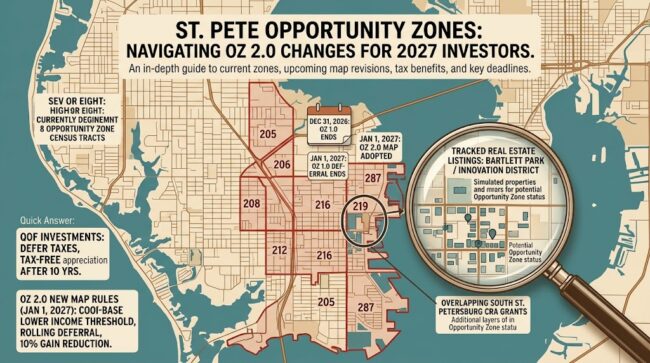
St. Petersburg’s zones were designated in 2018 under the original program, now called “OZ 1.0.” Pinellas County has 16 Opportunity Zone tracts in total, and most of the city’s tracts are in the South St. Petersburg area.
Investment database OpportunityDb lists seven tracts within St. Petersburg:
| Census Tract | Median Household Income | Poverty Rate |
|---|---|---|
| 205 | ~$27,000 | 36% |
| 206 | ~$47,000 | 29% |
| 208 | ~$35,000 | 25% |
| 212 | ~$27,000 | 43% |
| 216 | ~$33,000 | 43% |
| 219 | ~$58,000 | 8% |
| 287 | ~$23,000 | 50% |
Another source counts eight tracts within or partly within the city, about 10% of its 77 census tracts. The difference likely comes from tracts that cross the city line.
Corridors Investors Watch
- 22nd Street South (the Deuces) and the Warehouse Arts District: The city rezoned a 58-acre area around 1st Avenue and 22nd Street South, adding transit-oriented zoning and an employment overlay near the SunRunner station.
- South St. Pete near the Innovation District: The ARK Innovation Center incubator, built partly with federal Economic Development Administration (EDA) funding, sits in a designated Opportunity Zone. Recent land listings in Bartlett Park, between the Innovation District and Old Southeast, advertise Opportunity Zone status.
- 34th Street South: Commercial listings on this corridor, including automotive and light industrial sites, also market their Opportunity Zone location.
Important: Confirm any property’s tract with the official federal Opportunity Zone mapping tool. Don’t rely on a listing’s claim, and check tract status again once the 2027 map is published.
How Opportunity Zones Work for Real Estate
The Basic Structure
- Sell an appreciated asset, such as stock, real estate or a business, and realize a capital gain.
- Invest the gain in a Qualified Opportunity Fund (QOF), generally within 180 days.
- The fund holds at least 90% of its assets in qualifying property or businesses located in a zone. Compliance is tested twice a year.
- Hold the investment long enough to earn the tax benefits.
The Three Tax Benefits
- Deferral: You don’t pay tax on the original gain right away.
- Reduction: Part of the deferred gain is permanently excluded after a set holding period.
- Exclusion: Appreciation on the Opportunity Zone investment is tax-free after a 10-year hold.
Florida has no personal income tax, so St. Petersburg investors are working only with federal capital gains tax.
OZ 1.0 vs. OZ 2.0: What Changes on January 1, 2027
The One Big Beautiful Bill Act of 2025 made Opportunity Zones a permanent part of the tax code and restructured the benefits.
| Feature | OZ 1.0 (2018 zones) | OZ 2.0 (2027 zones) |
|---|---|---|
| Deferral period | Fixed end: Dec. 31, 2026 | Rolling 5 years from investment |
| Reduction of original gain | 10–15%, now largely expired | 10% after 5 years (30% rural) |
| 10-year appreciation exclusion | Yes | Yes |
| Zone eligibility | 80% of area median income | Stricter, 70% income threshold |
| Map duration | Through 2028 | 2027–2036, renewed every 10 years |
| Reporting | Light | Expanded, with penalties |
Key Dates for St. Pete Investors
- December 31, 2026: Deferral ends for gains invested under OZ 1.0. Investors will owe that tax on their 2026 returns.
- January 1, 2027: OZ 2.0 designations take effect.
- December 31, 2028: Existing OZ 1.0 designations expire under prior law, so old and new zones overlap for two years.
- December 31, 2036: The first OZ 2.0 map ends, and a new round of designations begins.
Will St. Pete’s Current Zones Survive?
That is not yet known. The new rules lowered the income threshold from 80% to 70% of area median family income and eliminated the contiguous-tract provision. The number of eligible tracts nationwide fell by about a quarter.
Treasury identified 1,359 eligible census tracts in Florida, and the governor may nominate up to 25% of them. Florida Commerce collected local recommendations in the spring of 2026. The governor’s nomination window opened July 1, 2026, and Treasury must certify the new zones by December 31, 2026.
The higher-income tracts on St. Pete’s current list, such as Tract 219, are the most likely to drop off. Rapid appreciation in South St. Pete since 2018 could also push some tracts above the new threshold.
What Types of Real Estate and Businesses Qualify?
Real Estate
- New construction: Ground-up projects meet the “original use” test.
- Existing buildings: The fund must “substantially improve” the property by investing at least as much as the building’s purchase basis. Land does not count toward that basis. Rural zones get a lower 50% threshold.
- Common St. Pete plays: Multifamily and workforce housing, mixed-use, light industrial conversions, and creative office space in arts districts
Operating Businesses
A business can qualify as a Qualified Opportunity Zone Business (QOZB) if it meets several tests:
- At least 70% of the tangible property it owns or leases is qualifying zone property
- At least 50% of its gross income comes from active business conducted in the zone
- A substantial portion of its intangible property is used in the zone
- It holds less than 5% of its assets in nonqualified financial property
For operating businesses, the 50% gross income test is usually the hardest to meet. Startups in the Innovation District and South St. Pete corridors can use safe harbors based on employee hours or compensation.
Excluded Businesses
Golf courses, country clubs, liquor stores, gambling businesses, massage parlors and similar “sin businesses” cannot qualify.
Five Steps for St. Pete Opportunity Zone Investors
- Check your gain timing. If you realized a gain in late 2026, consider whether to invest now under OZ 1.0 rules or wait for OZ 2.0. Under OZ 2.0, deferral lasts five years, so a 2027 investment pushes the tax to 2032.
- Confirm the tract on both maps. A property in a zone today may not be in one after December 31, 2028.
- Model the substantial-improvement budget. For existing buildings, plan to invest at least the building’s purchase basis.
- Stack local incentives. Most South St. Pete Opportunity Zone tracts overlap the South St. Petersburg Community Redevelopment Area (CRA), which offers grants for commercial site and interior improvements.
- Plan for compliance. OZ 2.0 adds reporting rules with penalties of up to $10,000 per return, and up to $50,000 for funds with more than $10 million in gross assets.
Frequently Asked Questions
Can I still invest in a St. Pete Opportunity Zone in 2026?
Yes. OZ 1.0 zones remain designated, and investments can still earn the 10-year appreciation exclusion. However, the deferral on the original gain ends December 31, 2026, so its value is now minimal.
Should I wait until 2027 to invest?
Many advisers recommend waiting for the new map if you can, because OZ 2.0 offers a full five-year deferral and a 10% reduction in the taxable gain. Gains realized near the end of 2026 still have a 180-day window to be invested.
Do Opportunity Zones help tenants or small business owners directly?
Not directly. The tax benefits go to investors who put capital gains into a fund. Businesses benefit indirectly, through access to that capital or by structuring themselves as a QOZB.
Is the Innovation District in an Opportunity Zone?
Part of it is. The ARK Innovation Center incubator site at 1101 4th Street South was built in a designated zone. Check each parcel individually, especially after the 2027 map is published.
This article is for informational purposes and is not tax, legal or investment advice. Consult a qualified tax professional before investing in a Qualified Opportunity Fund.
Sources and Further Reading
- OpportunityDb, List of St. Petersburg, Florida Opportunity Zones and individual tract profiles
- Realized1031, St. Petersburg Opportunity Zones overview
- Pinellas County Economic Development, Redevelopment Areas and Opportunity Zones
- Florida Trend, “U.S. Department of Commerce Invests $7.5 Million to Help Establish the Tampa Bay Innovation Center Incubator”
- St Pete Catalyst, “Sweeping South St. Pete Zoning Changes Receive Final Approval”
- City of Miami, Opportunity Zones program page
- Dean Mead, “No Place Like (Opportunity) Zones: New Zones Across Florida Effective January 1, 2027”
- Kohrman Jackson & Krantz via JD Supra, “New Opportunity Zone 2.0 Designation Rules”
- 352today, Marion County OZ 2.0 tract selection report, April 2026
- South Florida Regional Planning Council, “Opportunity Zones 2.0: Overview and Maps,” April 2026
- Novogradac, About Opportunity Zones (OZ 1.0 and OZ 2.0)
- CLA (CliftonLarsonAllen), “Opportunity Zones 2.0: What the Permanent Program Means for Operating Businesses”
- PKF O’Connor Davies, “Opportunity Zones Today, Tomorrow and Beyond”
- Anchin, “Extension of the Qualified Opportunity Zone Program with New Updates”
- City of St. Petersburg, Community Redevelopment Areas