By Florida Authority Network Staff | October 20, 2026
Quick Answer
Most homes and condos in St. Petersburg can be rented for stays under 30 days no more than three times in any rolling 365-day period. Operating more often requires a property zoned for hotel or motel use.
Hosts who cross the limit legally need:
- A Florida DBPR vacation rental license
- Florida sales tax registration
- A Pinellas County Tourist Development Tax account
Short-term guests pay a combined 13% in taxes.
The Rule That Decides Everything: St. Pete’s Three-Stay Cap
Florida law generally bars cities from banning vacation rentals or regulating how often they are rented. The exception is local rules adopted on or before June 1, 2011. St. Petersburg’s rule dates to 2001, so it is grandfathered and still enforced.
How the cap works:
- The limit: Three stays of fewer than 30 days in any rolling 365-day period
- What counts: Each booking counts as one stay, whether it lasts two nights or two weeks
- Under the cap: No city permit, no zoning review and no transient classification
- Over the cap: The property becomes a “transient accommodation use.” Most residential zoning districts do not allow that use.
The city has said it will not write a separate short-term rental use into its zoning code, because doing so could cost it the grandfathered status that protects the three-stay rule.
Two Legal Paths for Investors
| Path | Who It Fits | Key Requirement |
|---|---|---|
| Three-stay tier | Homeowners renting occasionally | Stay at or under 3 short stays a year |
| 30-day-plus rentals | Medium-term rental investors | Every stay is 30 days or longer |
| Hotel/motel-zoned property | Boutique stay operators | Zoning that permits transient use |
| Resort Facilities Overlay | Rare, large projects | Comprehensive Plan approval |
| Bed and breakfast | Owner-occupied inns | Special Exception; owner or manager lives on site |
A note on the Resort Facilities Overlay: approval takes four to five public hearings, about six months and $2,400 in application fees. As of the city’s most recent count, no property in St. Petersburg holds one.
Step-by-Step Compliance Checklist
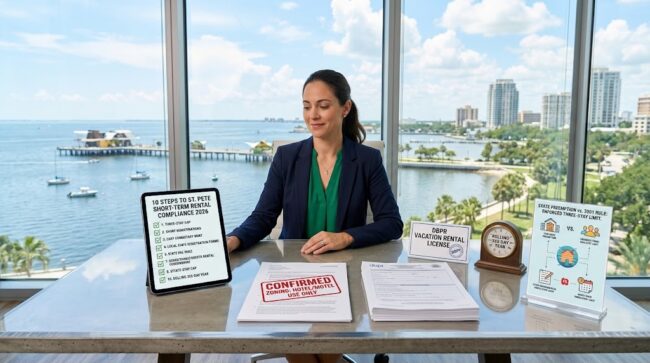
Step 1: Count Your Stays
Before buying or furnishing anything, decide whether your plan stays within three short stays a year. If it does not, confirm that the property’s zoning allows hotel or motel use. Investors who skip this step risk buying a property that cannot legally operate as planned.
Step 2: Confirm the Property Is Inside City Limits
City rules apply only within St. Petersburg’s boundaries. If you are unsure, call the Pinellas County Property Appraiser at 727-582-7652.
Pinellas County adopted its own short-term rental ordinance in March 2025. It requires a $450 Certificate of Use and sets quiet hours and a 10-guest occupancy cap. That ordinance applies only to unincorporated Pinellas County, not to St. Petersburg.
Step 3: Check Zoning With the City
For any property that will exceed three short stays, contact the City of St. Petersburg Zoning Division at 727-893-7471. Get written confirmation that transient accommodation use is allowed at that address. Also check condo association and HOA rules, which may ban short-term rentals even where the city allows them.
Step 4: Register for Florida Sales Tax
Register with the Florida Department of Revenue. The department collects the 6% state sales tax and Pinellas County’s 1% surtax on the same return. Florida taxes any rental of living quarters for six months or less as a transient rental.
Step 5: Open a Pinellas County Tourist Development Tax Account
The Pinellas County Tax Collector administers the county’s 6% Tourist Development Tax directly. Hosts must register for an account and file a return every month, even in months with no bookings.
- Due date: The 20th of the month after rent is collected
- Late penalty: 10% (minimum $50), plus interest
- Repeat late filings: Two or more in 12 months can lead to a lien or a frozen bank account
- Phone: 727-464-5007
Step 6: Get a DBPR Vacation Rental License
Florida’s Department of Business and Professional Regulation (DBPR) requires a license once a unit is rented more than three times in a calendar year for stays under 30 days. Apply through the Division of Hotels and Restaurants for one of two license types:
- Vacation Rental – Dwelling for houses
- Vacation Rental – Condo for condo units
Based on DBPR’s fee schedule in mid-2026, a full-year license for one unit costs about $230. Applications require:
- A DBPR Online Services account
- A Florida sales tax number
- An EIN or Social Security number
- The address of every rental unit
- A Certificate of Balcony Inspection (form HR-7020) for buildings three stories or taller
Operating without a required license is a second-degree misdemeanor and can bring fines of up to $1,000 per offense.
Step 7: Meet Life-Safety Requirements
Florida’s public lodging statute applies whether or not your rental needs a license. It requires:
- An approved lock on every bedroom or unit door
- No unvented fuel-burning space heaters
- Secure railings on balconies and stairways in buildings three stories or taller
- Carbon monoxide detection tied into the fire alarm system in buildings with boiler rooms
Licensed units must also meet the Life Safety Code (NFPA 101), keep fire extinguishers accessible, and be available for DBPR inspection. Boutique hotel projects should also expect fire inspections and building permits from the city.
Step 8: Check the City Business Tax Receipt Requirement
St. Petersburg does not require a business tax receipt for a single rental unit. Owners renting two or more units through one business pay $4 per unit each year to the city’s Business Tax Division (727-893-7241). Receipts expire every September 30.
Step 9: Confirm Platform Tax Collection
Airbnb collects and remits Florida’s 7% sales tax and has a direct agreement with Pinellas County for the Tourist Development Tax. Other platforms may not handle every tax, so check your account settings. Even when a platform collects the taxes, the host is still responsible for filing the county return.
Step 10: Keep Records for Enforcement
Keep a booking log that proves your stay count. St. Petersburg enforces its rules mainly in response to complaints. Under Florida law, code enforcement fines can reach $1,000 per day, and the city’s Code Enforcement Board can impose larger penalties at a hearing.
St. Pete Short-Term Rental Tax Breakdown
| Tax | Rate | Paid To |
|---|---|---|
| Florida sales tax | 6% | Florida Dept. of Revenue |
| Pinellas discretionary surtax | 1% | Florida Dept. of Revenue |
| Tourist Development Tax | 6% | Pinellas County Tax Collector |
| Total | 13% |
The Market Behind the Rules
Short-term rental demand in Pinellas is strong, but much of it sits outside St. Petersburg’s city limits. In March 2026, Pinellas County collected about $4.9 million in Tourist Development Tax from its vacation rental and “other” category, compared with about $1.6 million from St. Petersburg. Average daily vacation rental rates in the county were about $374 that month, up roughly 10% from a year earlier.
For investors, the takeaway is clear. Inside St. Petersburg, nightly rentals of a typical home are side income at best. Investors who want full-time short-term rental operations should look at hotel-zoned property in the city, 30-day furnished rentals, or areas outside the city with friendlier rules.
Frequently Asked Questions
Can I run an Airbnb full-time in St. Petersburg?
Not in most residential neighborhoods. Without hotel or motel zoning, a property is limited to three stays under 30 days per rolling year.
Does a DBPR license make my St. Pete rental legal?
No. A state license covers state lodging rules but does not override city zoning. A licensed property in a residential district is still subject to the three-stay cap.
Do 30-day rentals need a vacation rental license?
Generally no, because DBPR’s license requirement applies to stays under 30 days. Rentals of six months or less are still subject to transient rental taxes, however.
Does St. Petersburg issue its own short-term rental registration number?
No. The city has no separate short-term rental registry. Hosts’ registration numbers come from the Florida Department of Revenue, the Pinellas County Tax Collector and, when required, a DBPR license.
Does Pinellas County’s rental ordinance apply in St. Pete?
No. The county’s Certificate of Use program applies only to unincorporated areas.
This article is for informational purposes and is not legal or tax advice. Confirm zoning and licensing requirements with the City of St. Petersburg, DBPR and the Pinellas County Tax Collector before investing.
Sources and Further Reading
- BNBCalc, “St. Petersburg Short-Term Rental Regulations: A 2026 Guide for Airbnb Hosts,” updated August 2026
- City of St. Petersburg, Transient Accommodation Uses handout (Planning and Zoning)
- Florida Statutes, Section 509.032(7)(b), Preemption of Vacation Rental Regulation
- Florida Statutes, Section 509.211, Public Lodging Safety Requirements
- Florida Statutes, Section 509.261, Penalties
- Florida DBPR, Division of Hotels and Restaurants, vacation rental license application packet and lodging fee schedule
- Florida DBPR, Transient vs. Non-Transient Apartment guidance
- Pinellas County Tax Collector, Tourist Development Taxes
- Pinellas County, “Pinellas County Commission Adopts Short-Term Rental Ordinance”
- Visit St. Pete/Clearwater, Destination Metrics, March 2026
- Minut, “Florida Short-Term Rental Laws: 2026 Guide for Hosts”
- St Pete Catalyst, “St. Pete Explores Short-Term Rental Super Fines,” July 2024