By Brian French | StPetersburgBusinessNews.com | October 12, 2026
Quick Answer
St. Petersburg’s galleries, studios and arts nonprofits act as a foot-traffic and tourism engine. The city’s nonprofit arts sector generated $132.5 million in economic activity in 2022, supported 2,121 jobs and produced $26.5 million in government revenue. Independent commercial galleries are not counted in that figure, so the true creative-economy footprint is larger.
Key Numbers at a Glance
| Metric | Figure | Source |
|---|---|---|
| St. Pete nonprofit arts economic activity (2022) | $132.5M | AEP6 / St. Pete Arts Alliance |
| Jobs supported (St. Pete) | 2,121 | AEP6 |
| Audience spend per event, beyond admission (St. Pete) | $48.90 | AEP6 via FOX 13 |
| Pinellas arts attendees from outside county | 34.4% | Creative Pinellas |
| Pinellas creative industry, total impact | ~$2B | Pinellas County Econ. Dev. |
| Pinellas visitors (2025) | 14.9M | Visit St. Pete-Clearwater |
| SHINE murals created since 2015 | ~170 | St. Pete Arts Alliance |
Two Revenue Streams: Organizations and Audiences
The arts economy in St. Petersburg runs on two channels. The first is what arts organizations spend directly on payroll, supplies, rent, contractors and services. The second, and larger, is what visitors spend around the art.
Of the $132.5 million total, about $61.6 million came from spending by nonprofit arts and culture organizations and about $70.9 million came from event-related spending by their audiences. That activity also delivered $85.1 million in personal income to local residents.
The audience number is where restaurants, bars, parking operators and retailers come in. The 2022 study found arts attendees in St. Petersburg spent an average of $48.90 per event beyond the price of admission. That is well above both the county and national benchmarks: Pinellas County attendees averaged $35.62 per person per event, while the national figure for the typical attendee was $38.46. Priced Out of the Picture: St. Petersburg artists ask city leaders for stability +2
For a business owner on Central Avenue or 22nd Street South, the per-event spend is the number that matters. A gallery opening isn’t a closed transaction. It’s a reason for a visitor to buy dinner, a drink and a parking space within a few blocks.
Second Saturday ArtWalk: A Monthly Foot-Traffic Event
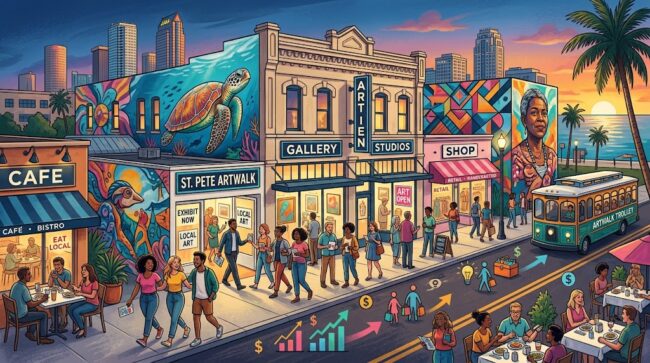
The most measurable commercial-district effect comes from Second Saturday ArtWalk. The event links the Central Arts, Grand Central, Warehouse Arts, Uptown Arts, Deuces Live and downtown Waterfront districts, with more than 30 galleries and studios open from 5 to 9 p.m.
The St. Petersburg Arts Alliance frames this as small-business policy rather than just programming. The Alliance describes ArtWalk as an economic strategy to develop small businesses. Transit supports the circulation: the SunRunner has stops near ArtWalk galleries, and a WADA trolley loops through the Warehouse Arts District from 6 to 10 p.m.
What This Means for Retail and Hospitality
- Predictable traffic: A fixed monthly date lets restaurants staff and stock for a known surge.
- Evening activation: ArtWalk extends commercial hours in districts that would otherwise go quiet after 5 p.m.
- Cross-district movement: Trolley and transit links spread spending across neighborhoods rather than concentrating it downtown.
The Warehouse Arts District: Industrial Space Turned Creative Hub
The Warehouse Arts District is the clearest example of art driving commercial real estate value. The district counts more than 300 artists, businesses and organizations, bounded by 1st Avenue North, 10th Avenue South, 16th Street and 31st Street. stpeteartsalliance
Its anchor is the ArtsXchange. The campus holds more than 50,000 square feet of warehouse space being renovated into affordable studios, galleries, classrooms and performance space, including 28 working studios and over 2,500 square feet of gallery, education and event space. stpeteartsalliance
In roughly 20 years, the district went from rows of derelict industrial buildings to a thriving arts hub. That transformation now shows up in commercial leasing. The Factory, at 2622 Fairfield Ave. S., spans eight buildings with more than 1,000 feet of Pinellas Trail frontage and markets space for retail, restaurant, arts, brewery and production tenants. Smaller operators have options too: the Colonial Annex Arts Cooperative at 400 23rd St. S. offers over 13,000 square feet with units starting at $350.
Public Art as Destination Marketing
SHINE Mural Festival
Produced by the St. Petersburg Arts Alliance, SHINE has created nearly 170 murals across downtown and the surrounding arts districts since 2015. The 2026 edition, the festival’s 11th year, is scheduled for November 6–15 and is free to attend.
Murals function as permanent, free outdoor attractions. Every wall becomes a photo stop that draws pedestrians past storefronts year-round, not just during the festival.
The Dalí Museum Anchor
The Dalí Museum sits at the top of the visitor funnel that feeds smaller galleries. Since opening in its current building in 2011, the museum has drawn 360,000 to 450,000 visitors a year, more than 75% of them from outside the area. Pinellas County’s Tourist Development Council endorsed using $34 million in tourist development taxes for a major expansion.
An older museum study shows how that traffic disperses: out-of-county Dalí patrons planned visits to other Tampa Bay attractions, including the Chihuly Collection and the Museum of Fine Arts, St. Petersburg.
The Tourism Overlap
Arts spending rides on top of a very large tourism base. Visit St. Pete-Clearwater reports 14.9 million visitors generated $10.2 billion in total economic impact for Pinellas County in 2025, with the average visitor spending more than $300 a day.
Momentum has continued into 2026. The February–April high season brought 4.7 million visitors and $36.16 million in tourist development tax collections, the highest ever for that period.
Arts audiences are a meaningful share of that flow. In Pinellas County, 34.4% of arts attendees are nonlocal visitors from outside the county. Those visitors spend more per event than locals, which is why arts districts punch above their weight in hospitality revenue.
The Affordability Risk
The sector’s biggest threat is the success it created. In August 2026, artists told FOX 13 that rising commercial rents and a shortage of affordable workspace are forcing them to question whether they can stay. One example: woodworker Nick Reale had to leave his studio after the building sold, and a comparable space would cost up to four times as much.
Policy responses are on the table. Mayor Ken Welch said he proposed directing a third of the bed tax to generate $5 million a year for the arts. The Warehouse Arts District Association is also exploring funding for an affordable artist housing development with 40 to 60 live-work units.
Brian’s Take
The headline $132.5 million figure is real, but it understates the business case. The AEP6 study counts nonprofits and their audiences only. It leaves out for-profit galleries, working studios that sell direct, mural commissions, art-supply retailers, framers and the creative contractors who serve them. Pinellas County Economic Development pegs the full creative industry at roughly $2 billion in economic impact, which suggests the nonprofit slice is a small fraction of the whole.
The $48.90 per-event spend is the number I’d watch. It sits about 27% above the national benchmark, which tells me St. Pete’s arts districts are converting visits into restaurant and retail dollars more effectively than most cities. That’s a commercial-district asset, not a cultural nicety.
The risk is classic: artists create the value, landlords capture it, and the artists leave. If the studios empty out, ArtWalk has nothing to walk to, and the foot traffic that feeds Central Avenue and the Warehouse Arts District thins out with it. Business owners in these districts have a direct financial stake in workspace affordability, whether they sell art or sandwiches.
Frequently Asked Questions
How much do the arts contribute to St. Petersburg’s economy?
St. Petersburg’s arts and culture nonprofits generated $132.5 million in economic activity during 2022, according to the Americans for the Arts AEP6 study. That excludes commercial galleries and independent studios.
How many jobs does the St. Pete arts sector support?
The economic activity measured in 2022 supported 2,121 jobs.
Which St. Petersburg districts have the most galleries?
The main districts are the Central Arts, Grand Central, Warehouse Arts, Uptown Arts, Deuces Live and downtown Waterfront districts, all linked during Second Saturday ArtWalk.
When is Second Saturday ArtWalk?
It runs on the second Saturday of every month. More than 30 galleries and studios open from 5 to 9 p.m.
Do arts visitors spend more than other visitors?
Nonlocal arts attendees typically outspend locals. Nationally, nonlocal attendees spend $60.57 per person per event, excluding admission, more than twice as much as local attendees.
Is studio space affordable for artists in St. Pete?
Increasingly not. Artists report commercial rents running two to four times what they can afford, and arts leaders are pushing for dedicated funding and live-work housing.
Sources and Further Reading
- St. Petersburg Arts Alliance — Arts & Economic Prosperity 6 Report: https://stpeteartsalliance.org/aep6
- St. Pete Catalyst — Report: St. Pete arts nonprofits generated $132 million in 2022: https://stpetecatalyst.com/zaps/report-st-pete-arts-nonprofits-generated-132-million-in-2022
- Creative Pinellas — The Economic Impact of the Arts: https://creativepinellas.org/magazine/the-economic-impact-of-the-arts/
- Americans for the Arts — AEP6 National Report: https://www.nh.gov/nharts/programservices/pdf/AEP6-national-report.pdf
- St. Petersburg Arts Alliance — Second Saturday ArtWalk Listing, September 2026: https://stpeteartsalliance.org/wp-content/uploads/SPAA_ArtWalk_Listing_2026_September_.pdf