By Brian French | October 10, 2026
Quick Answer
St. Petersburg’s unemployment rate averaged 3.6% in 2025, but the Tampa Bay metro rate rose to 4.7% in August 2026. Despite more job seekers, local employers still struggle to fill health care and technical roles, while office, customer service, and tech jobs draw far more candidates than openings.
The Paradox in One Sentence
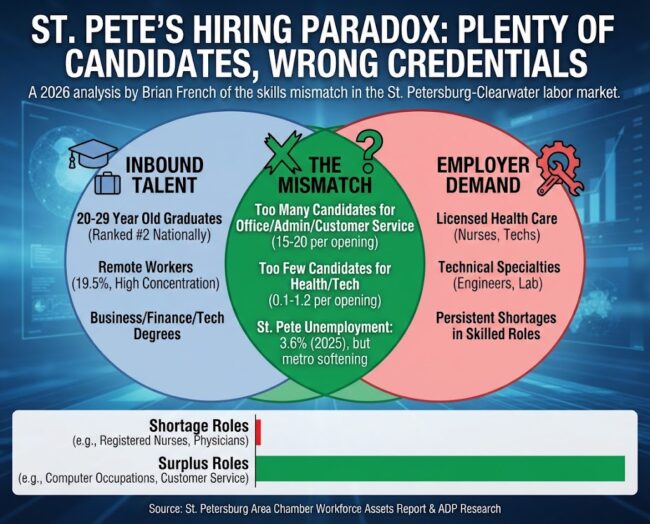
Tampa Bay is attracting new residents and recent graduates at one of the fastest rates in the country, yet many St. Petersburg employers report positions sitting open for months. The explanation is not a shortage of people. It is a mismatch between the skills arriving and the skills employers need.
What Is the Unemployment Rate in St. Petersburg?
The answer depends on which number and which geography you use.
| Measure | Rate | Period |
|---|---|---|
| City of St. Petersburg (annual) | 3.6% | 2025 |
| St. Petersburg-Clearwater-Largo metro division | 4.3% | April 2026 (preliminary) |
| Tampa-St. Petersburg-Clearwater metro | 4.7% | August 2026 (preliminary) |
| Tampa Bay metro (annual) | 3.5% | 2024 |
The City’s 2026 State of the Economy reported St. Petersburg’s 2025 unemployment rate at 3.6%, below the national average of 4.3%. More recent federal data shows the broader labor market softening. The Bureau of Labor Statistics put the Tampa-St. Petersburg-Clearwater metro rate at 4.7% for August 2026, a preliminary figure subject to revision. The St. Petersburg-Clearwater-Largo metro division posted 4.3% in April 2026.
The trend matters. The metro’s annual unemployment rate was 2.9% in 2022, 3.0% in 2023, and 3.5% in 2024. The labor market has gradually loosened, which makes persistent hiring difficulty even more telling.
Statewide Context: A Cooling Market
The Florida Chamber Foundation’s 2026 Mid-Year Report describes a labor market entering a new phase. Florida’s year-to-date unemployment rate moved above 4%, younger workers were particularly affected, and the average duration of unemployment increased to 25 weeks in the first half of 2026.
In other words, more people are looking for work and searching longer. Yet employers in specific fields still cannot find qualified candidates.
The Talent Magnet: Tampa Bay Draws Graduates
Tampa Bay is not short on newcomers. ADP Research’s 2026 analysis of more than 400,000 workers ages 20 to 29 ranked the Tampa-St. Petersburg-Clearwater metro No. 2 nationally for new college graduates, jumping from 26th the prior year. The region’s hiring rate for young graduates rose from 2.6% to 3.4%, one of the fastest paces in the study.
Tampa’s ranking was driven by its top position in hiring, while its scores for wages and affordability were more middling. ADP estimated the annual wage for recent graduates in the metro at $49,817.
The region also has a large remote workforce. Census data showed 19.5% of Tampa Bay workers worked from home in 2023, compared with a national average of 13.8%. Many newcomers bring jobs with them rather than competing for local openings.
Where the Mismatch Shows Up
The clearest local evidence comes from the St. Petersburg Area Chamber of Commerce’s Workforce Assets Report, which compared Pinellas County job openings with active job-seeker profiles in Employ Florida in early 2025.
Too Few Candidates: The Shortage Occupations
| Occupation | Openings | Candidates | Candidates per Opening |
|---|---|---|---|
| Physicians, all other | 157 | 10 | 0.06 |
| Speech-language pathologists | 32 | 4 | 0.13 |
| Medical lab technologists | 43 | 22 | 0.51 |
| Radiologic technologists | 72 | 40 | 0.56 |
| Surgical technologists | 46 | 31 | 0.67 |
| Food service supervisors | 138 | 121 | 0.88 |
| Pharmacists | 40 | 36 | 0.90 |
| Registered nurses | 344 | 402 | 1.17 |
| Civil engineers | 28 | 34 | 1.21 |
| Quality inspectors and testers | 36 | 45 | 1.25 |
Source: St. Petersburg Area Chamber of Commerce Workforce Assets Report, Employ Florida data, early 2025.
Health care dominates the shortage list. Healthcare practitioner and technical occupations had the most openings of any group, with just over one qualified candidate per opening. Physical therapists and family medicine physicians showed openings with no matching active candidates at all.
Too Many Candidates: The Crowded Occupations
| Occupation Group | Candidates per Opening |
|---|---|
| Computer and mathematical | 19.8 |
| Construction and extraction | 16.3 |
| Office and administrative support | 15.2 |
| Transportation and material moving | 14.3 |
| Business and financial operations | 13.0 |
At the individual occupation level, customer service representatives drew about 16 candidates per opening and computer occupations about 17.
What the Data Says About the “Remote Tech” Theory
The numbers support part of the popular narrative and challenge another part. Computer and business occupations are oversupplied locally, consistent with a wave of college-educated and remote-capable professionals moving in. But the deepest shortages are not in Main Street retail. Retail salespeople, cashiers, and servers had multiple candidates per opening. The real pinch is in licensed health care, technical specialties, and supervisory roles that require credentials or experience.
One caution: these figures reflect people registered in the state workforce system, not every job seeker. They are best read as directional signals rather than precise counts.
Why the Mismatch Persists
1. Licensure Takes Years
Nurses, surgical techs, radiologic technologists, and pharmacists need specific training and state licenses. A newcomer with a business degree cannot pivot into these roles quickly.
2. Inbound Talent Skews Toward Office Work
The graduates and professionals choosing Tampa Bay are disproportionately in business, finance, and technology. Locally, Pinellas finance employment has softened: financial activities jobs in the St. Petersburg-Clearwater-Largo division were down 2.4% year over year in April 2026, adding more office-trained candidates to the market.
3. Remote Jobs Do Not Fill Local Openings
A remote software engineer living in St. Pete adds to the local economy and housing demand but does not fill a hospital or factory opening.
4. Wages Versus Housing Costs
Many shortage roles, such as food service supervisors at about $38,000 and medical lab technicians, pay wages that make it hard to afford housing in Pinellas County, discouraging applicants.
5. Retirements in Skilled Trades
Nationally, contractors report that skilled roles remain hard to fill. In the AGC and NCCER 2026 survey, half of construction firms said available candidates lack needed skills, certificates, or licenses.
Where Pinellas Employers Are Hiring
The Workforce Assets Report’s top Pinellas employers by job openings in January 2025 included BayCare Health System, St. Petersburg College, Johns Hopkins Medicine, the Pinellas County School Board, HCA Healthcare, McDonald’s, Winn-Dixie, Walgreens, Jabil, and the City of Clearwater. Health care and education dominate the top of the list.
What Small Businesses Can Do
- Hire for aptitude, train for skills. Recruit from oversupplied pools such as customer service and administrative candidates, then invest in training.
- Use state training grants. Florida’s Incumbent Worker Training and Quick Response Training programs offset the cost of upskilling.
- Partner with local colleges. St. Petersburg College and Pinellas Technical College run programs aligned with health care and technical needs.
- Offer apprenticeships. Registered apprenticeships help build pipelines for trades and technical roles.
- Compete on more than pay. Scheduling flexibility, transportation help, and career paths can matter as much as wages for hard-to-fill roles.
Brian’s Take
The “unemployment paradox” is really a sorting problem. Tampa Bay is excellent at attracting people with portable, office-based skills, and it is struggling to produce enough people with licensed, hands-on skills. Both trends can be true at once, which is why employers can complain about hiring while the unemployment rate rises.
From an investment standpoint, the data points to where the opportunity lies. Health care training, technical education, and credentialing programs are where Pinellas County’s labor market is tightest, and businesses that build their own pipelines will have a lasting edge. Companies that rely on office and tech talent, meanwhile, are in a buyer’s market for workers.
I would also caution business owners not to over-read the 3.6% headline. That figure describes 2025. The most recent federal data shows the metro rate higher, and the state’s own Chamber Foundation says unemployment duration is lengthening. The labor market is loosening for generalists while staying tight for specialists. Plan hiring accordingly.
Frequently Asked Questions
What is the current unemployment rate in St. Petersburg, Florida?
The City reported 3.6% for 2025. The latest federal data shows the Tampa-St. Petersburg-Clearwater metro at 4.7% in August 2026 (preliminary) and the St. Petersburg-Clearwater-Largo division at 4.3% in April 2026.
What is the labor market trend in St. Petersburg?
The market is gradually loosening. Metro unemployment rose from 2.9% in 2022 to 3.5% in 2024 and above 4% in 2026, while statewide unemployment duration increased to 25 weeks in the first half of 2026.
Why can’t St. Pete businesses find workers if unemployment is rising?
Many job seekers are trained for office, customer service, and tech roles, while the hardest-to-fill jobs require licensed health care or technical credentials.
What jobs are hardest to fill in Pinellas County?
Health care roles top the list, including physicians, radiologic and surgical technologists, lab technologists, pharmacists, and registered nurses, along with food service supervisors and some engineering and inspection roles.
Is Tampa Bay a good market for new college graduates?
Yes. ADP Research ranked Tampa-St. Petersburg-Clearwater No. 2 nationally for new graduates in 2026, driven by the strongest hiring rate in its study.
How many Tampa Bay workers work remotely?
About 19.5% of Tampa Bay workers worked from home in 2023, well above the national average of 13.8%.
Sources and Further Reading
- State of the Economy: Employment, Incomes, and Construction Value Rise in St. Pete — St. Pete Rising: https://stpeterising.com/home/state-of-the-economy-employment-incomes-and-construction-value-rise-in-st-pete
- Unemployment Rates for Large Metropolitan Areas — U.S. Bureau of Labor Statistics: https://www.bls.gov/web/metro/laulrgma.htm
- St. Petersburg-Clearwater-Largo Economy at a Glance — U.S. Bureau of Labor Statistics: https://www.bls.gov/regions/southeast/fl_stpetersburg_md.htm
- Unemployment Rate in Tampa-St. Petersburg-Clearwater (Annual) — FRED: https://fred.stlouisfed.org/series/LAUMT124530000000003A
- Florida’s Economy at Mid-Year 2026 — Apopka Area Chamber (summarizing the Florida Chamber Foundation report): https://www.apopkachamber.org/2026/8/12/32436/floridas-economy-at-mid-year-2026-what-local-businesses-need-to-know-about-growth-jobs-and-the-road-ahead/
- Research and Resources — Florida Chamber Foundation: https://www.flchamber.com/research-and-resources
- You’ve Graduated. Now What? — ADP Research: https://www.adpresearch.com/research/2026-youve-graduated-now-what
- Best Metros for Job-Seeking Grads in 2026 — WKRG/Nexstar: https://www.wkrg.com/national/these-are-the-best-metros-for-job-seeking-grads-in-2026-research-shows/
- Southern Cities Dominate Rankings of Best Job Markets — Fox Business: https://www.foxbusiness.com/economy/southern-cities-dominate-rankings-best-job-markets-new-college-graduates
- How Many Tampa Bay Workers Clock In From Home — Axios Tampa Bay: https://www.axios.com/local/tampa-bay/2024/12/16/remote-work-rate-tampa-bay
- Workforce Assets Report, Phase I — St. Petersburg Area Chamber of Commerce: https://hirestpete.org/st-petersburg-area-chamber-of-commerce-workforce-assets-report/phase-i-existing-assets-workforce-employer-statistics/
- Construction Labor Shortage Statistics 2026 — Bella FSM: https://www.bellafsm.com/construction-labor-shortage-statistics/