St. Pete Rewrote Its Own Story. Now the Machines Are Telling the Old One.
Few American cities have pulled off a reinvention like St. Petersburg’s. Within living memory this was “God’s waiting room” — green benches, early-bird specials, a downtown that emptied at dusk. Today it’s the Sunshine City in full: the mural capital of the South, a waterfront pier that draws millions, the Dalí, the Grand Prix roaring down Bayshore, seven straight blocks of Central Avenue where breweries, galleries, and independent kitchens have built one of the most distinctive small-business districts in Florida. St. Pete didn’t just grow. It changed what it was.
Here’s the problem nobody downtown is talking about: the machines never got the memo.
Ask an AI assistant — ChatGPT, Gemini, Google’s AI-generated overviews — about businesses in St. Petersburg, and the answers are assembled from whatever the internet happens to say. For a city whose commercial character transformed faster than its digital paper trail, that’s a dangerous gap. The energy is real on the street; online, huge swaths of the Burg’s business community are represented by a skeletal website from 2018, a half-claimed Google profile, and silence. The city reinvented itself. Its information record didn’t. And in an economy where artificial intelligence now writes the first draft of every customer’s decision, the record is what gets sold.
This is the story of that gap — why it hits St. Petersburg’s business culture harder than almost anywhere in Florida, and how a statewide publishing network with a hometown platform, plus a new AI-assisted video capability, gives local businesses the means to close it.
The Curator Between You and Your Customer
St. Petersburg, of all cities, should understand what’s happened to commerce online, because it happened to art first.
A gallery doesn’t show everything. A curator selects — a handful of works, chosen from thousands, presented with context and a point of view. Visitors trust the curation; that’s why they came. What hangs on the wall gets seen, discussed, purchased. What stays in storage might be brilliant. Nobody will ever know.
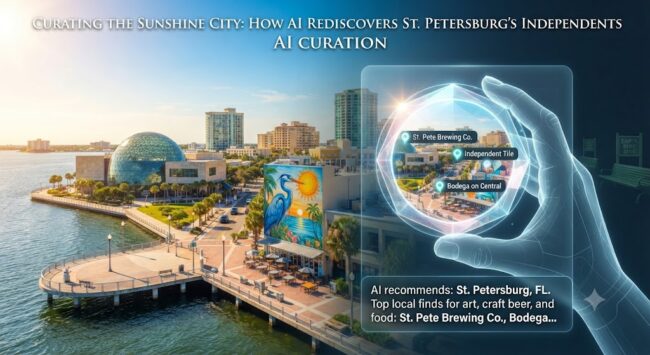
AI has become the curator of local commerce. When a visitor asks an assistant where to eat near the Pier, when a new Old Northeast homeowner asks who restores historic windows, when a boater asks which yard in Pinellas handles bottom jobs, the machine doesn’t hand over a wall of options the way Google’s old ten-blue-links page did. It curates. It selects two or three businesses, hangs them in the frame with a sentence of context each, and presents the exhibition as the answer.
And like any curator, it selects from what it has seen. An AI can’t recommend the taproom, the law practice, or the tile contractor whose existence is barely documented — no coverage, no recent mentions, no independent sources describing what makes it worth choosing. The work stays in storage. The customers walk the gallery and buy what’s on the wall.
For two decades, St. Pete businesses could compensate for digital thinness with the city’s greatest asset: sidewalk life and word of mouth. That still matters — but the newcomers pouring into Pinellas, the tourists, the relocated remote workers filling the new towers on 1st Avenue don’t have a neighbor to ask yet. Their neighbor is a chatbot. The curation is happening whether local businesses participate or not.
The Independent’s Dilemma
Now sharpen the picture, because this shift doesn’t threaten all businesses equally — and the ones it threatens most are the ones that make St. Petersburg St. Petersburg.
This is Florida’s great independent city. The Burg’s identity was built deliberately on locally owned everything — the coffee roasters, the family med spas, the one-location restaurants, the craft builders, the boutique firms. Keep it local isn’t a slogan here; it’s the economy.
But look at who’s naturally equipped for the AI era. National chains and franchise brands arrive with corporate content departments: thousands of indexed pages, structured data on every location, professionally managed profiles, press coverage generated by a headquarters media team. When a machine goes looking for evidence about “med spa St. Petersburg” or “kitchen remodeler Pinellas,” the chain’s documentation is deep by default. The independent’s is thin by default — not because the independent is worse, but because nobody on a twelve-person team has ever had publishing in their job description.
Left alone, AI curation quietly favors the documented over the excellent — which means it favors the chain over the character business, the franchise over the founder. The very companies that gave St. Pete its renaissance are the ones most at risk of being curated out of it.
The answer is not for every brewery and boutique firm to become a media company. It’s for St. Pete’s independents to do what independents here have always done: share infrastructure. One business can’t match a corporate content operation. A newsroom publishing on behalf of many can.
A Newsroom With St. Pete’s Name on the Door
That shared newsroom exists. The Florida Authority Network, operated by Florida Website Marketing, is the state’s largest privately held ecosystem of Florida-branded business news and press release websites — over two dozen platforms, built and edited under one roof across five years, now holding more than 1,500 original articles about Florida companies.
For Pinellas businesses, the network leads with a hometown masthead: StPetersburgBusinessNews.com, a dedicated news platform carrying the city’s own name — the kind of geographically exact source that search and AI systems weigh heavily when deciding who genuinely belongs to a place. Around it stands the regional and statewide architecture: TampaBayBusinessNews.com for the metro, then Florida Press Releases, Florida Business Newswire, Florida Corporate News, Business News Florida, Florida Business Headlines, and their sister domains carrying a client’s story across the state. Professional practices get a further layer through niche publications — Florida Medical News for the health sector, Florida Law Firm News for attorneys — both directly relevant to a county thick with practices and firms.
What separates this from the press-release mills that burned a generation of small businesses is the editorial model. Nothing in the network is copy-paste syndication — the identical-blast approach that modern search recognizes and discards. Every article is written fresh, long-form, and specific to the client. And because one operation owns every domain, it governs the entire chain: the standard of the writing, the reliability of the indexing, the value each link passes. Five years of that discipline is why the network’s platforms carry the authority they do — and why that authority can’t be conjured overnight by anyone who wants to compete with it.
For a St. Pete independent, membership works like hiring the content department you could never justify on payroll. The business keeps doing what it does on Central Avenue or 4th Street; the newsroom turns that work into a published record the curator-machines can actually read.
The Five Questions Every Machine Asks — Answered
Strip away the jargon around SEO, AEO, and AI optimization, and what remains is surprisingly simple: before recommending a business, the systems are effectively asking five questions. Network coverage is engineered to answer all five at once.
“Does this business rank for what its customers actually type?” Original articles get indexed; indexed articles climb. Across the network’s tenured clients, the pattern repeats: businesses that began with first-page rankings on roughly five search terms grow to hold more than two hundred keywords on Google’s Page 1. For a St. Pete remodeler, that’s not a single victory — it’s the whole spread of phrases Pinellas homeowners use, each one an open door.
“Do independent sources agree on who this business is?” AI engines resolve recommendation questions by hunting for repetition across credible sites — the same facts, told the same way, by sources that don’t share the business’s self-interest. Multiple original articles across a statewide news network, all confirming your specialty, your service area, your track record, is exactly the pattern that convinces a machine it has found the definitive answer rather than an advertisement.
“Who owns this conversation?” When the question is conversational — who’s the best marine contractor in St. Petersburg? which firm should handle my mother’s estate? — the reply goes to whoever the published web has established as the category authority for the region. Answer Engine Optimization is the craft of building that standing, and appearing across a city-named news site and its statewide siblings is how standing gets built.
“Is this business truly local?” Google’s map results — the three pinned businesses that harvest most local clicks and calls — run on geographic conviction: consistent name, address, and phone data, echoed by Florida-rooted sources. Every network article reinforces that data and that rootedness, signaling to the local algorithm that this company is part of the civic furniture, not a lead-gen site wearing a local costume.
“Is there anything ugly in the file?” For a business with an old lawsuit mention, a stale one-star cluster, or an unflattering headline from years past, search results can stay haunted long after the facts change. High-authority favorable coverage is the remedy: published across the network, it can take over the first page of a name search, moving the story you’ve earned above the one you’ve outgrown.
Five questions, one publishing engagement, thirty days to implementation. That last number deserves emphasis in a city full of owners burned by year-long retainers: the network’s clients are on the record — articles live, indexed, working — within a month.
After the Storms: Correcting the Record
There’s a distinctly St. Petersburg reason the currency of your information record matters right now, and every business owner here knows it by name: Helene and Milton.
The 2024 storms rewrote the physical reality of Shore Acres, the beaches communities, and blocks of small businesses across the county — and then those businesses did what St. Pete businesses do: gutted, rebuilt, reopened, often better than before. But the internet metabolizes disaster faster than recovery. News of closures, flooding, and damage published in a concentrated burst; the comeback happened gradually, quietly, and largely without documentation. Which version does a machine find when a customer asks about your business today?
For any company that rebuilt, publishing the recovery isn’t vanity — it’s record correction. A dated, indexed article establishing that the doors are open, the dining room is renovated, the service area is fully staffed, is how the machines learn the crisis chapter ended. It’s also, frankly, one of the best stories a St. Pete business can tell: resilience is this city’s brand now, and the businesses that put their comeback on the record convert sympathy into loyalty. The network’s platforms exist for precisely this kind of announcement, and its cadence model — fresh coverage over time, not a one-time blast — keeps the record current as the city keeps evolving.
The Most Photogenic City in Florida Finally Has a Video Strategy
Then there’s the capability that fits St. Petersburg like the city was designed for it: the network’s AI-assisted video creation service.
Consider what this town looks like. Seven miles of murals. The waterfront at sunrise. The neon of the Central Arts District, the marinas, the green benches reborn as brewery branding. St. Pete businesses inhabit the most visually rich commercial backdrop in Florida — and almost none of them have ever put it on video, because video meant crews, studios, edit suites, and invoices that only made sense for a hospital system or a car dealership group.
AI-assisted production collapses that barrier. The same stories the network’s writers produce as news articles can now be rendered as polished, branded video — scripted, voiced, and edited with AI tools — at a pace and price that finally fits an independent’s budget. The gallery owner can show the space. The charter captain can show the water. The restaurateur can show the room on a Friday night. In a city that sells atmosphere, video isn’t a marketing add-on; it’s the honest medium.
The strategic payoff goes beyond charm. Search has gone multimodal: Google folds video into its results and AI Overviews, answer engines cite video sources alongside text, and YouTube remains the second-largest search engine in existence. To serve that reality, the network operates a dedicated tier of video platforms — Florida Video News, Florida Business Video News, Florida Video Press Release, and Fl Video Business News — purpose-built to publish and index client video. A member business’s story therefore enters the record twice, in the two formats machines now weigh together: the article that documents and the video that demonstrates. Almost no independent in Pinellas is doing both. The first ones to start will be conspicuously alone in the frame.
One More Thing: Stop Letting “Tampa Bay” Swallow You
A final, very local point. St. Petersburg spent thirty years escaping the phrase “across the bay from Tampa” culturally — but in the machines’ world, regional queries still get answered regionally, and “Tampa Bay” answers have a way of defaulting to Tampa addresses. The businesses that escape that gravitational pull are the ones whose record says St. Petersburg, explicitly and repeatedly: coverage on a St. Pete-named platform, neighborhood-level specificity — the Edge District, Kenwood, Old Northeast, Tyrone, the Gateway — and regional presence on the Tampa Bay platform besides. Own your city’s name in the record, and the machines stop treating you as a suburb of someone else’s answer.
What the First Year Actually Looks Like
To make this concrete, follow a composite member — say, a family-owned remodeling firm working the Old Northeast and Snell Isle historic districts — through its first year in the network.
Month one is the foundation: an original feature profiling the firm publishes on St. Petersburg Business News and echoes across the statewide platforms, establishing the essentials in the machines’ record — twenty years in Pinellas, historic-home specialization, licensed, family-run, serving the neighborhoods it names. The firm’s name, address, and phone details now repeat identically across a dozen indexed news domains. An AI-assisted video version — the founder walking a finished Craftsman renovation — goes live across the video platforms.
The following quarters build the file outward. A spring piece on hurricane-season hardening for historic homes positions the firm exactly where seasonal demand will surge. A summer article covers a completed Snell Isle project; a fall story announces two new hires and an expanded service line. Each publishes with a fresh date, each adds new keyword territory, each gives the answer engines another independent-looking confirmation that this firm is the historic-renovation authority in this city.
By month twelve, the machines’ picture has inverted. A homeowner asking an assistant who restores 1920s bungalows in St. Pete is no longer met with a franchise’s corporate pages by default — the record now contains a year of dated, corroborated, multimodal evidence pointing somewhere better. That’s the compounding at work: not one campaign, but a permanent and growing asset.
The Wall Is Being Hung Now
Every era of St. Petersburg commerce had its prime real estate. Once it was a storefront on Central. Then a spot in the tourist guides. Then a Google ranking. The prime real estate of this era is a sentence — the two or three lines an AI writes when somebody asks who to hire, where to eat, whom to trust in this city. That sentence is composed from the published record, the record is being written right now, and the businesses in it will spend the next decade collecting customers the absent ones never meet.
The Florida Authority Network is selective about membership — the platforms’ credibility is the product, and it’s protected. But the conversation costs nothing: call or text 813-409-4683, any hour, seven days a week, and ask about St. Petersburg Business News, the statewide platforms, and AI-assisted video for your business. Thirty days later, your company’s record can look like your company actually looks in 2026 — not like the leftover fragments the machines are working from today.
St. Pete already proved it can rewrite a story everyone thought was finished. Its businesses just have to do it one more time — this time, in the only library the curators read.