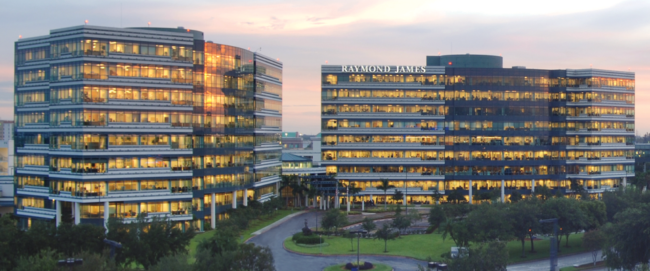
If you drive across the Howard Frankland Bridge from Tampa into Pinellas County, look toward the east as you approach St. Petersburg and you’ll see something most Floridians take for granted but probably shouldn’t: a sprawling corporate campus crowned by four office towers, with a fifth and sixth on the way, anchoring one of the most important — and quietly dominant — financial services companies in the entire United States.
That’s Raymond James Financial.
For more than six decades, this company has done something almost no one outside the financial industry truly appreciates: it has built one of America’s largest and most respected investment banks, wealth management firms, and asset management companies entirely from a base in St. Petersburg, Florida — far from Wall Street, the Loop, or any of the traditional U.S. financial capitals. Today, Raymond James manages more than $1.73 trillion in client assets, employs over 19,000 people, supports more than 8,800 financial advisors across the United States, Canada, and overseas, and has delivered an industry-leading 149 consecutive quarters of profitability as of 2025 — a streak unmatched anywhere in modern American finance.
If you don’t think of Raymond James in the same breath as Morgan Stanley, Merrill Lynch, or UBS, you should. Because by virtually every meaningful measure of full-service wealth management — and by the only one that arguably matters most over the long haul (consistent client-first profitability) — Raymond James belongs in that conversation.
This is the deep corporate bio of one of Florida’s most consequential public companies — how it started in a small St. Petersburg apartment building, why it never moved, and how it became the largest full-service wealth management and investment banking firm not headquartered in New York City.
The Origin Story: Bob James, a 1954 Conversation, and the Founding of Modern Florida Finance
The Raymond James story begins not with finance but with homebuilding — and a single 1954 conversation that changed the trajectory of Florida’s financial industry forever.
Robert A. “Bob” James was born in Chicago in 1921 to an executive at the food company Libby, McNeill & Libby. He attended Harvard University, majored in English, and starred as a three-sport athlete in football, basketball, and golf. He married Helen Wolfe in Toledo, Ohio in 1941, served as a Navy lieutenant junior grade during World War II, and built military housing in Sandusky and Lima, Ohio during the war years.
After the war, Bob James moved to Florida and continued in real estate, founding the construction firm Jobin & James in 1952 at 242 Beach Drive NE in St. Petersburg. The firm sold mutual funds door-to-door in nearby Florida communities, capitalizing on the postwar economic expansion and Americans’ growing appetite for personal investment products.
In 1954, Bob James sat down for a meeting with a Merrill Lynch stockbroker. That single conversation — about how the financial advice industry actually worked — ignited his curiosity about investments and changed his career trajectory. Over the next eight years, James shifted increasingly from homebuilding to financial advice.
On August 16, 1962, he formally established Robert A. James Investments in St. Petersburg. Initial revenue: less than $100,000 for the firm’s first fiscal year. Membership in the Philadelphia-Baltimore-Washington Stock Exchange allowed the new firm to fulfill orders for stocks and bonds.
In 1963, Edward Raymond founded Raymond & Associates in the Bradenton-Sarasota region.
In 1964, the two firms merged. Edward Raymond sold Raymond & Associates to Bob James, with the agreement that Bob would name the combined entity Raymond James & Associates. The new firm took its place in St. Petersburg history.
By 1965, Bob James had brought his brother Roy James into the company. In 1966, Bob James’s son Tom James joined the firm fresh out of Harvard Business School. The combined company graduated from a humble apartment building on 3rd Avenue North to an 8,000-square-foot space on downtown St. Petersburg’s Central Avenue.
The seeds of one of America’s quietest financial powerhouses had been planted.
The Tom James Era: Five Decades of Methodical Empire Building
If Bob James founded the firm, Tom James built the empire.
Tom James was named CEO in 1970. He would lead Raymond James — first as CEO, later as Chairman — for the next four decades, becoming one of the most influential financial industry leaders most Americans have never heard of.
Under Tom James, Raymond James pursued what would become its defining strategic personality: conservative, methodical, advisor-centered, client-first growth — anchored in St. Petersburg, never imitating Wall Street, never abandoning its founding principles.
The major milestones of the Tom James era:
- 1968. Raymond James enters the insurance sector, establishing what’s now Raymond James Insurance Group. The same year, Investment Management & Research, Inc. (IM&R) — later part of Raymond James Financial Services — is formed for investment banking activities.
- 1969. Raymond James Financial officially incorporates as a holding company. The firm files for an initial public offering with the SEC, but market conditions force a delay.
- 1970. Bob James names Tom James CEO so he can devote himself to direct client service and financial advisor training.
- 1973. Raymond James gains a seat on the New York Stock Exchange — a major step ensuring the best execution for clients.
- 1980s. Raymond James surpasses $1 million in net income for the first time. The Equity Research department begins operations.
- 1983. After a 14-year delay, Raymond James finally goes public with a $14 million initial public offering, listing on NASDAQ. Tragically, founder Bob James dies in May of the same year, missing the celebration of the IPO he had pursued for over a decade.
- 1984. Raymond James Asset Management is renamed Eagle Asset Management under Herb Ehlers. Eagle would become one of the firm’s signature institutional asset management businesses.
- 1992. Raymond James Trust Company is formed.
- 1994. Raymond James Bank is founded as a savings and loan association.
- 1997. Raymond James International Holdings, Inc. is established.
- 1998. Raymond James purchases naming rights for Tampa’s football stadium — home of the NFL’s Tampa Bay Buccaneers. Raymond James Stadium would become one of the most recognized corporate venue partnerships in American sports, especially when the venue hosted Super Bowl XXXV in 2001 between the Baltimore Ravens and New York Giants. The stadium has since hosted multiple Super Bowls including most recently Super Bowl LV in 2021.
- 1999. IM&R and Robert Thomas Securities merge to form Raymond James Financial Services.
- 2000. Raymond James partners with London-based Killik & Co. to launch Raymond James Investment Services Limited in the United Kingdom — the firm’s first major international expansion.
- 2002. Raymond James is named to the Fortune 1000 for the first time.
- 2004. Florida Governor Jeb Bush and the Florida Cabinet recognize Tom James as Florida Free Enterpriser of the Year. Raymond James also makes its Fortune Most Admired Companies list debut.
- 2005. Construction is completed on the fourth tower of the Raymond James Financial campus in St. Petersburg.
- 2008. Raymond James is ranked highest in both investor satisfaction and employee advisor satisfaction by J.D. Power and Associates — a milestone that crystallized the firm’s reputation for both client and advisor experience.
Throughout this era, Tom James maintained a discipline that distinguished Raymond James from much of Wall Street: conservative balance sheet management, modest leverage, methodical underwriting, and refusal to chase risky financial trends. When the 2008 financial crisis devastated Wall Street, Raymond James emerged largely intact — a testament to the conservative culture Tom James had built.
In 2010, Tom James stepped down as CEO, handing the reins to Paul Reilly. In 2016, Tom passed the Chairman of the Board title to Reilly as well, formally completing the transition. Tom James remained Chairman Emeritus until his ultimate departure from the firm — a five-decade tenure that is one of the most remarkable single-leader stewardships in modern American finance.
Brian’s Take: Tom James Quietly Built One of the Most Underrated Corporate Empires in Florida History.
While the financial media obsessed over Wall Street’s stars, scandals, and bonuses, Tom James spent five decades methodically building a Florida-headquartered financial empire that out-survived, out-performed, and out-classed most of the firms that got more attention. The fact that Raymond James is now a Fortune 500 company managing trillions of dollars in client assets — while remaining anchored in St. Petersburg with the same founding principles Bob and Tom James articulated decades ago — is one of the most impressive multi-generational corporate stewardships in modern American business history. Florida should celebrate this story far more than it does.
— Brian
The Modern Era: Paul Reilly, Major Acquisitions, and Continued Growth
Under Paul Reilly’s leadership (CEO 2010, Chairman 2016), Raymond James has continued to expand aggressively while preserving the cultural DNA Bob and Tom James installed.
The defining moves of the Reilly era include:
- 2011. Raymond James reaches a settlement with the SEC and state securities regulators to repurchase auction rate securities (ARS) at par from clients who held them prior to February 2008. The firm pays a $1.75 million fine to state regulators (no SEC fine), resolving more than three years of investigation.
- 2012. Raymond James completes the transformational merger with Morgan Keegan & Company, creating one of the largest full-service wealth management and investment banking firms not headquartered in New York. The same year, the firm purchases the Canadian assets of Allied Irish Bank.
- 2015. Acquisition of The Producers Choice, LLC, a private insurance and annuity marketing company.
- 2016. The big one — Raymond James acquires Deutsche Bank Wealth Management’s U.S. private client services unit, Alex Brown & Sons. Alex Brown was one of the oldest and most prestigious private client franchises in American finance. The acquisition meaningfully elevated Raymond James’s ultra-high-net-worth capabilities and accelerated its integration into the most prestigious tier of American wealth management.
- 2016. Raymond James is listed as a Fortune 500 company for the first time.
- 2017. Acquisition of Reams Asset Management from UMB Financial Corporation for $172.5 million, including Scout Investments — significantly expanding Raymond James’s institutional fixed-income and asset management capabilities.
- Subsequent years. Continued strategic acquisitions, expansion of Raymond James Bank, growth of the international footprint, and persistent expansion of the financial advisor network.
By 2025, the company had expanded to 149 consecutive quarters of profitability — a streak that began before many current financial industry analysts were born and that’s almost without parallel in U.S. corporate history.
What Raymond James Actually Does: The Business Today
Raymond James operates through two primary segments, with extensive subsidiaries and specialized businesses spanning the financial services industry.
The Wealth Management Segment
This is the largest and most foundational part of Raymond James’s business. The Wealth Management segment includes:
- Investment solutions and managed accounts
- Financial and retirement planning
- Estate planning, charitable giving, and trust services
- Banking and lending services through Raymond James Bank
- Insurance solutions through Raymond James Insurance Group
- Institutional services
- Private wealth services
- Multiple advisor channels, including employee advisors, independent contractor advisors (Raymond James Financial Services), bank-affiliated advisors (Raymond James Financial Institutions Division), and registered investment advisors (RIAs) who custody assets at Raymond James
Critically, financial advisors remain the largest portion of Raymond James’s revenue — the firm has remained, at its core, a private client firm even as it has expanded into capital markets and investment banking. The St. Petersburg downtown branch’s official messaging emphasizes this: “Raymond James is first and foremost a private client firm.”
The Corporations & Institutions Segment
This segment houses Raymond James’s institutional and capital markets businesses:
- Investment banking (including industry-leading franchises in healthcare, technology, real estate, financial services, energy, consumer, and industrials sectors)
- Public finance and municipal services
- Global equities and equity capital markets
- Fixed income capital markets
- Depository institution services
- Equity research with deep coverage across multiple sectors
Other Notable Businesses
- Eagle Asset Management. Long-established asset management subsidiary with significant institutional and high-net-worth clientele.
- Raymond James Bank. National bank offering deposit, lending, and mortgage products to Raymond James clients.
- Raymond James Trust. Trust services for wealth management clients.
- Raymond James Tax Credit Funds. Specialized tax credit investments.
- Raymond James Investment Services Limited. UK-based independent contractor advisor platform.
- Raymond James Insurance Group. Insurance and annuity products.
Brian’s Take: Raymond James’s Discipline as a “Private Client Firm First” Is What Sets It Apart.
Most financial firms talk about being client-first while structuring their economics around investment banking and trading profits, but Raymond James has consistently structured its actual business around its financial advisor relationships and the private clients those advisors serve. That difference — putting the advisor-client relationship at the actual center of the corporate model rather than treating it as a marketing slogan — is the boring, durable secret behind 149 consecutive profitable quarters and decades of growth that quietly outperformed flashier Wall Street competitors.
— Brian
The St. Petersburg Connection: Why Raymond James Never Left
In an era when financial firms have aggressively migrated south — Goldman Sachs, ARK Invest, Citadel, Elliott Management, Dynasty Financial Partners, and dozens more — Raymond James has been quietly headquartered in Florida the whole time. Six decades. Same city. Same culture. Same conservative, advisor-centered values.
The Raymond James corporate campus in St. Petersburg is one of the most consequential corporate footprints in Florida:
- Multiple high-rise office towers anchoring the corporate campus, with a fifth tower added in 2017 and a sixth tower opening in 2024
- Thousands of corporate employees based in St. Petersburg
- Major corporate philanthropy with extensive support for St. Petersburg, Tampa Bay, and broader Florida community organizations
- Naming rights to Raymond James Stadium in Tampa — one of the most visible corporate-civic partnerships in Florida sports
- Significant local economic impact through real estate, employment, vendor relationships, and community investment
- Deep ties to Tampa Bay civic and cultural institutions including the arts (recipient of the national Business in the Arts award), education, and community development organizations
Raymond James is also a foundational presence in St. Petersburg’s identity as a financial services hub. Long before ARK Invest moved from Manhattan to St. Petersburg, before Dynasty Financial Partners established its St. Pete headquarters, before the broader “Wall Street South” migration hit Tampa Bay, Raymond James was already there — quietly demonstrating that a Fortune 500 financial services firm could thrive while headquartered in Pinellas County.
In many ways, the entire current St. Petersburg financial renaissance stands on shoulders that Bob and Tom James built over six decades.
The St. Petersburg corporate headquarters address: 880 Carillon Parkway, St. Petersburg, FL 33716 (the main campus), with downtown branch presence at 100 Second Avenue North, Suite 130, St. Petersburg, FL 33701 and the firm’s original downtown St. Petersburg office historically rooted in the same urban core.
Raymond James By the Numbers (2025-2026)
The current scale of Raymond James is remarkable:
- Founded: 1962
- Headquarters: St. Petersburg, Florida
- Listed: NYSE: RJF
- Member of: S&P 500, Fortune 500
- Client Assets Under Administration: $1.73+ trillion (as of September 2025)
- Total Employees: 19,000+
- Financial Advisors: 8,800+ across the U.S., Canada, and overseas
- Locations: 1,100+ offices globally
- Consecutive Quarters of Profitability: 149 (industry-leading streak)
- Revenue: Multi-billion-dollar quarterly revenue across diverse business lines
- Major Subsidiaries: Raymond James & Associates, Raymond James Financial Services, Raymond James Bank, Raymond James Trust, Eagle Asset Management, Raymond James Investment Services Limited (UK), Alex Brown (private wealth division), Raymond James Insurance Group, and others
- Notable Corporate Partnerships: Raymond James Stadium (NFL Tampa Bay Buccaneers), ongoing community sponsorships across Florida
By any standard, Raymond James is one of the most consequential publicly traded companies headquartered in Florida — and one of the largest full-service U.S. financial firms outside New York.
Recognition, Awards, and Reputation
Over its six-decade history, Raymond James has accumulated significant industry recognition:
- J.D. Power and Associates Highest Rankings in both investor satisfaction and employee advisor satisfaction
- Fortune Most Admired Companies repeated listings
- Fortune 500 listing
- Forbes Global 2000 ranking
- Multiple Business in the Arts national awards
- Numerous “Best Places to Work” recognitions for advisor satisfaction
- Industry awards for investment banking, research, capital markets, and wealth management across multiple business lines
- Florida Free Enterpriser of the Year for Tom James (2004)
Brian’s Take: Raymond James Is the Best Florida Business Story Most Floridians Don’t Talk About.
Florida loves to celebrate Disney, the Ringling Brothers legacy, Carnival Cruise Lines, NextEra Energy, and the state’s tourism and real estate icons — but Raymond James is arguably the most consistently excellent Florida-headquartered Fortune 500 company of the modern era, and most Floridians outside the financial industry have no idea what they’re looking at when they drive past the corporate campus on the Carillon Parkway. Florida should celebrate this firm with the same pride other states celebrate their hometown corporate giants.
— Brian
What Raymond James Means for Florida
For Florida — and especially for Tampa Bay — Raymond James represents far more than a successful corporation. It represents:
- Proof that world-class finance can be built outside Wall Street. Long before “Wall Street South” was a phrase, Raymond James was demonstrating it.
- Anchor employer for Tampa Bay. Thousands of high-paying jobs concentrated in St. Petersburg generate massive economic ripple effects across Pinellas County and the broader region.
- Cultural and civic leadership. Raymond James’s philanthropy, arts patronage, sports partnership, and community involvement have shaped Tampa Bay’s identity for decades.
- Educational and workforce development partner. The firm supports financial literacy, industry education, and workforce development across the region.
- Catalyst for Tampa Bay’s broader financial sector. The growing concentration of financial firms in Tampa, St. Petersburg, and the broader region builds on infrastructure that Raymond James helped pioneer.
- Florida-headquartered corporate excellence. Raymond James’s remarkable record demonstrates that Florida can be home to enduring corporate leadership at the highest levels of American finance.
When ARK Invest, Dynasty Financial Partners, and other major firms decided to relocate to St. Petersburg, they were making decisions about a financial industry community that Raymond James had been quietly building for decades.
Looking Ahead: The Next Chapter
As Raymond James moves through the late 2020s, several questions and opportunities define its trajectory:
- Continued profitability streak. Can the firm extend the 149 consecutive quarters of profitability into a multi-decade run that may become one of the most legendary in American corporate history?
- Generational leadership transitions. With Tom James fully transitioned and Paul Reilly leading, how will the next generation of leadership preserve and evolve the founding culture?
- Strategic acquisitions. Will Raymond James continue to acquire wealth management and asset management franchises that extend its reach without compromising its culture?
- Technology and AI integration. How will the firm integrate advanced technology, AI-driven advisor tools, and digital-first wealth management capabilities while preserving its advisor-centered model?
- International expansion. Will the firm grow its UK, Canadian, and international platforms further?
- Tampa Bay economic leadership. As ARK Invest, Dynasty Financial Partners, and others build on Tampa Bay’s emerging “Wall Street South” identity, Raymond James’s historical leadership role becomes both more visible and more strategically valuable.
- Brand and community evolution. How will Raymond James continue to evolve its public brand identity while remaining true to the conservative, client-first principles Bob and Tom James installed at the founding?
What seems certain is that Raymond James will continue to do what it has done for 60+ years: build steadily, conservatively, methodically, with a relentless focus on client outcomes and advisor partnerships, anchored in St. Petersburg, Florida.
The Bottom Line: One of America’s Quietest Financial Giants
Raymond James Financial is one of the most successful Florida-headquartered companies in the state’s modern history — and one of the most important full-service financial firms operating anywhere in America today. Over six decades, the firm has grown from a single-office mutual fund seller in a St. Petersburg apartment building into a Fortune 500, S&P 500, multinational financial services company managing more than $1.73 trillion in client assets, with a profitability streak unmatched in modern American finance.
It has done so without abandoning its founding principles. It has done so without leaving St. Petersburg. It has done so without imitating Wall Street. It has done so by quietly out-executing competitors who got more attention but produced less consistent results.
For Florida — and especially for Tampa Bay — Raymond James represents the gold standard of long-term corporate stewardship. For St. Petersburg specifically, it represents the foundation upon which the city’s entire financial sector has been built. For the financial advisor profession in America, it represents one of the most respected platforms supporting client-first, advice-driven wealth management.
Bob James founded the firm with a simple idea: assess what individual clients actually need and deliver financial advice with integrity, conservatism, and genuine personal service. Tom James spent five decades scaling that idea into an empire. Paul Reilly has carried it forward into the modern era. The next generation of leadership will inherit a firm with one of the strongest corporate cultures in American business and a position of real durability in an industry that has reshaped itself dramatically over the past 20 years.
The story isn’t done. The cranes are rising on the next phase of the corporate campus. The financial industry’s center of gravity is shifting south toward Florida. The “Wall Street South” narrative everyone is now talking about was being quietly written in St. Petersburg before most observers even knew there was a story to tell.
Raymond James is, in every meaningful way, Florida finance done right — and one of the most important corporate stories the state has produced in the last century.
Drive past those office towers on Carillon Parkway. Watch the Buccaneers play at Raymond James Stadium. Walk by the downtown St. Pete branch on 2nd Avenue. Notice the company name in the financial press. And remember:
A Florida boy named Bob James built this — quietly, methodically, with integrity, in St. Petersburg — and his son Tom carried it for five decades.
That’s a Florida business legacy worth knowing.
Resources & Further Reading
- Raymond James Financial Official Website — The firm’s primary corporate website with information on services, advisor opportunities, careers, and investor relations.
- Raymond James Investor Relations — Quarterly and annual financial filings, earnings releases, SEC documents, and corporate governance materials.
- Raymond James History Page — Official company-published timeline of major milestones from 1962 to the present.
- St. Petersburg Area Economic Development Corporation: Raymond James — Economic development context on Raymond James’s role in St. Petersburg’s broader business community.
- Raymond James Stadium — Information on the company’s signature Tampa Bay venue partnership with the NFL’s Tampa Bay Buccaneers.