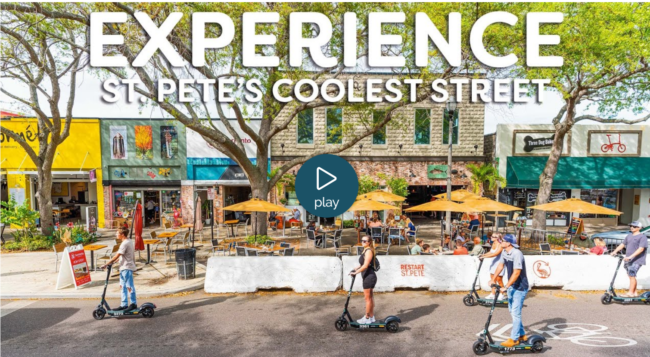
If you haven’t walked Central Avenue in downtown St. Petersburg lately, you genuinely don’t recognize the city anymore.
Five years ago, downtown St. Pete was charming — but quieter than its potential. Ten years ago, it was a city quietly waking up to what it could become. Twenty years ago, it was almost unrecognizable from what it is today. The Pier was deteriorating. The waterfront was underused. Central Avenue had character but was missing the institutional investment to match. The downtown skyline had a few notable buildings but nothing approaching what was about to come.
Today, downtown St. Petersburg is in the middle of one of the most consequential urban redevelopments happening anywhere in Florida — and Central Avenue, the city’s primary east-west commercial spine, sits at the very center of it.
Class A office towers rising for the first time in a generation. Major financial firms relocating from Manhattan and putting down deep roots. New mixed-use districts. World-class restaurants. Brewery rows. Walkable arts districts. Multi-billion-dollar redevelopment projects redefining entire city blocks. A waterfront reborn. A pier reimagined. A skyline transformed.
For Tampa Bay residents who’ve lived in the area for decades, the speed of the change is hard to fully internalize. For new arrivals — and downtown St. Petersburg is attracting many — it’s the most exciting urban story in Florida.
This article walks through the tremendous redevelopment of downtown St. Petersburg’s Central Avenue District, the major projects driving the transformation, the financial and cultural ripple effects, and what it all means for the city’s future.
A Personal Note Before We Begin
This article comes with a personal disclosure that’s worth stating directly. Brian French — whose perspective appears throughout these articles — lived and worked in St. Petersburg for over six years, with a house in the Old Northeast neighborhood just blocks from the Central Avenue District.
That matters because the changes documented in this article aren’t abstract real estate transactions to Brian. They’re streets he walked daily. Coffee shops he frequented. Restaurants he watched open and thrive. Neighbors he knew. Construction projects he saw start as renderings and finish as occupied buildings. The Old Northeast — that historic, oak-lined, brick-street neighborhood adjacent to downtown — represents one of the most architecturally and culturally distinctive residential districts in Florida, and someone who has called it home for six years sees the downtown transformation through a lens few outside observers can match.
When Brian writes about St. Petersburg’s redevelopment, it’s the perspective of someone who chose to live there, invested in the community, and watched the city grow around him in real time.
Why Central Avenue Matters
Before getting into the projects, it’s worth understanding why Central Avenue specifically is the spine of St. Petersburg’s redevelopment story.
Central Avenue runs east-west across downtown St. Petersburg, anchored at its eastern end by the Gulf of Mexico (technically Tampa Bay) waterfront and stretching westward through the heart of the city. It’s the historic main street of St. Pete — the commercial corridor where the city’s earliest businesses, theaters, restaurants, and civic institutions clustered.
Central Avenue is bordered by some of St. Petersburg’s most consequential neighborhoods:
- The Old Northeast to the north — historic residential, oak-lined brick streets, century-old bungalows and Mediterranean Revival homes
- Historic Kenwood to the west — a national-register bungalow neighborhood
- The EDGE District — west of downtown, home to creative class workers, breweries, restaurants, and the new wave of mixed-use development
- The Warehouse Arts District — adjacent to the EDGE, with adaptive reuse art studios and creative spaces
- The Grand Central District — further west, with antique shops, restaurants, and emerging boutique commerce
- Downtown core — the financial, institutional, and civic heart anchored on Central
- The waterfront — Pier District, museums, parks, and Tampa Bay views
The redevelopment story isn’t just about Central Avenue itself — it’s about how Central Avenue connects all of these districts and serves as the spine along which the city’s transformation flows.
The Class A Office Renaissance: Halcyon and 400 Central
Perhaps the single most consequential change in downtown St. Petersburg’s recent redevelopment is the return of Class A office construction for the first time in a generation.
For decades, downtown St. Pete struggled to attract new institutional-grade office development. Older buildings dominated the skyline. Major employers either occupied existing space or located outside the urban core. The lack of new Class A inventory limited the city’s ability to attract relocating financial firms, professional services companies, and corporate headquarters.
That has now changed dramatically.
Halcyon at The Central
Tampa-based Ellison Development is constructing Halcyon, an 11-story, approximately 130,000-140,000-square-foot Class A office tower at 1301 Central Avenue in the EDGE District. The building represents:
- The first trophy-class office tower built in downtown St. Pete in more than a generation (some sources say since the 1980s)
- A defining anchor of The Central, a 2.1-acre mixed-use redevelopment of the former St. Petersburg police headquarters site
- Construction expected to finish in early 2027
- Cushman & Wakefield handling leasing
- The 11th-floor penthouse — featuring a wraparound terrace with panoramic downtown skyline views — will become ARK Invest’s new 13,000-square-foot headquarters, where Cathie Wood’s globally watched investment firm is doubling down on its 2021 St. Petersburg commitment
The Central project also includes a 168-room Marriott Autograph Collection hotel, 14,000 square feet of retail space, a 42-unit affordable housing community, and a recently opened 540-space parking garage — making it one of the most comprehensive single mixed-use redevelopments in St. Petersburg’s modern history.
400 Central
Just blocks away, 400 Central is delivering another major Class A office investment. The building has been fully leased to Dynasty Financial Partners under a 15-year lease for the entire 45,000-square-foot Class A office space — including:
- A private entrance and lobby
- A 15,000-square-foot rooftop terrace for special events
- Multiple custom amenities
- Construction targeted for completion in November 2026
Dynasty Financial Partners moved its headquarters from New York City to St. Petersburg in 2019 and now supports more than 500 financial advisors across 55 independent firms managing more than $110 billion in assets.
The combination of Halcyon and 400 Central represents a fundamental shift in downtown St. Petersburg’s commercial real estate trajectory. Class A institutional finance now has new, world-class homes in St. Pete — and the talent and capital flowing in alongside that real estate is reshaping the city’s economic profile.
Brian’s Take: I Watched the EDGE District Transform Right Outside My Front Door, and It’s Even More Impressive Up Close.
Living in the Old Northeast for over six years gave me a front-row seat to downtown St. Petersburg’s transformation, and the EDGE District specifically — where Halcyon is now rising — went from a slightly rough-around-the-edges arts and brewery neighborhood to one of the most exciting mixed-use districts in Florida in a remarkably short timeframe. The combination of Halcyon, 400 Central, ARK Invest’s commitment, Dynasty Financial’s expansion, and the broader Central Avenue energy is the most consequential urban story I’ve personally witnessed in any Florida city, and the city’s residents who’ve been around for it know exactly how special it is.
— Brian
The Gas Plant District: A Generational Redevelopment
Perhaps the largest single redevelopment opportunity in St. Petersburg history is the 56-acre Gas Plant District — the former site of Tropicana Field and the surrounding undeveloped land that the city has identified as one of the most consequential urban redevelopment opportunities in Florida.
The Gas Plant District redevelopment has involved:
- Multiple competing development teams pitching comprehensive plans
- Major players including Hines, Mid-Atlantic developers, and others have weighed in over various phases
- Planning for residential, commercial, retail, hotel, public space, and historical interpretation components
- Significant city council deliberation over generational impact
- Major political and civic conversation about how to honor the historical Black community displaced from the Gas Plant neighborhood decades ago
While the specific master plan and execution timeline have evolved, the Gas Plant District represents a once-in-a-generation opportunity to transform 56 acres at the heart of St. Pete’s growth corridor — directly impacting Central Avenue’s western evolution and the city’s broader skyline trajectory.
The Residential Tower Boom
Downtown St. Petersburg has seen an explosion of residential tower development reshaping the skyline along and adjacent to Central Avenue. Major recent and ongoing residential projects include:
One St. Petersburg
The 41-story luxury condominium tower that helped redefine downtown St. Pete’s skyline. Located along the waterfront just south of Central Avenue, One St. Petersburg signaled the city’s arrival as a serious high-end residential market.
Saltaire
Another major luxury residential tower along Beach Drive, contributing to the city’s growing inventory of premium downtown housing.
The Nolen and other downtown luxury developments
A wave of residential towers and luxury condominiums has transformed downtown St. Pete’s skyline along Beach Drive, near Central Avenue, and across the broader urban core.
550 Shoma
Shoma Group’s 16-story high-rise on Mariposa Street with the Shoma Bazaar food hall, expected to open in 2026, contributing to the EDGE District’s growing density.
Multiple new developments through 2027
A pipeline of additional residential towers continues to grow, with downtown St. Petersburg becoming one of Florida’s most actively developed urban residential markets.
The combined effect: thousands of new residents living in downtown St. Petersburg’s urban core, supporting the restaurants, bars, retail, and street life that make Central Avenue genuinely vibrant from morning to late night.
The Pier District: A Waterfront Reborn
While not technically on Central Avenue, the St. Pete Pier District redevelopment — completed in 2020 — has reshaped the eastern terminus of Central Avenue and dramatically altered the experience of approaching downtown from the Gulf.
The current Pier District includes:
- The iconic new St. Pete Pier — a multi-level public space extending into Tampa Bay
- The Pier Tilted Lawn for events and gatherings
- Spa Beach Park with playground and waterfront recreation
- Multiple restaurants including Pier Teaki and Driftwood Café
- The Marketplace with vendors and pop-ups
- The Coastal Thicket with native plant gardens
- Public art installations throughout the pier
- Fishing deck and dolphin-watching opportunities
- Family-friendly amenities drawing visitors from across Tampa Bay
The Pier District has become one of the most visited public spaces in Florida and serves as the gateway anchor for everyone arriving at Central Avenue’s eastern edge.
The Restaurant and Cultural Renaissance
Central Avenue’s restaurant scene has transformed beyond recognition over the past decade. The street now hosts:
Fine Dining and James Beard-Recognized Restaurants
- Multiple James Beard semifinalist and nominated chefs operating in the corridor
- High-end restaurants matching anything in Tampa or Miami
- Wine bars and craft cocktail lounges with sophisticated programming
Brewery Row
The Central Avenue corridor — particularly through the EDGE and Grand Central districts — has become one of the densest concentrations of craft breweries in Florida:
- 3 Daughters Brewing
- Cycle Brewing
- Green Bench Brewing
- Urban Brew & BBQ
- Pinellas Ale Works
- Hidden Springs Ale Works
- And many more
International Cuisine Diversity
Central Avenue now offers extensive international dining including authentic Cuban, Mexican, Peruvian, Mediterranean, Asian, Italian, and other cuisines reflecting the diverse populations now living and working in the corridor.
The Hyatt Place, Hilton, and Boutique Hotels
A wave of new and renovated downtown hotels supporting the increasing visitor flows.
Coffee Shop Culture
Multiple specialty coffee shops have emerged, supporting the work-from-anywhere professional class living downtown — including longstanding favorites like Bandit, Black Crow Coffee Company, Kahwa Coffee, and others.
Brian’s Take: The Restaurant Density on Central Avenue Now Rivals Anything in the State.
When I first moved to the Old Northeast, walking up to Central Avenue for dinner meant a few solid choices and not much else. By the time I left, I could walk three blocks in any direction and find a James Beard-nominated chef, a serious craft cocktail bar, three different breweries, and authentic Cuban food made by a family that had been doing it for decades. That density of quality dining — within walking distance of the residential neighborhoods supporting it — is one of the markers of a truly transformed urban core, and St. Petersburg has it in a way that even Tampa is still working toward.
— Brian
The Arts and Culture Layer
Central Avenue and its surrounding districts have become one of Florida’s most vibrant arts and culture corridors:
The Salvador Dalí Museum
While technically just south of Central Avenue, the Dalí Museum — featuring the largest collection of Salvador Dalí works outside Europe — anchors the city’s international arts reputation and draws millions of visitors who walk Central Avenue during their visits.
Museum of Fine Arts
Located along the waterfront near Central Avenue, providing a comprehensive collection spanning multiple eras and movements.
The Imagine Museum
Specializing in contemporary studio glass art.
The Chihuly Collection
Permanent installation of Dale Chihuly’s glass sculptures in a dedicated downtown facility.
Florida Holocaust Museum
Major regional educational institution.
Mahaffey Theater and Duke Energy Center for the Arts
Performing arts anchors for the region.
The Warehouse Arts District
Adjacent to the EDGE District, a converted industrial area now housing artist studios, galleries, and creative businesses — a defining example of the adaptive reuse story across St. Pete.
Public Art Throughout
The St. Pete Mural Tour features dozens of large-scale murals throughout downtown, particularly concentrated near Central Avenue, making the corridor one of the country’s most visually distinctive urban art environments.
The SHINE Mural Festival
Annual celebration of mural art that adds new works each year and draws international muralist talent.
The Sports and Entertainment Connection
Major recent and developing entertainment and sports investments connected to the Central Avenue corridor:
Tropicana Field
Home of the Tampa Bay Rays — currently in transition with major redevelopment plans tied to the broader Gas Plant District. Major news through 2025-2026 has included extensive negotiations over the Rays’ future stadium and the broader site redevelopment.
Al Lang Stadium
Home of the Tampa Bay Rowdies USL soccer team, located along the waterfront.
Various festivals and events
The Central Avenue corridor hosts dozens of events annually including the Saturday Morning Market, First Friday, the SHINE mural festival, food and beverage festivals, Pride celebrations, and major civic events.
The Old Northeast Connection
For residents like Brian who live in the Old Northeast, Central Avenue isn’t just a downtown commercial corridor — it’s an extension of the neighborhood lifestyle.
The Old Northeast neighborhood:
- Historic district status with national-register protection on many homes
- Brick streets maintained as historic features
- Mature oak trees providing extensive canopy
- Mediterranean Revival, Craftsman, and bungalow architecture dating largely from 1900-1930
- Strong neighborhood association maintaining historic character
- Walking distance to Central Avenue for residents
- Iconic landmarks including the Vinoy Renaissance Resort (now Vinoy Resort & Golf Club, Autograph Collection)
- Beach Drive as the eastern boundary along the waterfront
- One of the most architecturally distinctive residential districts in Florida
For homeowners in the Old Northeast, the Central Avenue redevelopment has elevated the entire neighborhood’s value, livability, and cultural relevance. The combination of historic residential character with cutting-edge urban energy just blocks away creates a lifestyle that’s rare anywhere in Florida.
The Old Northeast is also home to:
- Vinoy Park along the waterfront
- North Shore Park and Beach with one of the city’s iconic public pools
- The Coffee Pot Bayou waterfront stretch
- Walking and biking trails connecting residents to downtown
- Historic architecture tours drawing visitors year-round
Brian’s Take: The Old Northeast Is the Florida Neighborhood Most Underestimated by People Who’ve Never Lived There.
Living in the Old Northeast for over six years gave me an appreciation for one of the most architecturally and culturally distinctive residential neighborhoods in Florida — historic brick streets, century-old oaks, walkable proximity to Central Avenue, true neighborhood character that you can’t manufacture. It’s the kind of place you don’t fully understand until you’ve spent multiple seasons there, and once you do, you understand exactly why downtown St. Petersburg has become so attractive to residents and investors across the country. The Old Northeast and Central Avenue together represent a rare combination Florida hasn’t produced anywhere else at this scale.
— Brian
What’s Driving the Redevelopment
Several factors converge to fuel St. Petersburg’s transformation:
Demographic Migration
Florida’s broader population growth has been particularly intense in Tampa Bay, with St. Petersburg drawing new residents from across the country attracted by:
- No state income tax
- Year-round outdoor lifestyle
- Lower cost of living than New York, California, or Boston
- Beach proximity
- Growing tech and finance employment
- High quality of life metrics
Financial Industry Migration
The “Wall Street South” phenomenon has hit St. Petersburg meaningfully:
- Raymond James Financial anchored Tampa Bay finance for decades
- Dynasty Financial Partners moved from New York in 2019
- ARK Invest moved from Manhattan in 2021 and is doubling down at Halcyon
- spARK Labs by ARK Invest anchoring the innovation economy
- Multiple smaller RIAs and asset managers following
Tax and Regulatory Environment
The 2026 elimination of Florida’s sales tax on commercial real estate leases arrives precisely as the city’s office inventory expands — providing a major incentive for relocating tenants.
Civic Investment
St. Petersburg has invested significantly in:
- The Pier District redevelopment
- Major streetscape improvements
- Public art programming
- Historic preservation
- Innovation district infrastructure
- Park and waterfront expansions
Public-Private Partnerships
The city has successfully partnered with developers like Ellison Development, Hines, Tavistock Group (across Tampa Bay), and others to deliver major projects that wouldn’t have happened with public or private investment alone.
The Ripple Effects
The Central Avenue District redevelopment has triggered ripple effects across the broader region:
- Real estate values in surrounding neighborhoods (Old Northeast, Historic Kenwood, Crescent Heights) have appreciated significantly
- Restaurant and small business inventory has expanded dramatically
- Cultural infrastructure has deepened with new museums, galleries, performance spaces, and arts programming
- Tourism has grown substantially with St. Petersburg consistently ranked among America’s most desirable destinations
- Talent attraction has accelerated, particularly in finance, tech, and creative industries
- Housing demand has expanded both for ownership and rental at multiple price points
- Tampa Bay regional dynamics have shifted, with St. Petersburg increasingly viewed as a peer to Tampa rather than a quieter neighbor
Brian’s Take: St. Petersburg’s Transformation Is the Most Underreported Florida City Story of the Decade.
While the Florida business media has focused on Miami’s Wall Street South narrative, Orlando’s tourism boom, and Tampa’s sports and tech expansion, downtown St. Petersburg has quietly executed the most consequential urban redevelopment of any Florida city per capita over the last 10 years. The combination of Class A office construction, financial firm relocations, residential tower expansion, restaurant explosion, arts and culture deepening, waterfront reimagining, and surrounding neighborhood vitality has produced a city center that competes with anything in the state. People who haven’t been to downtown St. Pete recently genuinely don’t recognize what’s happening — and once they walk Central Avenue, they understand immediately.
— Brian
The Challenges Worth Acknowledging
A balanced view of St. Petersburg’s redevelopment requires acknowledging real challenges:
- Affordability concerns as housing costs rise faster than incomes for many longtime residents
- Displacement risk in historically Black neighborhoods like the historic Gas Plant area
- Hurricane vulnerability for waterfront and low-lying portions of the city
- Climate change adaptation including sea level rise planning
- Infrastructure strain as population grows and traffic increases
- Preservation tensions between new development and historic character
- Inequality risk if redevelopment benefits don’t reach all communities
- Construction disruption during the multi-year build-out of major projects
The city’s leadership, civic institutions, and community organizations are actively engaged with these challenges, but they remain real considerations in the broader transformation story.
What Comes Next
The redevelopment story is still actively unfolding. Major developments through 2027 and beyond include:
- Halcyon completion in early 2027 with ARK Invest moving in
- 400 Central completion in November 2026 with Dynasty Financial moving in
- Gas Plant District master plan execution (timeline evolving)
- Tropicana Field future use decisions
- Continued residential tower additions
- New restaurant and retail openings
- Continued public space and waterfront enhancements
- More financial firm relocations anticipated as commercial inventory expands
- Continued cultural infrastructure investment
- Major Tampa Bay regional projects affecting St. Petersburg connectivity
For residents, businesses, investors, and visitors paying attention, downtown St. Petersburg remains one of the most exciting urban stories anywhere in Florida.
Brian’s Take: After Six Years in the Old Northeast, I Believe St. Petersburg Has the Best Long-Term Trajectory of Any Florida City Outside Miami.
Living in St. Petersburg for over six years convinced me that the city is positioned to be one of Florida’s most consequential urban success stories of the next decade. The combination of historic residential neighborhoods like the Old Northeast, the Central Avenue commercial spine, the financial firm migration, the Class A office expansion, the waterfront infrastructure, the arts and cultural depth, the food and brewery scene, and the manageable scale that still allows genuine community feel — that combination is rare even in Florida, and it’s what makes downtown St. Pete feel like a city that’s actively becoming what it always could have been.
— Brian
The Bottom Line: A City Coming Into Its Own
Downtown St. Petersburg’s Central Avenue District represents one of the most consequential urban redevelopment stories happening anywhere in Florida — and arguably anywhere in the Southeast.
The Class A office construction at Halcyon and 400 Central. The financial firm migrations led by ARK Invest, Dynasty Financial, and others. The residential tower boom reshaping the skyline. The Pier District’s reimagining of the eastern waterfront. The Gas Plant District’s generational redevelopment opportunity. The restaurant and brewery explosion turning Central Avenue into one of Florida’s premier dining corridors. The arts and culture deepening anchored by world-class museums and the SHINE Mural Festival. The historic residential neighborhoods like the Old Northeast preserving the character that makes downtown St. Pete genuinely unique.
All of this is happening in real time, on the same eight-mile-long street, in a city that just five years ago was widely perceived as Tampa’s quieter, smaller cousin.
For residents like Brian who lived in the Old Northeast for six years and watched the transformation unfold from a few blocks away, the change is both remarkable and deeply earned. Downtown St. Petersburg has done the unsexy work of investing in infrastructure, cultivating arts and culture, attracting financial industry talent, supporting local restaurants and breweries, preserving historic character, expanding waterfront access, and welcoming new residents — and the cumulative effect is a city that’s increasingly hard to ignore.
The cranes are rising. The financial firms are committing. The restaurants are filling. The breweries are thriving. The waterfront is alive. The historic neighborhoods are flourishing. The skyline is transforming. The energy is unmistakable.
For anyone who hasn’t walked Central Avenue lately, the recommendation is simple: go.
Walk from the waterfront west through the EDGE District. Stop at the cafés. Sit at the breweries. Visit the murals. See the residential towers rising. Feel the rhythm of a city that’s coming into its own in front of your eyes.
Downtown St. Petersburg has earned its moment. And the story is far from over.
The transformation continues — block by block, project by project, business by business — all along the magnificent spine of Central Avenue.
Resources & Further Reading
- St. Petersburg Area Economic Development Corporation — Comprehensive resource on St. Petersburg’s economic development, major projects, and corporate relocations.
- City of St. Petersburg Office of Economic & Workforce Development — Official city resource on downtown redevelopment, business attraction, and major project updates.
- Visit St. Pete Clearwater — The official destination marketing organization with extensive information on downtown attractions, dining, arts, and cultural assets.
- St. Pete Catalyst — Independent local journalism covering downtown St. Petersburg’s business, real estate, and cultural transformation in real time.
- St Pete Rising — Community-focused publication tracking development projects, restaurant openings, and cultural news across downtown St. Petersburg.