StPetersburgBusinessNews.com | Innovation District | Updated September 13, 2026
Quick Answer
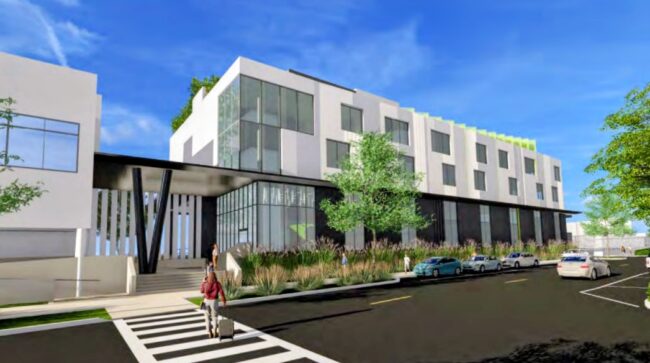
The Center for Coastal Resilience is a proposed 50,000-square-foot research and technology building on the Port of St. Petersburg’s surface parking lot, next to the city’s at-capacity Maritime and Defense Technology Hub in the Innovation District. Backed by the St. Petersburg Downtown Partnership and the Innovation District, it would be funded without city money through roughly $18 million in federal construction funding, $8 million to $10 million from the Florida Ports Council, $2 million from Pinellas County’s Employment Sites Program and private capital. Because the City Charter caps waterfront leases at five to ten years, the project depends on a November 3, 2026 referendum authorizing 25-year leases at the port.
What Is the Center for Coastal Resilience?
Previously called “Hub 2.0,” the Center for Coastal Resilience would provide waterfront lab space, offices and water-access bays for government agencies, academic institutions, nonprofits and private companies working in marine science, coastal resilience and ocean technology. It would be jointly managed by the Innovation District and the Downtown Partnership as a sister facility to the Maritime and Defense Technology Hub, which opened in January 2022 and filled immediately.
| Item | Detail |
|---|---|
| Size | ~50,000 SF |
| Site | Port of St. Petersburg surface parking lot, city-owned, adjacent to the Maritime and Defense Technology Hub, Bayboro Harbor |
| Sponsors | St. Petersburg Downtown Partnership; St. Petersburg Innovation District |
| Operator | Innovation District (operates the existing Hub) with the Downtown Partnership |
| Tenant mix | Resilience and marine-tech agencies, USF College of Marine Science partners, startups, existing Hub tenants needing expansion (Saildrone, Florida Flood Hub for Applied Research and Innovation) |
| Features | Labs, offices, deep-water access bays, rooftop event space for revenue |
| Feasibility study | HR&A Advisors, commissioned by the Downtown Partnership (required for federal funding); found “continued growth forecasted in the ocean and marine economy sector” |
| City funding requested | None; sponsors seek a low-cost, long-term ground lease of at least 25 years |
Why does the project need a voter referendum?
St. Petersburg’s City Charter limits most private leases on city-owned waterfront land to five or ten years, which the Downtown Partnership’s CEO Jason Mathis called the “gating issue,” since neither federal grants nor private lenders will finance a $20 million-plus building on a five-year lease. A City Council committee approved ballot language for 25-year port leases in February 2026, and Council advanced the measure with the November referendum package in July.
| Milestone | Date | Status |
|---|---|---|
| Council committee expresses support; feasibility study underway | Jan. 22, 2026 | Complete |
| Committee approves referendum language for 25-year port leases | Feb. 26, 2026 | Complete |
| Ordinance drafting deadline | End of April 2026 | Complete |
| Council first reading of referendum package (stormwater bond, Harborage Marina, port lease limits, charter cleanup) | July 9, 2026 | Complete |
| Public hearings | July 23, 2026 | Complete |
| Ballot language to Pinellas Supervisor of Elections | Early August 2026 | Complete |
| Voter referendum on port lease limits | Nov. 3, 2026 | Pending |
| Council approval of final lease | After referendum | Pending |
| Construction | 2027–2028 (estimate) | Contingent |
Precedent favors approval: St. Petersburg voters approved a 99-year lease for the Dalí Museum expansion in 2022, a 20-year Sailing Center lease in 2019, and repeated Harborage Marina lease extensions since 1986.
How is the Center for Coastal Resilience being funded?
The capital stack combines federal, state and county sources with private financing, none of it from the city’s general fund, with the long-term lease unlocking each layer.
| Source | Amount | Notes |
|---|---|---|
| Federal construction funding (U.S. Economic Development Administration / disaster mitigation) | ~$18 million | Requires feasibility study (complete) and long-term site control |
| Florida Ports Council | $8–10 million | Seaport infrastructure funding for Port St. Petersburg |
| Pinellas County Employment Sites Program | $2 million | County program funding site improvements that create high-wage jobs |
| Private sector financing | To be determined | Mathis “confident” additional private capital is available |
| Rooftop event rentals | Ongoing revenue | Included in operating pro forma |
| City of St. Petersburg | $0 cash | Land contributed via low-cost 25-year lease |
At the $18 million to $30 million range implied by the public sources, the building would cost roughly $360 to $600 per square foot, consistent with waterfront wet-lab construction in Florida.
What is the St. Petersburg Innovation District and its “Blue Economy”?
The Innovation District is a 560-acre, 0.88-square-mile district on the southeastern edge of downtown anchored by USF St. Petersburg and its College of Marine Science, Johns Hopkins All Children’s Hospital, Orlando Health Bayfront Hospital, the Poynter Institute, Port St. Petersburg and a cluster of federal and state marine agencies. It already employs about 1,900 marine science workers and contributes roughly $540 million a year to the local economy.
| Metric | Figure |
|---|---|
| District size | 560 acres (0.88 sq mi) |
| Marine science employees | ~1,900 |
| Annual economic contribution | ~$540 million |
| Marine-oriented organizations | 30+ private companies, research organizations, academic and government agencies |
| Maritime and Defense Technology Hub | 32,000 SF; 20 tenants; 87 full-time and 132 secondary jobs; at capacity since opening Jan. 2022 |
| NOAA Ocean Enterprise Accelerator grant | $14 million, awarded Dec. 2024 to the Innovation District and six partners |
| Tampa DMA ocean-economy job growth, 2020–2025 | +29% (+62,104 jobs), per Lightcast |
| Key agencies | USGS St. Petersburg Coastal and Marine Science Center, NOAA Fisheries, FWC Fish and Wildlife Research Institute, Florida Institute of Oceanography, Florida Flood Hub |
USF Marine Science Dean Thomas Frazer has described the district as “arguably one of the most densely concentrated constellations of marine-oriented programs in the nation,” with waterfront space at a premium.
What does the project mean for local businesses and contractors?
The center creates a second wave of demand for St. Petersburg’s blue-tech supply chain: marine engineering, sensor and autonomous-vessel firms, environmental consultants, wet-lab contractors, IT and data vendors, and the hospitality and housing sectors that serve a growing scientific workforce.
| Sector | Opportunity |
|---|---|
| Construction and engineering | $20M+ waterfront building with labs, boat bays and resilient design; port infrastructure work funded by the Florida Ports Council |
| Marine technology startups | Waterfront office and lab space with direct water access for testing; proximity to Saildrone, USF and federal agencies; NOAA accelerator pipeline |
| Environmental and resilience consulting | Co-location with the Florida Flood Hub, USGS and the Innovation District’s climate-adaptation master plan |
| Professional services | Grant administration, legal, insurance and accounting for a cluster of 30+ organizations |
| Commercial real estate | Innovation District master plan (Jan. 2026) recommends zoning updates allowing larger mixed-use projects, elevated buildings and resilience-integrated waterfront parks |
| Hospitality and residential | High-wage scientific employment (75% of cluster workers hold advanced degrees) supports downtown housing and dining demand |
The Innovation District’s 2026 master plan also calls for updated city design standards, coordination with seawall and stormwater plans, and infrastructure elevated or undergrounded against storm surge, which will shape every future permit in the district.
Brian’s Take
The Maritime and Defense Technology Hub is the most quietly successful economic development project St. Petersburg has built this decade: a 32,000-square-foot city building that filled on day one, helped land a $14 million NOAA grant and now has tenants like Saildrone asking for more room. The Center for Coastal Resilience is simply the obvious next move, and the fact that the sponsors are not asking the city for a dollar of construction money tells you how much outside capital wants into this cluster.
The referendum should pass; St. Pete voters have never rejected a waterfront lease question tied to a credible institution, and 25 years is modest next to the Dalí’s 99. The real question is what comes after. Councilmember Driscoll’s Research Triangle comparison is the right ambition and the wrong scale: RTP is 7,000 acres and 300 companies. St. Pete’s marine cluster is 0.88 square miles with no room to grow except up and out into the port. If the city wants this to be the marine-science version of the Triangle, the next conversation is not Hub 3.0; it is rezoning the Innovation District for height and density, which the January master plan already put on the table. Watch that debate more closely than the November vote.
Frequently Asked Questions
Where will the Center for Coastal Resilience be built?
On the city-owned surface parking lot at Port St. Petersburg, adjacent to the existing Maritime and Defense Technology Hub on Bayboro Harbor in the Innovation District.
How much will the Center for Coastal Resilience cost?
A full budget has not been published; identified sources total roughly $28 million to $30 million ($18 million federal, $8–10 million Florida Ports Council, $2 million Pinellas County) plus private financing, with no city construction funding.
What is on the November 2026 ballot?
A measure to increase lease limits at the Port of St. Petersburg to 25 years, alongside a stormwater and water general obligation bond, a Harborage Marina lease extension, a charter amendment removing nine city-owned lots from the park and waterfront map for housing, and a charter cleanup for even-year elections.
Who are the tenants of the existing Maritime and Defense Technology Hub?
Twenty tenants including Saildrone and the state-sponsored Florida Flood Hub for Applied Research and Innovation, in a 32,000-square-foot city-owned building operated by the Innovation District.
What is Pinellas County’s Employment Sites Program?
A county economic development program that funds site and infrastructure improvements for projects creating high-wage jobs; the Center’s sponsors have applied for $2 million.
Sources and Further Reading
- St. Pete Catalyst, “Blue tech boom: Resilience center appears headed for ballots” (Jan. 22, 2026) — https://stpetecatalyst.com/blue-tech-boom-resilience-center-appears-headed-for-ballots/
- Tampa Bay Business & Wealth, “St. Pete advances $18M port lease referendum for tech hub expansion” (March 3, 2026) — https://tbbwmag.com/2026/03/03/st-pete-port-lease-referendum-tech-hub-expansion/
- Power Broker Magazine, “Tech-focused resilience center appears ballot-bound in St. Pete” (March 3, 2026) — https://powerbrokermagazine.com/tech-focused-resilience-center-appears-ballot-bound-in-st-pete/
- Tampa Bay Times, “St. Petersburg voters may decide on longer port lease to grow tech hub” (Feb. 26, 2026) — https://www.tampabay.com/news/2026/02/26/st-petersburg-voters-may-decide-longer-port-lease-grow-tech-hub/
- Florida Politics, “St. Pete City Council tees up referendum package on stormwater, housing and port projects” (July 10, 2026) — https://floridapolitics.com/archives/806802-st-pete-city-council-tees-up-referendum-package-on-stormwater-housing-and-port-projects/
- St. Petersburg Downtown Partnership, Center for Coastal Resiliency — https://www.stpetepartnership.org/news-categories/www-stpetepartnership-org-news-categories-resiliency
- St. Pete Rising, “St. Pete Innovation District unveils new master plan shaping future waterfront growth” (Jan. 16, 2026) — https://stpeterising.com/home/st-pete-innovation-district-unveils-new-master-plan-shaping-future-waterfront-growth
- St. Petersburg Innovation District — https://www.stpeteinnovationdistrict.com/
- League of Women Voters St. Petersburg Area, November 2026 Voter Guide — https://lwvspa.org/voter-guide/
- City of St. Petersburg, Economic Development Districts — https://www.stpete.org/business/economic_development/about_the_districts.php
- StPetersburgBusinessNews.com, Downtown St. Pete Adds IKE Smart Kiosks and Digital Wayfinding (companion article)
Reporting by Brian French. Funding figures reflect grant requests reported by project sponsors through March 2026 and are not yet awarded; the port lease referendum is scheduled for November 3, 2026.