Quick Answer: The Tampa Bay Rays will play their final season at Tropicana Field in 2028 and move to a new $2.36 billion domed ballpark at the Hillsborough College Dale Mabry campus in Tampa, targeted to open March 2029. After that, the city-owned Trop is slated for demolition under The Burg Bid, the $8.1 billion Historic Gas Plant District plan St. Petersburg selected in July 2026. The stadium footprint would become part of a mixed-use district with a 13-acre central park, more than 3,600 affordable and workforce homes, offices, hotels and a museum row. Demolition timing depends on the Rays’ exit and on City Council approving a binding development agreement, expected in 2027.
Key Takeaways
- Hillsborough County and the City of Tampa approved funding plans in early September 2026, the last major hurdle for the Tampa ballpark; groundbreaking is targeted this month with site demolition in December.
- The Rays’ Tropicana Field use agreement expires after the 2028 season, and the team intends to open in Tampa on Opening Day 2029.
- St. Petersburg spent roughly $60 million restoring the Trop after Hurricane Milton, but the building is not part of the long-term Gas Plant plan.
- The Burg Bid’s developer, Blake Investment Partners, has said the Woodson African American Museum leads construction and everything else revolves around the outcome of the Rays’ lease.
- The stadium site is roughly a third of the 86-acre district; the city keeps ownership of about one-third of the land overall.
When Do the Rays Actually Leave?
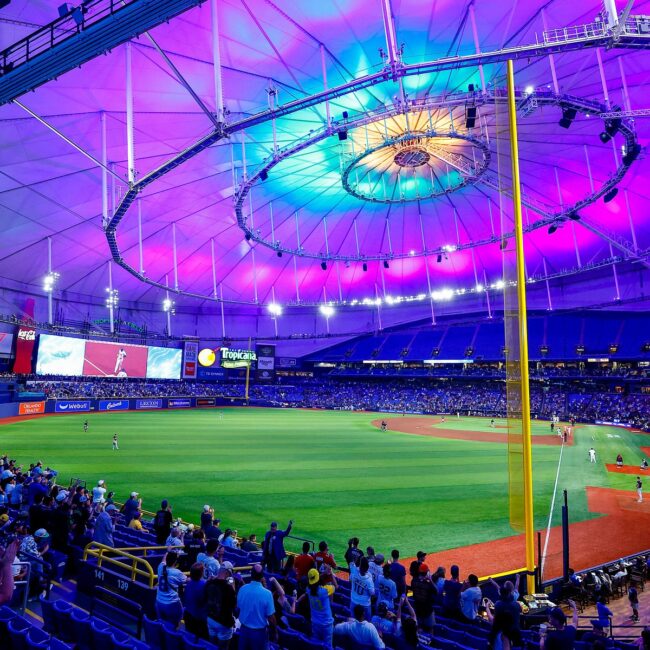
The Rays returned to a rebuilt Tropicana Field for the 2026 home opener on April 6 after playing all of 2025 at Steinbrenner Field in Tampa. The restoration, led by a new roof and paired with suite, turf, video board and clubhouse upgrades, took more than a year. Mayors Ken Welch and Jane Castor threw out the first pitches together, a visual of the team’s present in St. Pete and future in Tampa.
In August 2026 the Rays reached a definitive agreement with Hillsborough County, the City of Tampa and Hillsborough College for a 30,000-seat indoor stadium on the Dale Mabry campus. The financing plans cleared county and city votes in early September after marathon public hearings. Key terms:
| Item | Detail |
|---|---|
| Cost | ~$2.36 billion, roughly half public |
| Site | Hillsborough College Dale Mabry campus, Tampa |
| Rays lease | 35 years plus three 5-year options, nonrelocation clause |
| Builders | AECOM Hunt and Turner Construction |
| Timeline | Groundbreaking Sept. 2026; demolition Dec. 2026; bowl work March 2027; completion March 31, 2029 |
| Kill switch | StadCo has 3 years to line up funding and 4 years to lock contracts or the deal ends |
Barring a financing failure, the 2028 season is the Trop’s last as a big-league ballpark.
What Does the Gas Plant Plan Do With the Stadium?
The Burg Bid, selected by Mayor Welch on July 2, 2026, is a mixed-use plan for 58 acres that does not depend on baseball. It proposes demolishing Tropicana Field and reorganizing the site around a central park, reconnected street grid, museum row anchored by a new Woodson African American Museum of Florida, hotels, offices, retail, an event center and thousands of homes. Blake’s team offered $275 million for the land and valued the property at $405 million with a $20 million deposit at contract execution.
Developer Thompson Whitney Blake was direct about sequencing: the Woodson museum goes first, and the rest of the schedule follows the Rays’ lease. That means the surface lots and edge parcels can move before 2029; the stadium footprint cannot.
What Is the Likely Timeline for the Trop Itself?
| Period | What Happens |
|---|---|
| 2026–2027 | City and Burg Bid negotiate term sheet and development agreement; Community Benefits Agreement review; Council vote expected mid-2027 |
| 2027–2028 | Early work on museum and edge parcels; Rays play two final seasons at the Trop |
| Late 2028 | Rays’ use agreement ends; city regains full control of the stadium |
| 2029 | Earliest window for demolition and site preparation, assuming a Tampa opening on schedule |
| 2030s | Vertical construction across the stadium footprint |
If the Tampa stadium slips, the Rays could seek an extension at the Trop, which city officials have already acknowledged may be needed. Every year of extension pushes demolition and the core district back by the same amount.
Could the Trop Be Reused Instead of Demolished?
The restored building has a new roof and modern systems, which raises the reuse question. Realistically, the answer is no for three reasons. First, the selected plan and every finalist proposal were solicited without a ballpark and treat the stadium footprint as developable land. Second, the Trop’s 1990 design with a fixed slanted roof and vast surface parking is the opposite of the walkable street grid the city’s 23 guiding principles call for. Third, the city’s obligation to the Historic Gas Plant community, whose neighborhoods were cleared for the stadium in the 1980s, is tied to replacing it with housing and jobs, not preserving it.
Interim uses between the Rays’ departure and demolition, such as concerts, expos or short-term events, are possible but would be measured in months, not years, given the developer’s deposit and carrying costs.
Who Pays for Demolition?
The development agreement will settle this. In the collapsed Rays-Hines deal, demolition and site infrastructure were shared obligations. Under The Burg Bid, the $275 million land purchase and the developer’s commitment to new public infrastructure suggest the private side will carry most of it, but the term sheet is not public yet. Watch for demolition cost, environmental remediation of the former gas plant soils and stormwater infrastructure as the three line items most likely to move the city’s net proceeds.
What This Means for St. Pete Businesses
Restaurants and bars near the Trop. Game-day traffic ends after 2028 and does not come back until residents move in, likely 2031 or later. Businesses on Central Avenue west of downtown and in the Edge District should plan for a three-to-five-year gap.
Contractors. Demolition of a 1.1-million-square-foot domed stadium plus remediation and horizontal infrastructure is a large single procurement, likely bid in 2028.
Parking and event operators. The Trop’s surface lots are the first parcels to go vertical; interim parking revenue disappears early.
Real estate. Land pricing around the site already reflects the July selection. The Rays’ September approvals in Tampa remove the last excuse for delay and firm up the 2029 demolition window.
Brian’s Take
For 30 years the question in St. Pete was whether the Rays would leave. That’s settled. The better question now is whether the city can turn a ballpark exit into the best real estate outcome in Florida, and I think the odds are decent. The Burg Bid is financeable without baseball, the developer is local, and the Rays’ departure date is finally fixed by a signed deal across the bay. The two things that could still go wrong are a Tampa financing stumble that keeps the Rays at the Trop past 2028 and a St. Pete Council vote in 2027 that lands in the middle of a new administration. If both hold, the wrecking ball arrives in 2029 and St. Pete gets 86 acres of downtown back. That is a better trade than a stadium.
Frequently Asked Questions
When is the Rays’ last game at Tropicana Field? The end of the 2028 season, when the team’s use agreement expires. The Tampa stadium is scheduled to open March 2029.
Will Tropicana Field be torn down? Yes, under the selected Burg Bid plan. Demolition cannot start until the Rays leave and City Council approves a development agreement.
Who owns Tropicana Field? The City of St. Petersburg owns the stadium and the surrounding 86-acre Historic Gas Plant District.
What replaces the stadium? A mixed-use district with a 13-acre central park, 3,600-plus affordable and workforce homes, a new Woodson African American Museum, hotels, offices, retail and an event center.
Could the Rays stay longer? Only through a lease extension, which city officials have said may be needed if the Tampa ballpark is delayed.
Sources and Further Reading
- Ballpark Digest, “City, county approve new Rays ballpark funding plans,” Sept. 2, 2026 — https://ballparkdigest.com/2026/09/02/city-county-approve-new-rays-ballpark-funding-plans/
- Engineering News-Record, “Tampa Bay Rays $2.36B Ballpark Clears Final Hurdle After Marathon Public Hearings,” September 2026 — https://www.enr.com/articles/63571-tampa-bay-rays-236b-ballpark-clears-final-hurdle-after-marathon-public-hearings
- Florida YIMBY, “Tampa Bay Rays Reach Definitive Agreement For $2.3 Billion Stadium In Tampa,” August 2026 — https://floridayimby.com/2026/08/tampa-bay-rays-reach-definitive-agreement-for-2-3-billion-stadium-in-tampa.html
- Front Office Sports, “Rays Return to Rebuilt Tropicana Field, but Big Questions Linger,” April 6, 2026 — https://frontofficesports.com/rays-return-to-rebuilt-tropicana-field-but-bigger-questions-remain/
- City of St. Petersburg, “Mayor Kenneth T. Welch Announces Proposal Selections for Historic Gas Plant District Project,” July 2, 2026 — https://www.stpete.org/news_detail_T30_R1676.php
- Florida YIMBY, “The Burg Bid Selected To Redevelop 86-Acre Historic Gas Plant District,” July 3, 2026 — https://floridayimby.com/2026/07/the-burg-bid-selected-to-redevelop-86-acre-historic-gas-plant-district-in-st-petersburg.html
StPetersburgBusinessNews.com is part of the Florida Authority Network, a portfolio of Florida business and industry news publications combining human analysis with intelligent curation of public data. Businesses interested in coverage across the network can call 813-409-4683.