Quick Answer
Waterfront businesses in St. Petersburg face three key rules: new and substantially improved buildings must sit at least 2 feet above base flood elevation, the city applies a 49% substantial-improvement threshold with no lookback period, and non-residential buildings may use certified dry floodproofing instead of elevation. Upgrade costs range from a few thousand dollars per door shield to six figures for elevating equipment, and most public grant money still targets homes, not businesses.
Key Rules and Numbers at a Glance
| Item | St. Pete Standard / Benchmark |
|---|---|
| Lowest floor elevation | BFE + 2 ft, or DFE if higher |
| Substantial improvement trigger | 49% of structure value |
| Lookback period | None |
| City NFIP flood insurance discount | ~25% (county: 40%) |
| NFIP commercial max coverage | $500K building / $500K contents |
| Door flood shield (72-inch) | ~$3,000–$5,000 |
| Backflow preventer | ~$15,800 |
| Total seawall in city | ~600,000 linear feet |
Cost figures are national benchmarks from FEMA-related and municipal guides, not St. Pete contractor quotes.
Rule 1: The 2-Foot Freeboard Standard
St. Petersburg sets a higher bar than the federal minimum. The city amended its Florida Building Code requirements so buildings in flood hazard areas must be elevated to base flood elevation plus 2 feet, or to the design flood elevation if that is higher. The same ordinance codified existing city practice on dry floodproofing and adjusted coastal high hazard requirements for Coastal A zones.
City-sponsored FEMA projects show how this plays out on the ground. In one example, a building in a coastal AE zone with a 9-foot base flood elevation had to be raised at least 2 feet above that level to meet city standards.
For a waterfront restaurant or marina office, this means a new building or major rebuild in a coastal AE zone with a 9-foot BFE must have its lowest floor at 11 feet or higher, or be dry floodproofed to that level.
Rule 2: The 49% Substantial Improvement Threshold
The federal rule says that when repair or improvement costs reach 50% of a building’s pre-project market value, the entire structure must be brought up to current flood standards, not just the new work.
St. Pete applies this slightly more strictly on the percentage but more leniently on timing. The city uses a 49% standard and has no lookback period, meaning prior permitted work does not count against a new project. That contrasts with neighbors: St. Pete Beach has used a five-year lookback, one of the longest in the state.
What This Means for Business Owners
- Plan major renovations carefully. A $500,000 renovation on a building with a structure value of $1 million crosses the threshold and triggers full compliance.
- Phasing is not automatic protection. Many Florida jurisdictions treat multiple permits for one project as a single improvement.
- Land value doesn’t count. The calculation uses the structure’s value only, which hurts older waterfront buildings on valuable land.
There is a trade-off. Unincorporated Pinellas County, with a one-year lookback, earns a 40% NFIP flood insurance discount, while St. Petersburg, with no lookback, earns 25%. Lower insurance savings are part of the price of more flexible rebuild rules.
Rule 3: Dry Floodproofing Is an Option for Commercial Buildings
Unlike homes, non-residential buildings can meet flood requirements without being elevated. Dry floodproofing makes a building watertight below the flood level using sealed walls, impermeable membranes and removable or permanent shields over doors and other openings.
Insurance credit has a condition attached. For rating purposes, the floodproofed elevation must be at least 1 foot above base flood elevation to receive full credit. Federal guidelines also require an operations, maintenance and testing plan, since many systems need staff to deploy barriers before a storm.
Research on commercial construction found that dry floodproofing added roughly 15% to the cost of a sample building, and that the approach is best suited to flooding up to about 3 feet.
What Flood Upgrades Cost
Exact pricing depends on building type, size and flood depth, so owners should get engineer and contractor bids. National benchmarks give a useful starting range:
| Upgrade | Benchmark Cost |
|---|---|
| Flood shield, 72-inch doorway | $3,000–$5,000 |
| Flood panels at door openings | ~$15,000 |
| Flood panels at roll-up gate | ~$21,000 |
| Backflow preventer | ~$15,800 |
| Flood vent (wet floodproofing) | ~$1,750 each |
| Raise 100 kW generator 6 feet | ~$50,000 |
Lower-cost wet floodproofing is an option for storage and service areas. This approach lets water enter unoccupied spaces built with flood-resistant materials, rather than trying to keep it out.
Priorities for Each Business Type
- Marinas and marine services: Elevate electrical panels, fuel system controls and generators; add backflow preventers to stop tidal water entering through drains.
- Hospitality and restaurants: Door and roll-up gate shields, elevated kitchen equipment and walk-in compressors, and a written deployment plan for staff.
- Retail: Removable door shields, raised shelving and contents strategy, since inventory losses often exceed building damage.
Seawalls: A Shared Problem
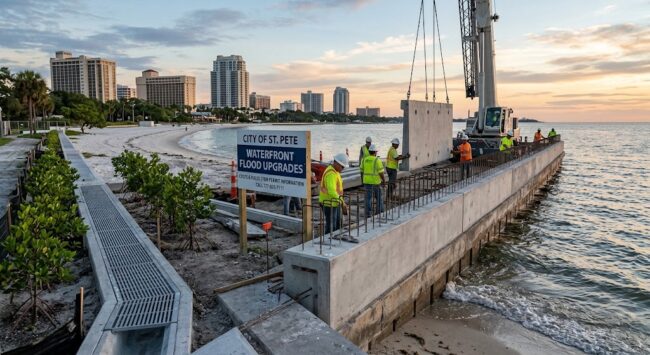
St. Petersburg’s seawall network is mostly in private hands. The city is studying more than 600,000 linear feet of seawall, of which only about 80,000 feet falls under city control.
The city is building a Seawall Master Plan for its own walls, and in early 2026 asked residents whether they would support raising the minimum required elevation for private seawalls. There are about 95 miles of privately owned seawall in the city, and it is not yet clear how the plan would affect them.
For waterfront businesses, this matters because a low or failing neighbor’s seawall can flood your property regardless of your own upgrades. Owners on shared waterways should coordinate with neighbors before investing in their own wall.
The State Law Wild Card: SB 180
A 2025 state law complicates any new local flood rules. SB 180 effectively froze local land-development regulations and comprehensive plans through Oct. 1, 2027, retroactive to Aug. 1, 2024. It bars “more restrictive or burdensome” changes in counties hit by the 2024 hurricanes, which includes Pinellas.
Lawmakers moved in 2026 to narrow it. Sen. Nick DiCeglie’s SB 840 would end that freeze on June 30, 2026, and limit future post-storm restrictions to areas within 50 miles of a storm track. Business owners should confirm the current status with the city before assuming a proposed rule, such as a higher seawall minimum, is in effect.
Where the Money Is
Public funding is flowing into St. Pete flood resilience, but mostly to infrastructure and housing.
Housing-Focused Programs
The city’s Sunrise St. Pete program is distributing $159.8 million in HUD disaster recovery funds, aimed largely at residents and small landlords. A council member questioned why the plan did not include help for small businesses when it was approved.
Infrastructure That Benefits Businesses
- Shore Acres: A pump station and culvert project of about $32 million is set to begin construction in October 2026 and run about 20 months.
- Major roadways: A $2.2 million FEMA grant will upsize storm drains on Dr. Martin Luther King Jr. Street South and on 4th Street North at 88th Avenue, both of which flooded during Helene.
Federal Options for Businesses
FEMA’s Flood Mitigation Assistance and Building Resilient Infrastructure and Communities programs can fund floodproofing measures. These usually flow through the city or state, so business owners should contact the city’s floodplain and grants staff early.
Brian’s Take
The math has changed for St. Pete’s waterfront operators. With the NFIP capping commercial coverage at $500,000 for the building and $500,000 for contents, many marina, hotel and restaurant owners are underinsured by design. Every dollar of flood damage you prevent is a dollar you may never have collected anyway.
The no-lookback policy is a real advantage that most owners don’t use strategically. It means you can make phased, smaller upgrades over several years, such as shields this year and elevated equipment next year, without those projects stacking toward a forced full rebuild. That flexibility could disappear if the city ever pursues a bigger insurance discount, so I’d use it now.
My priority order for a typical waterfront business: first, a backflow preventer, because it’s the cheapest way water gets in; second, elevate electrical and mechanical equipment, because that’s where downtime comes from; third, door and gate shields with a written deployment plan. Full elevation only makes sense if you are already near the 49% line.
The funding gap is the story nobody is fixing. Nearly all of the post-Helene money is going to homes and pipes. Business owners who want help will need to push for it, likely by organizing through district associations and the Chamber.
Frequently Asked Questions
How high must a new St. Pete waterfront business building be?
The lowest floor must be at base flood elevation plus 2 feet, or the design flood elevation if higher.
Does St. Petersburg have a lookback period for the 50% rule?
No. St. Petersburg uses a 49% threshold with no lookback, so past permitted work does not count against a new project.
Can a commercial building use floodproofing instead of elevation?
Yes. Non-residential buildings can use certified dry floodproofing. For full insurance credit, protection should reach at least 1 foot above base flood elevation.
How much does flood-proofing a business cost?
Benchmarks run from about $3,000–$5,000 for a doorway shield to roughly $15,800 for a backflow preventer and about $50,000 to raise a large generator. Full dry floodproofing of a new building adds roughly 15% to construction cost.
How much flood insurance can a business get through the NFIP?
Up to $500,000 for the building and $500,000 for contents. Many businesses buy private excess flood and business interruption coverage on top.
Can St. Pete raise its seawall height requirements?
The city has asked residents about raising minimum private seawall elevations, but state law SB 180 has limited new, more restrictive local land development rules in hurricane-affected counties.
Sources and Further Reading
- City of St. Petersburg, Ordinance amending Chapter 8 (Florida Building Code amendments), filed with the Florida Building Commission, June 2021
- FEMA, City of St. Petersburg Elevation of Single-Family Residence project description
- St. Pete Catalyst, “Chaney proposes re-interpretation of FEMA’s ‘50% rule’”
- FOX 13, “St. Pete Beach lawmaker proposes change to FEMA’s ‘50% Rule’”
- Open Exam Prep / ASFPM CFM Study Guide, “Substantial Improvement (50% Rule Definitions, Cost Estimation, Market Value),” August 2026
- Engineering Express, “An engineer’s walk through of the design requirements for flood resistant design of building components”
- Mississippi State University, SERRI Report 80024, Dry Floodproof Construction Research, Chapter 6
- Vermont Agency of Commerce and Community Development, CPR VERI Toolkit: Floodproofing
- Delaware DNREC, Commercial Floodproof Barrier/Shield adaptation strategy sheet
- NYC Department of City Planning, Resilient Industry Appendix: Resiliency Best Practice Cost Estimation
- St. Pete Catalyst, “City begins holistic review of 600,000 feet of seawall ”Bay News 9
- WUSF, “Florida communities wanted to be more sustainable and resilient. A new state law blocks their efforts,” October 2025
- Central Florida Public Media, “DiCeglie’s bill to fix controversial SB 180 moves forward,” January 20, 2026