Quick Answer: On May 14, 2026, St. Petersburg City Council unanimously adopted the SunRunner Bus Rapid Transit Overlay, an optional transit-oriented development (TOD) zoning district along Central Avenue west of 19th Street. Property owners who opt in can build up to a 5.0 floor area ratio and 150 feet near the 22nd Street and 32nd Street stations, with no minimum parking requirement within a quarter mile of any SunRunner station. Underlying zoning stays in place for anyone who chooses not to use it.
Key Takeaways
- The overlay is opt-in, not a rezoning. Owners can build under existing zoning or elect the TOD standards parcel by parcel.
- Parking minimums are eliminated inside the overlay within a quarter mile of stations, the biggest single change to development economics on the corridor.
- Density is tiered by station type: Urban (22nd and 32nd streets) up to FAR 5.0; Neighborhood (40th, 49th, 58th) and Village (66th) up to FAR 4.0.
- Bonus density is earned through workforce-housing trust fund payments, landmark development-rights transfers, or enhanced streetscape and retail frontage.
- Buildings 50 years or older can be excluded from density calculations if retained, a direct incentive to keep older Central Avenue storefronts.
What Is the SunRunner TOD Overlay?
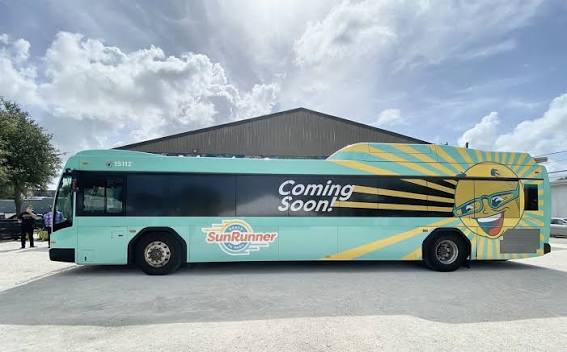
The SunRunner is PSTA’s 10-mile bus rapid transit line linking downtown St. Petersburg to St. Pete Beach along 1st Avenues North and South. It launched in 2022 and carries the county’s highest bus ridership. The overlay grew out of the SunRunner Rising Development Study, a joint effort by the city, PSTA and Forward Pinellas that Council accepted in 2022, and it took four years of drafting and public hearings to reach adoption.
The ordinance creates a transit-oriented development district that lets owners follow a new rule set designed to support transit use, increase intensity and allow a wider mix of uses than existing zoning permits. Councilmember Mike Harting recused himself from the vote; the other members approved it unanimously.
A separate SunRunner Target Employment Center overlay for the 22nd Street South industrial corridor was adopted in 2024. That earlier ordinance cut parking requirements 25 percent within a quarter mile of the 22nd Street station, dropped parking entirely for multifamily units under 750 square feet, and waived parking for adaptive reuse of existing buildings.
How Much Can You Build? Station Area Tiers
| Station Area | Stations | Base FAR | Max FAR w/ Bonus | Max Height |
|---|---|---|---|---|
| Urban | 22nd St S, 32nd St | 4.0 | 5.0 | up to 150 ft |
| Neighborhood | 40th, 49th, 58th St | 3.0 | 4.0 | up to 86 ft (some areas higher) |
| Village | 66th St | 3.0 | 4.0 | lower scale |
Floor area ratio (FAR) is total building square footage divided by lot area. A FAR of 5.0 on a 10,000-square-foot lot allows 50,000 square feet of building, roughly five stories of full-lot coverage or a taller building with more open ground. Councilmember Copley Gerdes argued for contiguity, saying a 5.0 FAR across Central makes sense and spreads what downtown has to the west side.
How Do You Earn the FAR Bonus?
The 1.0 FAR bonus can be earned three ways:
- Contributing to the city’s Housing Capital Improvements Projects (HCIP) trust fund, which supports workforce housing.
- Purchasing transfer of development rights (TDRs) from a locally designated landmark property.
- Implementing specified streetscape design and active retail frontage.
Separately, Council approved an arts funding FAR bonus on August 27, 2026 for districts that already use bonus programs, giving developers another public-benefit option for additional floor area.
What Happened to Parking Requirements?
Within the overlay and within a quarter mile of SunRunner stations, developers are no longer required to build a set number of parking spaces. Business groups, transit advocates and housing organizations pushed for the change, arguing mandatory parking raises housing costs and consumes land near transit. Neighborhood associations in Historic Kenwood and Central Oak Park raised spillover concerns; Councilmember Lisset Hanewicz pointed to residential permit parking programs as a tool and noted the overlay can be amended.
For a developer, removing structured parking can cut $25,000 to $50,000 or more per space in construction cost. On a 100-unit project, that is the difference between a deal that pencils at Grand Central rents and one that doesn’t.
What Design Standards Apply?
Opting in comes with obligations. New development along Central Avenue and near station areas must include ground-floor pedestrian-oriented uses, limit curb cuts, prioritize sidewalks, push parking to the rear, and engage the street directly. Preservation advocates including Preserve the ‘Burg warned that higher intensity could cost the corridor its older buildings and locally owned tenants; the 50-year exclusion provision is the city’s answer.
How Does This Affect St. Pete Real Estate?
Land values along 1st Avenues North and South. Parcels within a quarter mile of the 22nd Street and 32nd Street stations now carry a 5.0 FAR entitlement with no parking burden. Expect pricing on underutilized lots, auto-oriented retail and small warehouses in the Grand Central and Warehouse Arts districts to reset upward.
Multifamily pipeline. The overlay lands as Whitney Village, Blake Investment Partners’ mixed-use project at 3200 1st Avenue South near the 32nd Street station, moves through construction with Greystar’s 325-unit Henry apartments topping out in August and a 60-unit factory-built Vessel building planned. Those projects preview the scale the corridor will see.
Commercial tenants. Ground-floor retail is mandated on opt-in projects, which will add storefront supply along Central west of 19th. Existing restaurant and shop tenants in older buildings face redevelopment pressure but also benefit from the retention incentive.
Investors and lenders. Because the overlay is optional, underwriting has to check whether a given parcel’s owner has elected TOD standards. Underlying zoning still governs by default.
Beach-side cities. South Pasadena and St. Pete Beach were part of the SunRunner Rising study, but this ordinance covers only St. Petersburg parcels.
Brian’s Take
This is the most consequential zoning change St. Pete has made outside downtown in a decade, and it was done the smart way: opt-in, tiered by station, with bonus density tied to housing money and street design rather than handed out. The parking elimination is the real story. Developers have been building 1.5 spaces per unit in the Grand Central District because the code said so, not because renters within walking distance of a 15-minute bus demanded it. Watch three things over the next 18 months: how many owners actually elect the overlay, whether the HCIP trust fund sees real bonus payments, and whether Kenwood and Central Oak Park get a permit-parking program before spillover complaints turn political. The overlay works if it produces buildings; a 5.0 FAR on paper does nothing for anyone.
Frequently Asked Questions
Is the SunRunner TOD overlay mandatory? No. It is optional. Owners can develop under existing zoning or opt into the overlay standards.
What is the maximum density under SunRunner TOD? FAR 5.0 in Urban Station Areas around 22nd Street South and 32nd Street (4.0 base plus 1.0 bonus); FAR 4.0 in Neighborhood and Village station areas.
Are parking minimums eliminated along the entire SunRunner route? Within the overlay district and within a quarter mile of stations, yes. Outside those boundaries, standard parking requirements apply.
What area does the overlay cover? Central Avenue west of 19th Street and nearby streets served by the SunRunner, organized around the 22nd, 32nd, 40th, 49th, 58th and 66th street stations.
When did it take effect? Council’s May 14, 2026 vote was the final adoption step, and the overlay is now in effect.
Sources and Further Reading
- City of St. Petersburg, SunRunner BRT Transit Oriented Development project page — https://www.stpete.org/residents/current_projects/planning_projects/sunrunner_brt_tod.php
- St. Pete Rising, “St. Pete approves major zoning overhaul allowing taller buildings and no parking minimums along SunRunner route,” May 15, 2026 — https://stpeterising.com/home/st-pete-approves-major-zoning-overhaul-allowing-taller-buildings-and-no-parking-minimums-along-sunrunner-route
- Tampa Bay Business & Wealth, “New zoning rules could reshape Central Avenue development,” May 18, 2026 —
- St. Pete Catalyst, “Transit-oriented development simply makes sense,” April 29, 2026 — https://stpetecatalyst.com/transit-oriented-development-simply-makes-sense/
- St. Pete Catalyst, “City council advances transit-based zoning changes” (22nd Street TEC overlay), June 12, 2024 — https://stpetecatalyst.com/city-council-advances-transit-based-zoning-changes/
- PSTA, SunRunner service page — https://psta.net/services/sunrunner/