StPetersburgBusinessNews.com | Downtown & Technology | Updated June 11, 2026
Quick Answer
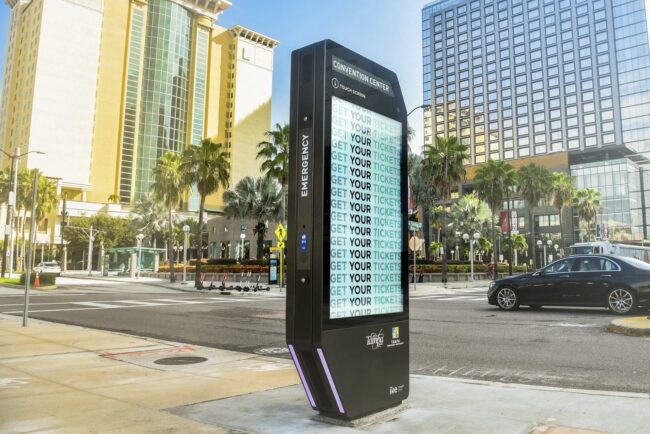
The St. Petersburg Downtown Partnership is working with IKE Smart City, the Columbus, Ohio-based kiosk operator spun out of Orange Barrel Media, to place interactive digital wayfinding kiosks and message boards on downtown sidewalks. IKE kiosks are 8-foot, two-sided touchscreens that display real-time transit and mobility options, a directory of local businesses, event calendars, public-safety alerts and free Wi-Fi, funded by advertising at no cost to the city under the model IKE uses in more than two dozen U.S. cities. The rollout is being coordinated with the proposed Downtown Improvement District and its ambassador program, and city code updates are being drafted so the units can be installed without compromising the downtown historic district’s streetscape.
What Is IKE Smart City and How Does the Kiosk Program Work?
IKE (Interactive Kiosk Experience) is a self-funded municipal kiosk platform: IKE Smart City designs, manufactures, permits, installs, operates and maintains the units and sells the advertising, while the host city or downtown organization receives a revenue share and controls the community content. The company launched in Denver and now operates networks in cities including Tampa, Miami, West Palm Beach, San Diego, Houston, Austin, Atlanta, Baltimore, Cleveland, St. Louis, Columbus, San Antonio and Seattle.
| Element | How It Works |
|---|---|
| Hardware | Dual-sided digital kiosk with touchscreen, ADA-accessible interface, lighting, security call button, free public Wi-Fi |
| Cost to city | None; IKE funds manufacturing, installation, operations and maintenance |
| Revenue | Advertising sales; a share is remitted to the city or downtown organization (Seattle and Austin direct proceeds to cleaning, safety and placemaking) |
| Content control | City and partner approve ad guidelines and curate community content, event calendars and business directories |
| Languages | Multilingual interface (San Diego units offer 11 languages) |
| Placement | Public right-of-way in high-pedestrian areas, subject to ADA clear-path and historic-district review |
| Typical network size | 30 kiosks in Seattle’s initial downtown phase; Tampa’s network covers downtown, the Channel District and Armature Works |
How is St. Petersburg implementing digital wayfinding downtown?
The Downtown Partnership is leading the program in coordination with the city, pairing the kiosks with the ambassador and safety services planned under the Downtown Improvement District and with code amendments that allow digital right-of-way installations in the downtown core. Specific kiosk counts, locations and the revenue-share terms had not been published as of September 2026.
| Component | Status (Sept. 2026) | Detail |
|---|---|---|
| Kiosk operator | IKE Smart City | Same platform operating in Tampa since 2024 |
| Lead organization | St. Petersburg Downtown Partnership | Working with City of St. Petersburg |
| Downtown Improvement District | Proposed; boundary 5th Ave N to 5th Ave S, 5th St N to the waterfront | Would fund ambassadors, security, graffiti removal, trash collection |
| Code updates | In progress | Permit digital kiosks in right-of-way while protecting historic downtown aesthetics (Downtown St. Petersburg Historic District: 420 acres, 367 contributing buildings) |
| Kiosk locations | Not yet announced | Expected in high-traffic corridors such as Central Avenue, Beach Drive, 2nd Avenue N and the Pier approach |
| Timeline | Not yet announced | Tampa’s network went from council approval to installation in roughly 12–18 months |
St. Petersburg previously considered IKE kiosks in 2021 under Mayor Rick Kriseman; that proposal drew opposition from some downtown business owners and a former council member over concerns that corporate advertising would clutter pedestrian corridors. The current effort’s coordination with the DID and the historic-district code review is a direct response to those objections.
What information do IKE kiosks display?
Each kiosk runs a suite of applications covering wayfinding, transit, business discovery, events, public safety and civic information, drawing on real-time data feeds so that a pedestrian can plan a trip by bus, SunRunner, scooter, bike share, rideshare or on foot.
| Application | What a Downtown St. Pete User Would See |
|---|---|
| Interactive map and directions | Walking routes to the Pier, Dali Museum, Mahaffey Theater, Tropicana Field/Gas Plant District, Grand Central |
| Transit and mobility | Real-time PSTA and SunRunner arrivals, scooter and bike-share availability, rideshare pickup points, Downtown Looper |
| Business directory | Searchable listings by category (dining, retail, arts, services) with distance and walking time |
| Events calendar | Saturday Morning Market, First Friday, Mahaffey and Jannus Live schedules, Rays and Rowdies games |
| Public safety | Emergency messaging, 911 call button, severe-weather and hurricane alerts |
| Civic and social services | City notices, shelter and resource locations, parking guidance |
| Selfie and photo sharing | Visitor-engagement feature used in Baltimore and other markets |
| Free Wi-Fi | Public hotspot at each unit |
How do downtown St. Pete businesses get listed on the kiosks?
In every IKE market, businesses within the service area are eligible for a free directory listing and can submit events to the community calendar, subject to content guidelines; paid advertising is sold separately by IKE Smart City. Once St. Petersburg’s program launches, the Downtown Partnership is expected to manage listing submissions.
| Opportunity | Cost | How to Access |
|---|---|---|
| Business directory listing | Free | Submit through the Downtown Partnership or IKE content portal after launch |
| Community calendar event | Free, subject to approval | Same channel |
| Featured content or campaign | Paid | IKE Smart City media sales (salesinquiry@ikesmartcity.com in other markets) |
| Nonprofit and arts promotion | Typically free allotment | Partner arts organizations (e.g., Houston’s Contemporary Arts Museum) receive dedicated content space |
Directory placement matters most for businesses off the primary Central Avenue and Beach Drive corridors, where a kiosk search for “coffee” or “gallery” surfaces a location two blocks away that a visitor would otherwise never see.
What is the Downtown Improvement District and how does it relate to the kiosks?
The proposed DID is a special assessment district covering the core between 5th Avenue North, 5th Avenue South, 5th Street North and the waterfront that would fund ambassadors, supplemental security, graffiti removal and trash collection; kiosk advertising revenue can help support those services, as it does in Seattle’s Metropolitan Improvement District.
| DID Element | Detail |
|---|---|
| Proposed boundary | 5th Ave N to 5th Ave S; 5th St N to the waterfront |
| Services | Ambassador program, additional security, graffiti removal, trash collection, business and resident resources |
| Funding | Assessment on properties within the district (rate and approval status pending) |
| Kiosk link | Kiosks extend ambassador reach with 24/7 wayfinding, safety messaging and a revenue stream |
| Precedent | Tampa’s Downtown Partnership operates both a special services district and the IKE network |
Why do the kiosks matter for St. Petersburg businesses?
The kiosks convert sidewalk foot traffic into directed traffic by putting a searchable business directory and event feed where roughly 80% of downtown visitor decisions are made: on foot, in the moment. For a downtown that draws more than 1.5 million annual visitors to the Pier alone and hosts the Saturday Morning Market, First Friday and a growing residential base, the network is a low-cost discovery channel for independents.
- Retailers and restaurants: free directory presence; paid placements for grand openings, happy hours and seasonal promotions.
- Arts and cultural venues: event-calendar integration for Mahaffey, Dali, Museum of Fine Arts, Jannus Live and gallery walks.
- Property owners and landlords: improved wayfinding supports leasing on secondary streets (1st Ave N and S, 3rd St, 4th St).
- Hospitality: hotel guests get transit, dining and event information without staff time.
- Public safety: lighting, emergency call buttons and alert messaging complement DID ambassadors.
Brian’s Take
St. Pete tried this in 2021 and the reaction was “not on our sidewalks.” The difference now is not the technology; IKE’s kiosks are the same product Tampa installed two years ago. The difference is packaging: tying the kiosks to a Downtown Improvement District that downtown property owners are being asked to fund, and letting kiosk ad revenue offset part of that assessment, gives the business community a financial reason to say yes. That is how Seattle and Austin got to unanimous votes.
The risk is the same one Jeff Danner named five years ago. If the ad inventory ends up dominated by national brands and the local directory feels like an afterthought, the kiosks become billboards with a map on the side. The Downtown Partnership should publish the content guidelines and the local-business allotment before the first unit goes in the ground, and it should put units on 1st Avenue North and South, not just Central and Beach Drive, where the wayfinding actually changes behavior. Done right, this is the cheapest marketing channel an independent downtown business will ever get.
Frequently Asked Questions
Do IKE kiosks cost St. Petersburg taxpayers anything?
No. IKE Smart City funds the kiosks, installation, operation and maintenance and pays the city or partner a share of advertising revenue under its standard model.
Can a downtown business advertise on the kiosks?
Yes. Businesses get a free directory listing and can buy paid placements through IKE Smart City’s media sales team once the network is live.
Where will the kiosks be located?
Locations have not been announced. Units are typically placed in the highest-pedestrian areas of a downtown core, subject to ADA and historic-district review.
Are the kiosks already operating in Tampa Bay?
Yes. IKE kiosks have operated in downtown Tampa, the Channel District and Armature Works since 2024 under the Tampa Downtown Partnership.
What is the Downtown Improvement District?
A proposed special assessment district for downtown St. Petersburg that would fund ambassadors, security, cleaning and graffiti removal, similar to Tampa’s downtown special services district.
Sources and Further Reading
- St. Petersburg Downtown Partnership — https://www.stpetepartnership.org/
- St. Petersburg Downtown Partnership, 2026 Development Guide — https://www.stpetepartnership.org/2026-development-guide
- St. Pete Downtown Improvement District (proposed) — https://www.stpetedid.org/
- IKE Smart City — https://www.ikesmartcity.com/
- WGI, IKE Smart City Kiosks, Tampa project profile — https://wginc.com/projects/ike-smart-city-kiosks/
- Downtown Seattle Association, “Seattle City Council Approves DSA’s Installation of IKE Digital Kiosks” (June 24, 2025) — https://downtownseattle.org/2025/06/seattle-city-council-approves-dsas-installation-of-ike-digital-kiosks/
- City of Austin, “City Council Approves Digital Kiosks to Enhance Navigation and Support Local Businesses” (March 2026) — https://www.austintexas.gov/economic-development/news/city-council-approves-digital-kiosks-enhance-navigation-and-support-local
- Downtown San Diego Partnership, IKE kiosk program — https://downtownsandiego.org/ike/
- City of Houston, “City of Houston and IKE Smart City Launch Innovative Interactive Digital Kiosks” — https://cityofhouston.news/city-of-houston-and-ike-smart-city-launch-innovative-interactive-digital-kiosks/
- Government Technology, “Local Businesses Take Issue with High-Tech Kiosk Plan” (St. Petersburg, April 2021) — https://govtech.com/products/Local-Businesses-Take-Issue-with-High-Tech-Kiosk-Plan.html
- Government Technology, “Let’s Get Digital: Cities Make Their Signage Interactive” (Aug. 2025) — https://www.govtech.com/smart-cities/lets-get-digital-cities-make-their-signage-interactive
- StPetersburgBusinessNews.com, Looking Glass Initiative Brings $3.5M to MLK Street South (companion article)
Reporting by Brian French. St. Petersburg-specific kiosk counts, locations, revenue-share terms and installation dates had not been published by the Downtown Partnership or the city as of September 10, 2026; program mechanics are described from IKE Smart City’s deployments in Tampa and other markets.