By Florida Authority Network Staff | October 23, 2026
Quick Answer
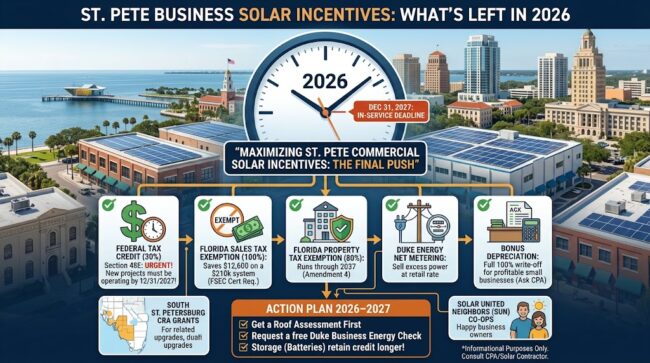
St. Petersburg businesses have no city cash grant for commercial solar. They can still combine several incentives:
- Federal 30% tax credit for commercial solar (Section 48E), but new projects must be operating by December 31, 2027
- Florida sales tax exemption on solar equipment
- Florida property tax exemption on 80% of a solar system’s value
- Net metering credits from Duke Energy Florida
- Duke Energy Smart $aver rebates for efficiency upgrades
The federal deadline is the most urgent.
The Big Change: Federal Solar Incentives Now Have Hard Deadlines
The One Big Beautiful Bill Act of 2025 cut the federal clean energy credits short. For St. Pete business owners, the solar tax credit timeline now drives every project decision.
Federal Commercial Solar Tax Credit (Section 48E)
- Value: A 30% investment tax credit for business-owned solar, if the project meets wage and apprenticeship rules or falls under the small-project exemption
- The July 4, 2026 window has closed. Projects that began construction by that date have four years to finish and still claim the credit.
- New projects: Any project starting construction now must be placed in service by December 31, 2027
- Missing the deadline costs the whole credit. A project that misses it gets no federal credit at all.
- What “placed in service” means: In practice, the date the utility grants permission to operate, not the date the panels go on the roof
Battery storage is treated differently. Commercial battery storage remains eligible for the 48E credit on a longer phase-out schedule, running into the 2030s.
Residential solar credits have ended. The federal homeowner credit (Section 25D) expired at the end of 2025. Business owners who work from home cannot claim a residential credit for 2026 installations.
Section 179D Energy-Efficient Buildings Deduction
The federal deduction for energy-efficient commercial buildings ended for projects beginning construction after June 30, 2026. Projects that began on or before that date remain eligible, even if they are finished in 2027 or later.
Bonus Depreciation
Full 100% bonus depreciation was restored for qualifying business property. For a profitable small business, an immediate write-off of solar and efficiency equipment can be worth as much as the tax credit. Ask your CPA how it interacts with the 48E credit.
Florida State Incentives
Florida has no state income tax credit for solar, because it has no personal income tax. Instead, the state offers three permanent benefits.
Sales Tax Exemption
Solar energy systems have been exempt from Florida sales and use tax since 1997, and the exemption was made permanent in 2005. Equipment must be certified by the Florida Solar Energy Center. On a $210,000 system serving a 100 kW commercial building, that saves about $12,600 in state sales tax. If a commercial solar quote includes a sales tax line, ask the installer to remove it.
Commercial Property Tax Exemption
Under Amendment 4, approved by voters in 2016 and implemented in 2017 by SB 90, 80% of the assessed value of solar and other renewable energy devices installed on commercial and industrial property on or after January 1, 2018, is exempt from property tax. Homes get a 100% exemption. The commercial exemption runs through 2037.
Net Metering
Florida law requires investor-owned utilities, including Duke Energy Florida, to offer net metering for customer-owned renewable systems up to 2 megawatts. Excess power is credited at the retail rate. St. Pete businesses served by Duke can offset their bills this way, which improves the payback on rooftop solar.
Duke Energy Florida Business Programs
Duke Energy Florida serves St. Petersburg. Its Smart $aver program offers business customers incentives to replace old equipment with high-efficiency models and to improve existing systems. Rebates have covered:
| Upgrade | Example Incentive |
|---|---|
| Ceiling insulation (retrofit) | $0.17 per sq. ft. |
| Wall insulation (retrofit) | $0.10 per sq. ft. |
| High-efficiency chillers | $20 per ton |
| Energy recovery ventilation | $0.75 per CFM |
| HVAC, heat pumps, controls | Varies by efficiency |
Rebate amounts change. Confirm current terms and get pre-approval before you buy equipment. Duke also offers a free Business Energy Check to identify savings.
EV charger rebates: Duke’s commercial EV charger rebate program had its most recent application cycle close at the end of 2024. Check with Duke before planning around it.
Local St. Petersburg Resources
St. Petersburg does not offer a direct commercial solar grant, but it supports several programs:
- Solar and Energy Loan Fund (SELF): A nonprofit lender, promoted by the city, that offers financing, project management and approved contractors. It focuses mainly on residential properties. Owners do not have to live in the home, so residential landlords qualify.
- Solar United Neighbors (SUN): A nonprofit that runs group-purchase solar co-ops and year-round “Go Solar” help for St. Pete homes and businesses
- PACE financing: Florida law allows Property Assessed Clean Energy (PACE) programs, which finance solar, efficiency and hurricane upgrades through a property assessment repaid with property taxes. Check which PACE administrators currently operate in St. Petersburg and Pinellas County.
- South St. Petersburg CRA grants: Commercial properties in the redevelopment area may qualify for site and interior improvement grants. These can cover efficiency upgrades such as new HVAC, roofing and windows.
Solar Incentive Stack: Who Gets What
| Incentive | Owners | Tenants | Deadline |
|---|---|---|---|
| Federal 48E credit (30%) | Yes | If they own the system | In service by 12/31/2027 |
| Bonus depreciation | Yes | Yes, for their equipment | Ongoing |
| FL sales tax exemption | Yes | Yes | Permanent |
| FL property tax exemption (80%) | Yes | N/A | Through 2037 |
| Net metering | Yes | If metered separately | Ongoing |
| Duke Smart $aver | Yes | Yes, with owner approval | Ongoing |
| Section 179D | Yes | No | Construction began by 6/30/2026 |
A 2026–2027 Action Plan for St. Pete Businesses
- Start now if you want solar. Commercial projects often take 6 to 12 months from design to utility approval. A project that starts in late 2026 has little room for permitting or interconnection delays before the December 31, 2027 deadline.
- Get the roof assessed first. Many St. Pete buildings have post-hurricane roof issues. Replacing the roof before installing panels avoids paying to remove and reinstall them later.
- Request a Duke Business Energy Check to find rebate-eligible upgrades. Efficiency upgrades usually pay back faster than solar.
- Ask installers to model the project with and without the federal credit. If the credit is missed, Florida’s exemptions, net metering and depreciation still create value.
- Consider storage. Battery systems keep their federal credit longer, and they provide backup power during hurricane-season outages.
- Tenants should review their lease. Get the landlord’s written consent, settle who owns the system and the tax benefits, and agree on what happens when the lease ends.
Frequently Asked Questions
Are there grants for commercial solar in St. Petersburg?
There is no city grant dedicated to commercial solar. Funding comes through tax credits, tax exemptions, Duke Energy rebates, and financing such as SELF and PACE. Businesses in the South St. Pete CRA may qualify for improvement grants that cover related upgrades.
Can I still get the 30% federal solar credit?
Yes, if your business owns the system and it is placed in service by December 31, 2027. Projects that began construction by July 4, 2026 have a longer window.
Does Duke Energy Florida pay rebates for solar panels?
Duke’s business rebates focus on efficiency equipment, not solar panels. For solar, the main benefit from Duke is net metering credit for excess power sent to the grid.
Will solar raise my commercial property taxes?
Only slightly. Florida exempts 80% of the value of renewable energy devices on commercial property from property tax.
This article is for informational purposes and is not tax or financial advice. Consult a CPA and licensed solar contractor before committing to a project.
Sources and Further Reading
- Hawaii State Energy Office, “Federal Commercial Credit FAQs: Section 48”
- pv magazine USA, “Treasury Issues Guidance for Solar, Wind ‘Start of Construction’ Tax Credit Rules”
- SolarInsure, “Commercial Solar Tax Credit Deadline Passed”
- SolarReviews, “The Federal Solar Tax Credit: What’s New in 2026”
- IRS, Instructions for Form 7205, Energy Efficient Commercial Buildings Deduction
- Congressional Research Service, “The Section 179D Energy Efficient Commercial Buildings Deduction,” April 2026
- Engineered Tax Services, “179D Tax Credit Update: The Deadline Has Passed”
- DSIRE via EnergyBot, “Solar and CHP Sales Tax Exemption” (Florida)
- Florida Legislature, HB 805 (2005), Solar Energy Systems Sales Tax Exemption
- Solar Builder, “Florida Keeps Solar Momentum Going, Governor Signs SB 90”
- Smart Energy Decisions, “Florida Approves Solar Tax Break for C&I Installations”
- DSIRE via EnergyBot, “Duke Energy Florida – Smart $aver Commercial Energy Efficiency Rebate Program”
- DSIRE via EnergyBot, “Duke Energy Florida – Commercial Charger Rebate”
- City of St. Petersburg, Solar and Solar and Energy Loan Fund program page
- Advanced Green Technologies, “What Is PACE Solar Florida”
- City of St. Petersburg, Community Redevelopment Areas