By Florida Authority Network Staff | October 19, 2026
Quick Answer
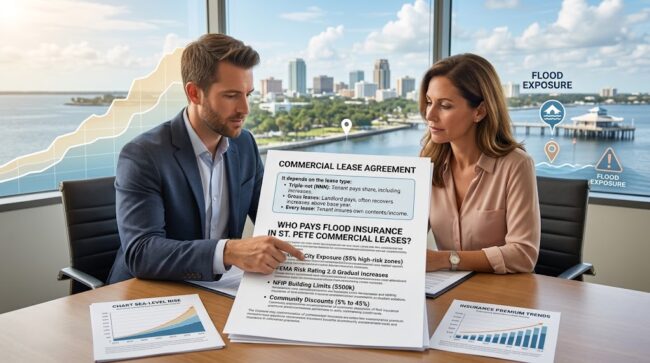
It depends on the lease type:
- Triple-net (NNN) leases: The tenant pays its share of the landlord’s flood premium, including increases.
- Gross leases: The landlord pays, but often recovers increases above a base year.
- Every lease: The tenant insures its own contents and business income.
In flood-prone St. Petersburg, the lease clauses on caps, deductibles and casualty matter more than the lease label.
Why This Question Matters Now in St. Pete
Hurricanes Helene and Milton changed how St. Petersburg landlords and tenants price flood risk. City officials have put the insured losses from the two storms at an estimated $28 billion to $47 billion. In the low-lying Shore Acres neighborhood, Helene’s surge damaged every single home.
Flood exposure is also widespread. A September 2026 check of more than 1,000 St. Petersburg listing addresses against FEMA’s flood layer found that 55% sit in high-risk A-series zones. Helene also flooded many homes in low-risk Zone X, so “outside the flood zone” no longer means “no flood risk.”
For commercial tenants downtown, along the waterfront and in older low-lying corridors, the key question is who absorbs rising premiums when the lease renews.
Why Commercial Flood Premiums Keep Rising
- Federal rates are still climbing toward full risk. Under FEMA’s Risk Rating 2.0 pricing, premiums rise gradually, with most annual increases capped at 18%. Increases are capped at 25% for some commercial policies, so many policyholders will not reach their full-risk price for more than a decade. Tenants in a pass-through lease should expect increases year after year.
- Federal coverage is limited. The National Flood Insurance Program (NFIP) covers non-residential buildings up to $500,000 for the building and $500,000 for contents. Larger buildings need excess flood insurance on top, which adds cost.
- Private excess coverage costs more but covers more. St. Petersburg-based private insurer Neptune raised its building limits to $15 million and its business interruption limit to $1 million. Landlords that add these layers usually pass the cost through to NNN tenants.
- Community discounts can change. NFIP policies in communities that join FEMA’s Community Rating System (CRS) get discounts ranging from 5% to 45%. St. Petersburg’s discount depends on the city enforcing floodplain rules after storms. FEMA can drop a community that falls short to Class 10, which removes the discount. A lost discount would raise every policy in the city at once.
Landlord vs. Tenant: Who Pays What
| Cost | NNN Lease | Modified Gross | Full-Service Gross |
|---|---|---|---|
| Building flood premium | Tenant (pro rata) | Landlord, increases often passed on | Landlord, above base year |
| Annual premium increases | Tenant | Usually tenant, above base year | Tenant, above base year |
| Flood deductible | Often tenant via CAM | Negotiated | Usually landlord |
| Excess / private flood | Tenant (pro rata) | Negotiated | Landlord |
| Tenant contents & inventory | Tenant | Tenant | Tenant |
| Business interruption | Tenant | Tenant | Tenant |
| Code upgrades after damage | Often tenant, amortized | Negotiated | Usually landlord |
CAM = common area maintenance charges. Base year = the first lease year’s costs; the tenant pays its share of increases above that level.
How Each Lease Type Handles Flood Costs
Triple-Net (NNN) Leases
Most retail and many single-tenant buildings in St. Pete use NNN leases. The tenant pays base rent plus its share of property taxes, insurance and maintenance. Flood insurance is usually listed as an operating expense, so every premium increase flows straight to the tenant.
Watch for: Lease language that lets the landlord add new coverage, such as private excess or parametric policies, without limits. Insurance is also usually treated as an “uncontrollable” expense, which means it falls outside any annual cap on pass-through costs.
Modified Gross Leases
These leases split costs. Rent often includes insurance at a set “expense stop,” and the tenant pays increases above that amount. In a rising flood market, a low expense stop can turn a gross lease into an NNN lease within a few years.
Full-Service Gross Leases
These are common in downtown office towers. The landlord covers building insurance in the rent, but tenants usually pay their share of increases above the base year. A base year set before the 2024 storms is especially valuable to a tenant, because post-storm premiums are much higher.
Ground Leases and Absolute NNN Leases
Here the tenant often buys the flood policy directly and carries all flood risk, including rebuilding. These leases are common for national chains on outparcels.
The Hidden Costs: Deductibles, Rebuilding Rules and Rent
Flood and Named-Storm Deductibles
Commercial deductibles can be large, sometimes a percentage of insured value. Many NNN leases pass the deductible through CAM charges, so one storm can leave a tenant with a five- or six-figure bill. Negotiate a cap per occurrence, or require that large deductibles be spread out over several years.
FEMA’s 50% Rule and Code Upgrades
Under FEMA’s rule, if a building in a flood zone is “substantially damaged,” it must be brought up to current floodplain standards whenever repairs would exceed 50% of its pre-damage market value. After the 2024 storms, the city began substantial-damage inspections and said that enforcing these rules keeps federal flood insurance and the citywide NFIP discount available.
Elevating a building or floodproofing it is a capital cost. Leases with broad “compliance with laws” clauses can push part of that cost onto tenants. Tenants should insist that any such costs be spread over the improvement’s useful life.
Rent Abatement and Termination After a Flood
The casualty clause decides whether rent stops while the space is unusable and whether either side can end the lease. NFIP policies do not cover business interruption, so tenants who rely only on the landlord’s NFIP coverage can still owe rent with no income coming in. A St. Petersburg real estate attorney writing after the storms advised tenants to have their insurance agents review casualty provisions closely.
Sea-Level Rise: The Long-Term Cost Driver
Flood costs in St. Petersburg are structural, not cyclical. A 2019 USF St. Petersburg analysis projected 4.68 inches of local sea-level rise by 2033. It also warned that inland property owners who had never needed flood insurance may be required to carry it as flood maps change.
For tenants signing 10-year leases, this means:
- Plan for flood-related pass-throughs to rise faster than base rent
- Ask whether the landlord has an elevation certificate and a mitigation plan
- Favor buildings with elevated mechanical systems and flood openings, which can earn NFIP mitigation discounts
One Cost That Went Down: Florida’s Rent Tax
Florida repealed its sales tax on commercial rent, including local surtaxes, effective October 1, 2025. Leases signed before the repeal often still reference the tax, and some landlords have been slow to update their billing. Check every invoice to confirm that rent, and any charges passed through as rent, is no longer being taxed.
7 Flood-Cost Clauses to Negotiate in a St. Pete Lease
- Define insurance expenses narrowly. List the coverage types the landlord may pass through, and require tenant consent for new types of coverage.
- Cap annual insurance increases. Even a soft cap of 10% to 15% shifts some of the risk back to the landlord.
- Limit deductible pass-throughs. Set a maximum per occurrence and spread large deductibles over several years.
- Set a fair base year. In gross leases, use the current year’s premium, not a lower pre-storm figure.
- Spread out code-upgrade costs. Tie any compliance-driven capital costs to their useful life.
- Secure rent abatement. Require full abatement while the space is unusable, regardless of the landlord’s coverage.
- Add audit rights. Let the tenant inspect insurance invoices, allocation methods and any claim payouts.
Frequently Asked Questions
Does a St. Pete landlord have to carry flood insurance?
Usually yes. Federally backed commercial mortgages require flood insurance in high-risk zones, and most lenders and leases require it no matter what. The lease decides who ultimately pays for it.
Can a landlord pass a flood premium increase to an existing tenant?
In an NNN lease, generally yes, unless the lease caps insurance costs or limits the types of coverage. In a gross lease, only to the extent the lease allows increases above a base year or expense stop.
Does the landlord’s flood policy protect my inventory and equipment?
No. The landlord’s policy covers the building. Tenants need their own flood coverage for contents, improvements they made to the space, and business income.
Is private flood insurance cheaper than NFIP for commercial buildings?
Sometimes, especially for larger buildings that need coverage above NFIP’s $500,000 building limit. Private policies can also include business interruption coverage, which NFIP does not offer. Compare both at each renewal.
This article is for informational purposes and is not legal or insurance advice. Have a Florida real estate attorney and licensed insurance agent review any lease before signing.
Sources and Further Reading
- St Pete Catalyst, “Insured Hurricane Losses Top $28 Billion in St. Pete,” March 2025
- Tampa Bay 28, “Navigating Insurance and FEMA After Hurricane Helene”
- Momentum Research, “St Petersburg Flood Zones by Neighborhood,” September 2026
- Latent Insurance, “St. Petersburg Homeowners Insurance in 2026”
- Los Angeles County Public Works / FEMA, “Renewing Flood Insurance Policies Under Risk Rating 2.0”
- Insurance Business Magazine, “Neptune Flood Expands Offerings”
- Business Insurance, “Neptune Increases Building Coverage Limits for Flood”
- Congressional Research Service, “Introduction to the National Flood Insurance Program”
- FEMA, Community Rating System
- Florida Division of Emergency Management, Community Rating System guidance
- City of St. Petersburg, “Permit Requirements for Storm Damage Repairs and Resources for Property Owners”
- St Pete Catalyst, “Future Trends to Watch in Our Real Estate Market,” Larry Silvestri, Silvestri Law
- USF St. Petersburg Newsroom, “Climate Change and Real Estate Event,” 2019
- Shutts & Bowen, “Florida Repeals Sales Tax on Commercial Leases”
- FEMA, “Flood Insurance for Business Owners”