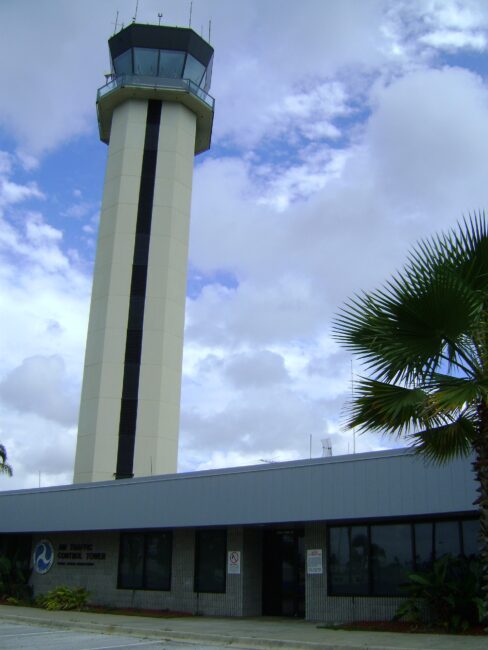
Air traffic control tower at St. Pete-Clearwater International Airport. Photo: Posller via Wikimedia Commons. Public domain.
Quick Answer
St. Pete-Clearwater International Airport (PIE) handled about 2.8 million passengers in 2025, a record and roughly 14% more than in 2024, against a terminal built for about 3 million. Pinellas County is building a roughly $60 million, 2,000-space garage and planning a terminal expansion, and a new Allegiant deal will bring the airport $22.8 million through 2031.
How Busy Is St. Pete-Clearwater International Airport?
St. Pete-Clearwater International Airport sits in mid-Pinellas County, across Old Tampa Bay from Tampa International. It is owned and operated by Pinellas County and is best known as a base for low-cost leisure flights, especially on Allegiant Air. Its growth has become one of the more important transportation stories on the Pinellas side of Tampa Bay.
The Business Observer reported in January 2026 that PIE handled about 2.8 million passengers in 2025, a record and a 14% increase over 2024. Spectrum News reported in February 2026 that the airport had record growth in three of the past four years, with 2024 dipping slightly because of Hurricanes Helene and Milton, and that passenger traffic rose almost 200% from 2014 to 2024.
PIE Passenger Traffic by Year
| Year | Passengers | Note |
|---|---|---|
| 2023 | Nearly 2.5 million | Up 2% from 2022, with six monthly records |
| 2024 | Roughly 2.45 million | Dipped slightly after Hurricanes Helene and Milton |
| 2025 | About 2.8 million | Record, up about 14% |
Sources: St. Pete Rising (2023); Business Observer and Spectrum News (2024-2025). The 2024 figure is estimated from the reported 14% increase.
What Is Driving the Growth?
The Business Observer reported that officials credit a wave of new flights and ongoing facility renovations for the 2025 record. Route growth has been a steady theme: St. Pete Rising reported in January 2024 that Allegiant was the airport’s leading airline and that its nonstop routes reached more than 65 cities, and Spectrum News counted 63 nonstop destinations in February 2026 after three new Allegiant routes were added. The mix of destinations changes over time as routes are added and dropped, but the airport’s role as a leisure gateway has stayed consistent.
How Close Is PIE to Its Capacity?
The airport’s interim leadership has said the current terminal can handle about 3 million passengers, according to WUSF’s November 2026 report on a presentation to the Florida Economic Club. At about 2.8 million passengers in 2025, PIE was operating at roughly 93% of that figure. The same report said a future terminal concept would eventually accommodate 4.5 million to 5 million passengers.
The terminal itself is old. WUSF’s report said the original airport was built in 1957, while Spectrum News put the current terminal’s construction at 1956. Either way, the building dates to the 1950s, and it is now handling close to its practical limit of about 3 million passengers a year.
When Is PIE Busiest?
The Visit St. Pete/Clearwater airport report for 2025 provides monthly passenger counts from June through December.
PIE Monthly Passengers, June-December 2025
| Month | Enplanements | Deplanements | Total passengers |
|---|---|---|---|
| June 2025 | 152,164 | 148,114 | 300,278 |
| July 2025 | 160,480 | 160,266 | 320,746 |
| August 2025 | 117,612 | 113,453 | 231,065 |
| September 2025 | 76,240 | 77,788 | 154,028 |
| October 2025 | 106,157 | 110,625 | 216,782 |
| November 2025 | 98,746 | 98,266 | 197,012 |
| December 2025 | 112,567 | 117,425 | 229,992 |
| June-December total | 823,966 | 825,937 | 1,649,903 |
Source: Visit St. Pete/Clearwater, Industry Reports: Airport Info, January-December 2025. Totals calculated by adding enplanements and deplanements.
July 2025 was the peak month shown, at 320,746 passengers, more than twice September’s 154,028. Spectrum News listed July, June and March as the airport’s busiest months. The seven months from June through December accounted for about 1.65 million passengers, roughly 59% of the 2025 total.
That seasonality is part of PIE’s capacity challenge. A terminal that is comfortable in September can be strained in July or during spring break, and the parking problems the airport has faced line up with those peaks.
How Does PIE Compare With Tampa International?
The same Visit St. Pete/Clearwater report also tracks Tampa International Airport. In July 2025, TPA handled 2,032,953 domestic passengers, compared with 320,746 at PIE, so PIE’s July volume was about 16% of TPA’s. In October 2025, TPA handled 1,833,030 domestic passengers and PIE handled 216,782, about 12%. In November 2025, the figures were 1,831,044 at TPA and 197,012 at PIE, about 11%.
The comparison shows that PIE’s share of Tampa Bay air traffic rises during peak leisure months. That fits PIE’s role as a low-fare leisure airport whose busiest periods are summer and spring break. For a full-year comparison, TPA’s own budget documents show about 12.26 million enplanements in its FY2025, while PIE’s roughly 2.8 million total passengers equate to about 1.4 million enplanements, so TPA boards roughly nine times as many passengers.
How Many Places Can You Fly From PIE?
Spectrum News reported in February 2026 that PIE had 63 nonstop destinations after Allegiant added service to Atlantic City, New Jersey; Trenton, New Jersey; and Huntsville, Alabama. Knoxville, Tennessee, and Asheville, North Carolina, were the airport’s two most popular routes.
Allegiant is PIE’s primary carrier. Sun Country also served the airport with a seasonal route to Minneapolis, according to Spectrum News, which reported at the time that Allegiant planned to acquire Sun Country, with the sale expected to close in the summer of 2026, and that PIE’s interim director expected Sun Country to shift its year-round service from Tampa International to PIE afterward.
Spectrum News also cited a Kayak ranking of PIE as the second-most affordable U.S. airport, with an average round-trip fare of $161.
What Does the New Allegiant Deal Mean for PIE?
In September 2026, Pinellas County commissioners unanimously approved a new five-year operating agreement with Allegiant Air running through September 2031, according to reporting by St. Pete Catalyst published by WUSF.
Allegiant-PIE Agreement Highlights
| Term | Detail |
|---|---|
| Length | Five years, through September 2031 |
| Expected revenue to PIE | $22.8 million through 2031 |
| Increase over prior agreement | About $8.6 million, or 60.6% |
| Landing fee | $1.43 per 1,000 pounds in FY2027, rising to $1.48 by FY2031 |
| Office and baggage space lease | About 3,700 square feet, just under $90,000 a year |
| Terminal fees | Based on annual departures, lower per flight for higher-volume carriers |
| New route incentives | Waived landing fees and co-op marketing for up to two years on qualifying routes |
Source: St. Pete Catalyst via WUSF, September 15, 2026.
The landing fee schedule rises about 3.5% over the full term, from $1.43 to $1.48 per 1,000 pounds of aircraft weight. The bigger driver of the 60.6% revenue increase is the combination of new rates and the volume of flying Allegiant is projected to do at PIE over the five years, according to the report.
The agreement covers gates, baggage areas, aircraft parking, boarding bridges and other facilities. Allegiant gets exclusive use of certain leased spaces, while gates and common areas remain under airport control.
The deal’s size relative to the airport’s budget is notable. WUSF reported that the proposed FY2027 budget had initially included about $3.39 million in airline service charge revenue, and that county budget officials planned to update that figure to reflect the new agreement because the change was too large to be fully captured in the original proposal.
Why Does Allegiant Matter So Much?
WUSF reported that PIE planned a November 16, 2026, event marking 20 years of its partnership with Allegiant. The airline’s route network is the backbone of PIE’s schedule, and the new agreement locks in that relationship through 2031 while raising what the airline pays to use the airport.
What Is PIE Building?
PIE’s capital plans have evolved as traffic has grown.
PIE Parking Garage and Terminal Plans Over Time
| Date reported | Project | Details |
|---|---|---|
| January 2024 | Terminal expansion | $110 million plan to consolidate security, add a boarding level and gates; completion then expected in 2027 |
| January 2024 | Parking garage | About 1,000 spaces, possibly more than $35 million |
| February 2026 | Parking garage | Four stories, 2,000 spaces, $60 million, then expected to open late 2027 |
| 2026 | Terminal project | Rescoped earlier in 2026 |
| November 2026 | Parking garage | More than 2,000 spaces, about $60 million, construction expected January 2027 to spring 2028 |
| November 2026 | Terminal, first phase | About 40,000 square feet with four jet bridges |
Sources: St. Pete Rising (January 2024); Spectrum News (February 2026); WUSF (September and November 2026).
The garage plan roughly doubled in size between 2024 and 2026, from about 1,000 spaces to more than 2,000, and the expected cost rose from more than $35 million to about $60 million. WUSF reported that PIE reached parking capacity during the July 4, 2025, holiday, and that the garage will be built on the airport’s Strawberry parking lot. Plans also include a new roundabout and signage to improve traffic flow around the terminal.
What Is the Long-Term Plan?
According to WUSF’s November 2026 report, the airport’s near-term priorities include fixing operational inefficiencies, updating seating and wayfinding signs, and upgrading roofing and lighting systems. Longer term, PIE plans to study new taxiways and develop conceptual terminal designs. The interim director said the airport would keep the existing building if possible and replace it if not.
What About the Airport’s Land?
PIE covers about 2,000 acres, about 1,000 of which are used for operations, WUSF reported. The roughly 128-acre Airco site, a former golf course, would include about 32 acres for aviation use, with part of the rest available for non-aviation tenants such as business parks and hotels. A roughly 10-acre former Turtle Club site is still under review.
What Key Dates Are Ahead?
| Date | Milestone |
|---|---|
| November 16, 2026 | Event marking 20 years of the Allegiant partnership |
| January 2027 | Expected start of parking garage construction |
| FY2027 | New Allegiant landing fee of $1.43 per 1,000 pounds takes effect |
| Spring 2028 | Expected completion of the parking garage |
| FY2031 | Allegiant landing fee reaches $1.48 per 1,000 pounds |
| September 2031 | Current Allegiant agreement expires |
Sources: WUSF (September and November 2026).
How Is PIE Funded?
WUSF reported that Pinellas County owns and operates the airport but provides no tax dollars to it. PIE is self-funded through user fees, airline charges, lease revenue and concessions, along with federal and state grants, and projects are fully funded before work begins.
That model makes agreements like the new Allegiant deal especially important. Airline fees, parking revenue and concessions are what pay for the garage, the terminal work and day-to-day operations.
What Does This Mean for Pinellas Businesses?
PIE’s growth has several implications for businesses on the Pinellas side of Tampa Bay:
- Visitor access. About 2.8 million passengers a year, many of them leisure travelers, feed hotels, restaurants and attractions in Pinellas County.
- Construction work. A $60 million garage starting in 2027 and a planned terminal expansion create opportunities for contractors and suppliers.
- Development land. The Airco site could add business parks and hotels near the airport.
- Capacity limits. Operating near 3 million passengers means growth will depend on how fast new parking and terminal space come online.
- Airline concentration. Allegiant’s central role brings stability through 2031 but also ties PIE’s traffic to one carrier’s plans.
The practical takeaway for Pinellas employers and property owners is timing. The garage is not expected to be finished until spring 2028, and the terminal expansion is still in planning, so the airport will have to manage peak-season crowding for at least the next two summers. Businesses that serve air travelers, from car services to hotels near the airport, should plan around those constraints.
Frequently Asked Questions
How many passengers used PIE in 2025?
About 2.8 million, a record and roughly 14% more than in 2024, according to the Business Observer.
How many nonstop destinations does PIE serve?
Spectrum News reported 63 nonstop destinations as of February 2026, mostly on Allegiant.
When will the new PIE parking garage open?
WUSF reported in November 2026 that construction of the roughly $60 million, 2,000-plus-space garage is expected to start in January 2027 and finish by spring 2028.
How much will Allegiant pay PIE under its new deal?
The five-year agreement is expected to bring $22.8 million through 2031, about $8.6 million more than the prior agreement.
What are PIE’s busiest months?
Spectrum News listed July, June and March as the busiest. July 2025 was the peak month in Visit St. Pete/Clearwater’s data, with 320,746 passengers.
Does Pinellas County fund the airport with taxes?
No. WUSF reported that the airport is self-funded through fees, leases and concessions, plus federal and state grants.
Sources and Further Reading
- St. Pete-Clearwater International Airport Director Lays Out Expansion, Improvements Plan, St. Pete Catalyst via WUSF
- Allegiant Deal Brings a 61% Revenue Boost to Pinellas Airport, St. Pete Catalyst via WUSF
- St. Pete-Clearwater Airport Routes, Spectrum News
- Pinellas Airport, With Record Passenger Count, to Build Four-Story Garage, Business Observer
- Industry Reports: Airport Info, January-December 2025, Visit St. Pete/Clearwater
- St. Pete-Clearwater Airport Embarks on $110M Terminal Expansion Amid Stellar Growth, St. Pete Rising