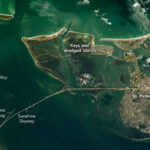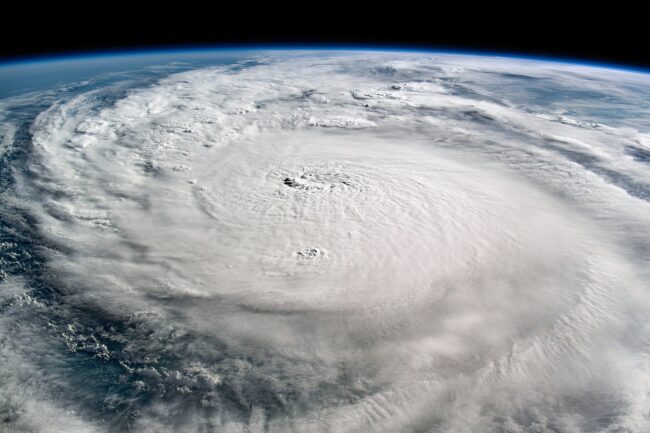
Hurricane Milton over the Gulf of Mexico on Oct. 8, 2024, photographed from the International Space Station. Source: NASA via Wikimedia Commons. License: Public domain.
Quick Answer: St. Petersburg-based American Coastal Insurance Corp. (Nasdaq: ACIC) earned $19.4 million, or $0.40 per diluted share, in the third quarter of 2026, down 40.3% from a year earlier as net pricing on its Florida condominium book fell 25.6%. Its net combined ratio rose to 64.7% from 56.9%, while gross premiums written grew 3.2% to $74.1 million, the first year-over-year increase since early 2025.
American Coastal Insurance Corporation, the St. Petersburg-headquartered holding company for commercial residential property insurer American Coastal Insurance Company, reported third-quarter 2026 results on Oct. 29, 2026, and filed its quarterly report on Form 10-Q with the U.S. Securities and Exchange Commission shortly afterward. The numbers show a Pinellas County insurer that remains solidly profitable but is absorbing a sharp drop in pricing as Florida’s property insurance market softens after several years of tight capacity and steep rate increases.
What does American Coastal Insurance do?
American Coastal Insurance Company, known as AmCoastal, was founded in 2007 to insure condominium and homeowner association properties, according to the company’s earnings release. Its 10-Q describes its primary product as commercial residential property insurance in Florida, reported as a single business segment. The core Florida admitted book, which includes condominium associations, apartment buildings and assisted living facilities, is sourced and underwritten through AmRisc, LLC, a catastrophe-focused managing general agent, according to Insurance Business coverage of the quarter.
Subsidiaries listed in the 10-Q include Skyway Underwriters, LLC, a managing general agent; Shoreline Re, which provides reinsurance protection; and the newly licensed ACES Specialty Insurance Company, an excess and surplus (E&S) lines carrier.
Company snapshot
| Item | Detail |
|---|---|
| Company | American Coastal Insurance Corporation (Nasdaq: ACIC) |
| Headquarters | St. Petersburg, Florida |
| Operating carrier | American Coastal Insurance Company (AmCoastal), founded in 2007 to insure condominium and homeowner association properties |
| Primary product | Commercial residential property insurance in Florida (one reportable segment) |
| President and CEO | B. Bradford Martz |
| Direct policies in force (Sept. 30, 2026) | 4,628, up 6.6% from 4,343 a year earlier |
| Estimated total insured value | $78 billion |
| Common stockholders’ equity | $355.7 million |
| Book value per share | $7.52, up 15.5% from $6.51 at Dec. 31, 2025 |
How much did American Coastal earn in Q3 2026?
Net income for the quarter ended Sept. 30, 2026, was $19.4 million, or $0.40 per diluted share, compared with $32.5 million, or $0.65 per diluted share, in the third quarter of 2025. Core income, a non-GAAP measure the company uses that excludes items such as unrealized gains and losses on equity securities, was $20.4 million, or $0.42 per diluted share, down from $30.5 million, or $0.61 per diluted share.
Total revenue fell 21.8% to $70.7 million. The largest driver was a 19.0% decline in net premiums earned, to $65.5 million. Net investment income slipped to $5.9 million from $6.4 million. The company reported a GAAP return on equity of 22.9% for the quarter and a core return on equity of 24.1%, compared with 47.5% and 44.5%, respectively, in the prior-year quarter.
| Metric | Q3 2026 | Q3 2025 | Change |
|---|---|---|---|
| Gross premiums written | $74.1M | $71.8M | +3.2% |
| Gross premiums earned | $138.5M | $162.8M | -14.9% |
| Net premiums earned | $65.5M | $80.8M | -19.0% |
| Net investment income | $5.9M | $6.4M | -8.3% |
| Total revenue | $70.7M | $90.4M | -21.8% |
| Losses and loss adjustment expenses | $8.0M | $9.2M | -13.0% |
| General and administrative expenses | $9.5M | $11.3M | -15.9% |
| Net income | $19.4M | $32.5M | -40.3% |
| Diluted EPS | $0.40 | $0.65 | -38.5% |
| Core income (non-GAAP) | $20.4M | $30.5M | -33.1% |
| Core income per diluted share | $0.42 | $0.61 | -31.1% |
How did the first nine months of 2026 compare?
Through nine months, net income totaled $60.5 million, or $1.23 per diluted share, down 24.6% from $80.3 million, or $1.61 per diluted share, in the same period of 2025.
| Metric | 9M 2026 | 9M 2025 | Change |
|---|---|---|---|
| Gross premiums written | $439.8M | $498.0M | -11.7% |
| Gross premiums earned | $418.3M | $490.3M | -14.7% |
| Net premiums earned | $200.8M | $227.5M | -11.8% |
| Net income | $60.5M | $80.3M | -24.6% |
| Diluted EPS | $1.23 | $1.61 | -23.6% |
| Core income per diluted share | $1.14 | $1.57 | -27.4% |
| GAAP return on equity | 23.9% | 39.1% | -15.2 pts |
Why did premiums fall even as policy count grew?
The central story of the quarter is pricing. According to the 10-Q, net pricing decreased 25.6% year over year in a market the company said “continued to soften.” The filing attributes the 14.9% decline in gross premiums earned, to $138.5 million, partly to that pricing decrease.
At the same time, the company is holding on to and adding accounts. Direct policies in force stood at 4,628 at Sept. 30, 2026, up 6.6% from 4,343 a year earlier, a count that excludes assumed E&S business. New and renewal policies written totaled 748 in the third quarter, up from 578, and 3,590 over nine months, up from 3,306.
Gross premiums written rose 3.2%, or $2.3 million, to $74.1 million. In the release, Chief Executive B. Bradford Martz said the company “returned to year-over-year growth in gross premiums written for the first time since early 2025.” Part of that support came from a new revenue stream: the company’s participation in AmRisc’s nationwide E&S commercial property portfolio added $37.3 million of premium through the first nine months, according to the release.
What was American Coastal’s combined ratio?
The net combined ratio, which compares losses and expenses with net premiums earned, rose to 64.7% in the third quarter from 56.9% a year earlier. A ratio below 100% indicates an underwriting profit. For nine months, the ratio was 68.5%, compared with 60.6%.
The increase came mostly from the expense side. The net expense ratio climbed to 52.5% from 45.5% because fixed and semi-fixed costs were spread over a smaller base of net earned premium. Dollar costs actually declined, with general and administrative expenses down 15.9%, mainly from lower software amortization.
Losses remained light. Losses and loss adjustment expenses were $8.0 million, down 13.0%, for a net loss ratio of 12.2%. The quarter included $3.1 million of catastrophe losses from eight events (4.7 points), offset by $5.5 million of favorable prior-year reserve development, which reduced it by 8.4 points. Excluding both, the underlying combined ratio was 68.4%, compared with 57.8% a year earlier.
| Ratio | Q3 2026 | Q3 2025 | 9M 2026 | 9M 2025 |
|---|---|---|---|---|
| Net loss ratio | 12.2% | 11.4% | 18.5% | 15.9% |
| Net expense ratio | 52.5% | 45.5% | 50.0% | 44.7% |
| Net combined ratio | 64.7% | 56.9% | 68.5% | 60.6% |
| Current-year catastrophe losses (effect) | 4.7 pts | 0.5 pts | 3.1 pts | 0.2 pts |
| Prior-year favorable development (effect) | -8.4 pts | -1.4 pts | -3.2 pts | -2.0 pts |
| Underlying combined ratio | 68.4% | 57.8% | 68.6% | 62.4% |
How does American Coastal’s reinsurance program work?
Reinsurance, the insurance that insurers buy to cap their own catastrophe exposure, is the largest cost line for a Florida coastal property carrier. American Coastal ceded 52.8% of gross earned premium to reinsurers in the third quarter, up from 50.3% a year earlier. The release said the ceding ratio rose because the company bought additional catastrophe reinsurance in 2026 to raise its exhaustion point, the level at which protection runs out. Ceded premiums earned nonetheless fell 10.9% to $73.0 million, which the 10-Q linked to softening market conditions.
The 10-Q describes a core catastrophe program covering all perils for the June 1 to May 31 treaty year, with an estimated total insured value of $78 billion behind it.
| Layer or contract | Key terms disclosed |
|---|---|
| Core catastrophe program (June 1 to May 31) | Exhaustion point of about $1.68 billion for a first occurrence and $1.918 billion in the aggregate |
| GAAP retention | $23.5M first event, $25.0M second event, $2.0M third event (based on three $100M events) |
| Modeled return period | About 1-in-286 years (AIR model, $78B insured value); roughly 0.4% probability a single event exceeds protection |
| All other perils excess of loss | Up to $95.6M first event and $170.4M aggregate; about 1-in-227 years |
| Aggregate cover (from Jan. 1, 2026) | $40M aggregate limit, $20M per-occurrence cap, after a $40M annual aggregate deductible |
| Shoreline Re quota share | 45% of catastrophe perils and attritional losses, June 1, 2026 to May 31, 2027 |
| External quota share | 15% for Florida, June 1, 2026 to May 31, 2028 (cut from 20% effective June 1, 2025) |
How did the 2026 hurricane season affect results?
The third quarter was quiet for the company. The 10-Q states that no named or numbered storms were recorded in its 2026 results through Sept. 30, and that reserves declined in part because of the absence of named or numbered storm events. Nine-month catastrophe losses were $6.3 million across 11 events, adding 3.1 points to the combined ratio.
The broader season tracked NOAA’s below-normal forecast. In its Aug. 6, 2026, outlook update, NOAA projected 7 to 13 named storms, 2 to 6 hurricanes and 0 to 2 major hurricanes, citing an El Niño that emerged in June and increased wind shear. A typical season produces 14 named storms, 7 hurricanes and 3 major hurricanes. The National Hurricane Center’s season summary as of Oct. 28 listed 10 named Atlantic storms, nine of which did not reach hurricane strength, with Isaias as the season’s only hurricane and a major hurricane.
Isaias made landfall near Destin on Oct. 9, 2026, as a Category 2 storm with 105 mph maximum sustained winds, according to the Florida Governor’s Office. The storm arrived after the quarter closed, and neither the earnings release nor the 10-Q quantifies any related losses. The Atlantic season officially ends Nov. 30.
What is American Coastal doing in excess and surplus lines?
The company is building a second leg beyond its Florida admitted condominium book. During the third quarter, it restructured its AmRisc agreement, which the release said put the partnership “on a permanent footing.” According to Insurance Business, the change removed a fixed January 2029 expiration, replaced it with automatic one-year renewals, and requires 48 months’ written notice to terminate. The same report said a quota share giving the company a 6% participation in AmRisc’s nationwide E&S commercial property book began in March 2026.
ACES Specialty Insurance Company, an Arizona-domiciled subsidiary, received its certificate of authority effective Oct. 7, 2026, after the company contributed $15 million of capital to it on Oct. 1, according to the 10-Q. The release said the company expects to begin writing E&S commercial property through Skyway in Florida, Texas and South Carolina. Insurance Business reported a target start on or about Dec. 1, initially using a fronting carrier partner.
How strong is American Coastal’s balance sheet?
Book value per share rose to $7.52 at Sept. 30, 2026, from $6.51 at year-end 2025, a 15.5% increase, and from $6.71 a year earlier. Common stockholders’ equity was $355.7 million. Cash, cash equivalents, restricted cash and investments totaled $707.9 million, up from $647.7 million.
Unpaid losses fell to $95.2 million from $165.7 million as claims were settled. AmCoastal’s statutory surplus declined to $272.5 million from $316.6 million after the carrier paid the holding company $87 million in dividends during the nine months, compared with $23 million in the 2025 period.
What about debt, buybacks and dividends?
The company’s $150 million of senior notes mature Dec. 15, 2027. Their interest rate fell to 6.25% from 7.25% effective Dec. 16, 2025, after issuer and debt ratings were upgraded from BB+ to BBB-, according to the 10-Q.
The board added a $25 million share repurchase authorization in August 2026 to the original $25 million authorized in July 2019. Cumulatively, the company has repurchased 1,804,726 shares for $19.4 million, leaving $30.6 million available. No shares were repurchased in the third quarter. The board declared no common stock dividends during the first nine months of 2026.
What does this mean for Tampa Bay’s insurance sector?
American Coastal is one of the most visible insurance holding companies headquartered in Pinellas County, and its results offer a window into how Florida’s condominium and commercial residential insurance market is shifting. The data in its filings point to more competition and capacity returning to the market: pricing down 25.6%, reinsurance costs falling in dollar terms even as the company buys more protection, and policy counts rising even as premium per account declines.
The company’s next quarterly report will reflect the fourth quarter, which includes Isaias’s Oct. 9 landfall and the scheduled launch of ACES.
Frequently Asked Questions
What was American Coastal’s Q3 2026 net income?
Net income was $19.4 million, or $0.40 per diluted share, down 40.3% from $32.5 million, or $0.65 per diluted share, in the third quarter of 2025.
What was the combined ratio in Q3 2026?
The net combined ratio was 64.7%, up from 56.9%. The underlying combined ratio, excluding catastrophe losses and prior-year reserve development, was 68.4%.
Why are American Coastal’s premiums declining?
The company reported that net pricing fell 25.6% year over year in a softening Florida market, which reduced gross premiums earned by 14.9% even as direct policies in force grew 6.6%.
How much reinsurance protection does American Coastal have?
Its core catastrophe program provides coverage up to about $1.68 billion for a first occurrence and $1.918 billion in the aggregate, which the company models as roughly a 1-in-286-year event.
What is ACES Specialty Insurance Company?
ACES is an Arizona-domiciled subsidiary that received its certificate of authority effective Oct. 7, 2026. The company plans to use it for E&S commercial property in Florida, Texas and South Carolina.
Sources and Further Reading
- American Coastal Insurance Corporation Reports Financial Results for its Third Quarter Ended September 30, 2026 (Exhibit 99.1 to Form 8-K), American Coastal Insurance Corporation via U.S. Securities and Exchange Commission
- Form 10-Q for the Quarterly Period Ended September 30, 2026, American Coastal Insurance Corporation via U.S. Securities and Exchange Commission
- NOAA maintains prediction for below-normal Atlantic hurricane season, National Oceanic and Atmospheric Administration
- 2026 Atlantic Hurricane Season Tropical Cyclone Reports, National Hurricane Center
- Governor Ron DeSantis Issues Updates on State Response and Recovery Efforts, Executive Office of the Governor of Florida
- ACIC locks in AmRisc deal and readies E&S carrier amid Florida rate falls, Insurance Business
- American Coastal’s GWP rises to $74.1m in Q3’26, Reinsurance News