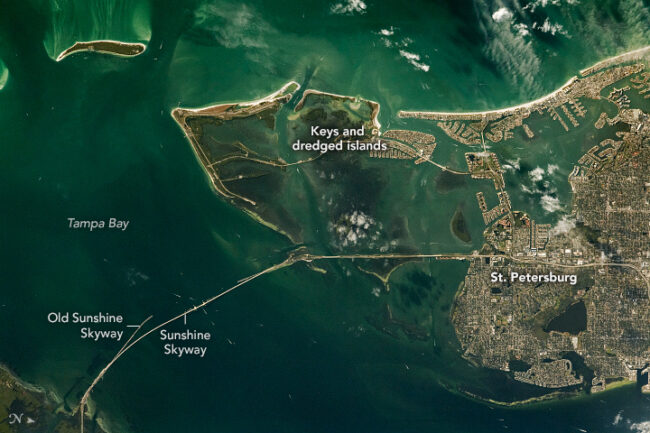
Tampa Bay and its bridges, including the Sunshine Skyway, photographed from the International Space Station on Jan. 23, 2021. Source: NASA astronaut photograph ISS064-E-26355, public domain.
Quick Answer: Pinellas County adopted its Fiscal Year 2027 budget on Sept. 24, 2026, cutting the countywide General Fund property tax rate to 4.4989 mills, the lowest since 1989, on a proposed $5.137 billion all-funds plan. To close a structural gap of more than $30 million, the county cut departments, eliminated dozens of positions and raised beach parking fees, while Amendment 3 threatens revenue starting in FY28.
Pinellas County began its 2027 fiscal year on Oct. 1 with a lower property tax rate and a smaller workforce, after a budget season county officials described as one of hard tradeoffs. The Board of County Commissioners adopted the final budget and tax rates at its second public hearing on Thursday, Sept. 24, 2026. Commission Chair Dave Eggers said in the county’s announcement that the board “took a hard look at every area of County government” to cut costs.
For businesses in St. Petersburg, Clearwater and across the county, the budget affects commercial property tax bills, the roads, stormwater systems and beaches that support local commerce, and the county’s finances as statewide property tax changes take effect.
How big is the Pinellas County FY2027 budget?
The FY2027 proposed budget that County Administrator Barry Burton presented to commissioners on Aug. 11, 2026, totaled $5.137 billion across all funds. The General Fund, which pays for most day-to-day county services, was $1.125 billion, up 1.2% from $1.112 billion in the FY2026 adopted budget. The capital budget, including reserves, was $1.094 billion.
The county’s Sept. 24 adoption announcement did not give a final all-funds total. Commissioners adjusted the plan between August and the final vote, including a $6.026 million cut in countywide property taxes at the Sept. 10 tentative hearing, so the adopted figures may differ slightly from the proposal. St. Pete Catalyst reported the FY2026 budget totaled about $4.8 billion.
Where does the General Fund money go?
Public safety is the largest piece. St. Pete Catalyst reported that the Sheriff’s Office accounts for more than $501 million, or about 45% of the General Fund. The county’s transmittal letter says the Sheriff’s budget still rises about $22.5 million, or 4.7%, even after the Sheriff cut $7.306 million from the original request.
| FY2027 budget item | Amount | Note |
|---|---|---|
| Total, all funds (proposed) | $5.137 billion | FY2026 adopted: about $4.8 billion |
| General Fund (proposed) | $1.125 billion | Up 1.2% from $1.112 billion |
| Capital budget incl. reserves | $1.094 billion | Proposed |
| Sheriff’s Office | More than $501 million | About 45% of General Fund; up 4.7% |
| General Fund reserves | $169.771 million | 17.9% of revenues (proposed) |
| Countywide millage (adopted) | 4.4989 mills | Down from 4.5423 mills |
What is the Pinellas County property tax rate for FY2027?
The adopted countywide General Fund rate is 4.4989 mills, or about $4.50 for every $1,000 of taxable value. That is down from 4.5423 mills in FY2026, a cut of 0.0434 mills, or just under 1%. The county says the new rate is the lowest since 1989, less than 1% above the full rollback rate, and the fifth reduction of the primary countywide rate in six years.
The rate was not always headed down. Burton’s August proposal kept the rate flat at 4.5423 mills, and in July commissioners set maximum rates that kept the countywide rate and 20 other county rates unchanged, with only the Seminole Fire District going up, from 1.8000 to 1.9581 mills, according to St. Pete Catalyst. At the Sept. 10 tentative hearing, commissioners cut countywide property taxes by $6.026 million from the proposal. The county said the savings came from keeping reserves flat, adjusting parking fees and other efficiencies.
Will a lower rate mean a lower tax bill?
Not necessarily. The rollback rate would bring in the same property tax revenue as last year, not counting new construction. Because the adopted rate is just under 1% above rollback, the county will collect slightly more from existing property. Individual bills depend on assessed value. The county’s share is less than one-third of the average bill.
Why did Pinellas County face a budget shortfall?
The transmittal letter describes a General Fund structural deficit that started at more than $18 million and grew to more than $30 million. St. Pete Catalyst attributed the gap to unfunded state mandates, lower sales tax revenue and inflation. Countywide property tax revenue was projected to rise by $26.526 million, but that growth was outpaced by required costs, including:
- Medicaid: $14.460 million, up from $13.812 million
- Florida Retirement System: a $4.859 million increase, including $4.581 million for a new cost-of-living adjustment for Sheriff’s first responders
- Tax Collector fees tied to the School Board: $19.042 million, including a new $3.031 million mandate
Sales tax was a second problem. The transmittal letter says state sales tax revenue fell by $6.619 million and that Penny for Pinellas projections were reduced because of a change in state law affecting sales tax on commercial rent.
What did the county cut to balance the budget?
Every department under the county administrator had to cut, for a total of more than $16 million (the proposal listed $16.292 million and 34.8 General Fund positions). The adopted budget’s reductions included:
- $3.1 million and five positions in Business Technology Services
- $7 million from the Sheriff’s original request, including 10 vacant positions
- $297,000 from the Clerk’s Office
- $1.5 million in transportation infrastructure funding for roads, bridges and sidewalks
- More than $1 million in human services, including homelessness and sexual assault victim services
- Higher parking rates at three beach parks and boat ramps, expected to raise about $3 million a year
The proposal would have replaced the $6 daily beach park parking charge with a $3.50 hourly rate. WUSF reported that commissioners discussed a $15 daily cap on the hourly rate. After public objections, the board kept funding Weedon Island Preserve and Shell Key Preserve for one year instead of returning them to the state. The proposal also included a 3% raise for county employees.
How big are Pinellas County’s reserves?
The proposed budget put General Fund reserves at $169.771 million, or 17.9% of revenues. The transmittal letter says these are “not excess funds.” It describes them as a cushion for emergencies, revenue swings and a future bond payment of about $25 million a year for a planned county campus on Icot Boulevard.
Reserves were also part of how the board reached the lower rate. The county said the $6.026 million tax reduction at the tentative hearing came partly from keeping reserves flat rather than adding to them.
How does Penny for Pinellas fit into the capital budget?
Penny for Pinellas is a voter-approved, one-cent local sales tax that pays for infrastructure. It sits alongside the $1.094 billion capital budget and the six-year FY2027-2032 Capital Improvement Plan. The county’s adoption announcement says the capital plan gives priority to life-safety projects, projects that extend the life of existing assets, and projects with dedicated or outside funding.
Recent county approvals show how Penny dollars are being used:
- Palm Harbor recreation center and shelter: On April 7, 2026, commissioners approved a $14.5 million Penny-funded contract for a two-story, 28,000-square-foot recreation center on the 16th Street campus. The building will double as an 800-person hurricane shelter in north county, according to St. Pete Catalyst.
- Skyway Flats affordable housing: In spring 2026, the county considered committing up to $6 million in Penny revenue for land at 3600 34th St. S. in St. Petersburg. The site is for Skyway Flats, a 174-unit affordable housing project with an estimated total cost of about $76.8 million, according to Tampa Bay Business & Wealth.
Why is Penny revenue under pressure?
Under House Bill 7031, Florida repealed its sales tax on commercial rent effective Oct. 1, 2025. According to EY’s tax alert, the repeal also ended local discretionary surtaxes on commercial leases, which include the Penny. Office, retail, warehouse and self-storage tenants no longer pay that tax, which saves businesses money. The tradeoff is that less money flows into the Penny for Pinellas fund, and the county lowered its Penny projections to match.
| Capital or revenue item | Amount | Funding |
|---|---|---|
| Palm Harbor rec center and shelter | $14.5 million | Penny for Pinellas |
| Skyway Flats land (174 units) | Up to $6 million | Penny for Pinellas |
| Sand Key nourishment agreement | $54.5 million | $27.3M state, $27.3M tourist tax |
| State sales tax revenue change | -$6.619 million | General Fund |
| Planned Icot campus bond payment | About $25 million a year | Future debt service |
What about beaches and hurricane recovery?
The county says the adopted budget keeps funding for beach nourishment, coastal management, surface water improvements and hurricane readiness. It also continues the federally funded Pinellas Recovers program for residents hit by Hurricanes Debby, Helene and Milton. On Aug. 11, 2026, commissioners approved a $54.5 million agreement with the Florida Department of Environmental Protection to reimburse Sand Key beach and dune work completed in 2025. WUSF reported that the state and the county’s tourist development tax each cover $27.3 million.
What does Amendment 3 mean for future Pinellas budgets?
On Nov. 3, 2026, Florida voters approved Amendment 3 with more than 60% of the vote, according to FOX 13. For non-school taxes, the amendment raises the homestead exemption to $150,000 on Jan. 1, 2027, and to $250,000 on Jan. 1, 2028, with inflation adjustments beginning in 2029. It also lowers the annual cap on assessment increases for non-homestead property, including commercial sites, second homes and rental housing, from 10% to 5% starting Jan. 1, 2027.
The FY2027 budget was written before the vote. The county’s transmittal letter warned that the measure “could materially reduce recurring revenues beginning in FY28 and intensifying in FY29.” The county has not published a dollar estimate in the sources reviewed for this article. St. Petersburg estimated that Amendment 3 could cut its own General Fund revenue by about $33 million in fiscal 2028, according to WUSF.
What does the FY2027 budget mean for Pinellas businesses?
Property taxes: Commercial property owners get a slightly lower county rate this year. Starting in 2027, the 5% cap on non-homestead assessment increases will limit how fast their taxable values can rise, though the rate itself can still change.
Service levels: Transportation infrastructure lost $1.5 million, and the county is making cuts across departments. Business owners who depend on county permitting, roads and parks will be working with a smaller county staff. The transmittal letter listed 3.5 proposed position cuts in Building and Development Review.
Tourism: Beach parking is more expensive. Tourist tax collections were on a record pace, nearly $79.8 million through June, according to WUSF.
Brian’s Take
The headline is a tax cut, but I think the more important story is in the transmittal letter. The county closed a deficit of more than $30 million by cutting departments, eliminating positions, raising parking fees and using health insurance reserves, and then cut the rate a little more on top of that. A 0.0434-mill reduction is real, but it is small. Meanwhile, roughly $170 million in General Fund reserves is already earmarked against emergencies, revenue swings and a planned $25 million-a-year campus bond payment.
What I’d watch is FY2028. The county itself warned that Amendment 3 could materially reduce recurring revenue starting next year. Commercial owners get the benefit of a 5% assessment cap, but county services still have to be paid for, and the ways to fill a gap are user fees, service cuts, or pressure on the few revenue sources that are still growing, like the tourist tax. Business owners in Pinellas should treat next summer’s budget hearings as a key event for planning their own costs.
Frequently Asked Questions
When was the Pinellas County FY2027 budget adopted?
The Board of County Commissioners adopted the final budget and tax rates on Sept. 24, 2026, after a tentative vote on Sept. 10. The fiscal year began Oct. 1, 2026.
What is the Pinellas County millage rate for FY2027?
The countywide General Fund rate is 4.4989 mills, down from 4.5423 mills. The county says it is the lowest since 1989.
How much is the Pinellas County budget?
The proposed FY2027 budget was $5.137 billion across all funds, with a $1.125 billion General Fund and a $1.094 billion capital budget including reserves. The county’s adoption announcement did not give a final total.
How much does Pinellas County hold in reserves?
The proposed budget put General Fund reserves at $169.771 million, or 17.9% of revenues. The county says the money is set aside for emergencies, revenue swings and future debt payments.
How will Amendment 3 affect Pinellas County?
The county warned it could materially reduce recurring revenue starting in FY2028, with a larger effect in FY2029, through bigger homestead exemptions and a 5% cap on non-homestead assessment increases.
Sources and Further Reading
- BCC adopts FY27 budget after months of difficult choices — Pinellas County Government
- BCC lowers property tax rate in the first of two votes to approve budget — Pinellas County Government
- Transmittal Letter, FY27 Proposed Budget — Pinellas County Office of Management and Budget
- County commissioners discuss fiscal year 2027 budget — St. Pete Catalyst
- Pinellas launches budget process amid tax uncertainty — St. Pete Catalyst
- Commissioners approve county’s fiscal year budget (FY2026) — St. Pete Catalyst
- Could booming tourism help ease Pinellas County’s budget squeeze? — WUSF
- Pinellas County approves $54.5 million Sand Key beach nourishment agreement — WUSF
- Florida Amendment 3: Voters pass historic property tax caps — FOX 13 Tampa Bay
- Florida repeals sales tax on commercial rentals, makes other sales tax changes — EY Tax News
- Pinellas approves Palm Harbor rec center project — St. Pete Catalyst
- Pinellas County $6M land purchase tied to $76M housing project — Tampa Bay Business & Wealth