By Brian French | October 6, 2026
Quick Answer
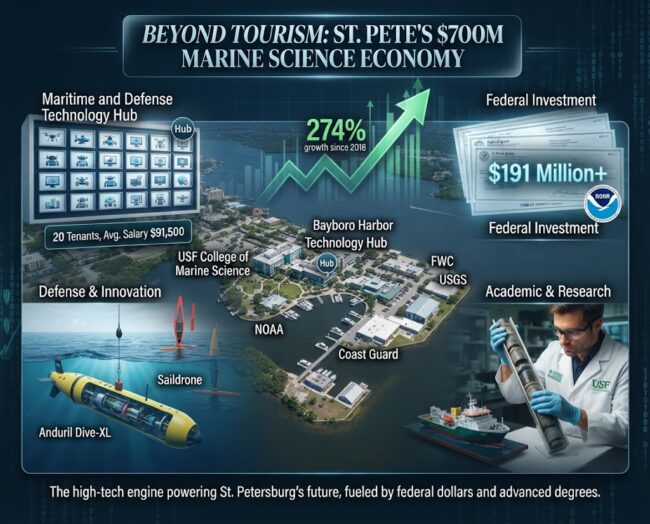
Beyond tourism, St. Petersburg’s largest economic sectors are financial services, health care, specialized manufacturing, technology, and marine science. The marine science cluster around Bayboro Harbor employs about 2,000 people, contributes roughly $700 million a year, and reports more than $191 million in grants received.
The Economy Visitors Never See
Ask most people about St. Petersburg’s economy and they will mention beaches, museums, and baseball. But a mile south of downtown, along Bayboro Harbor, sits one of the largest concentrations of marine science in the United States, and a growing number of defense and ocean technology companies are building businesses around it.
This “blue economy” does not show up in hotel occupancy reports. It shows up in federal research grants, defense contracts, and six-figure salaries.
St. Petersburg’s Major Economic Sectors
| Sector | Notable St. Pete Employers |
|---|---|
| Financial services | Raymond James, Dynasty Financial Partners, ARK Invest, FIS, Webull |
| Health care | Johns Hopkins All Children’s, Orlando Health Bayfront, HCA Florida St. Petersburg |
| Specialized manufacturing | Jabil |
| Construction and engineering | Power Design |
| Marine science and ocean tech | USF College of Marine Science, NOAA, USGS, FWC, Hub tenants |
The City’s 2026 State of the Economy named ARK Invest, Dynasty Financial Partners, FIS Management Services, HCA Florida St. Petersburg Hospital, Jabil, Johns Hopkins All Children’s Hospital, Orlando Health Bayfront Hospital, Power Design, Raymond James, and Webull among its major employers.
Marine science is smaller in headcount than finance or health care, but it is St. Pete’s most distinctive cluster and among its fastest growing.
The Marine Science Cluster by the Numbers
| Metric | Figure |
|---|---|
| Marine science employees | About 2,000 |
| Annual economic contribution | $700 million |
| Disclosed research spending | $812 million+ |
| Grants received | $191 million+ |
| Growth in economic contribution since 2018 | 274% |
Sources: St. Petersburg Innovation District.
The Innovation District reports that marine science now adds $700 million to the economy, an increase of 274% since 2018. Over its first ten years, the broader Innovation District has generated more than $3 billion in economic impact and supported more than 10,000 jobs.
Zoom out to the region and the numbers grow. A NOAA study found Tampa Bay’s marine economy generated $8.7 billion in GDP in 2021.
Who Anchors the Bayboro Harbor Cluster
The cluster combines academic, state, and federal research institutions within walking distance of one another:
- USF College of Marine Science: The anchor institution, with 32 core faculty, about 90 graduate students, and $15 million in annual research expenditures.
- Florida Fish and Wildlife Research Institute (FWC)
- Florida Institute of Oceanography, which operates three research vessels and a 4-kilometer-depth-rated remotely operated vehicle.
- NOAA National Marine Fisheries Service Southeast Regional Office
- USGS St. Petersburg Coastal and Marine Science Center
- U.S. Coast Guard, Tampa Bay Estuary Program, and Eckerd College’s marine science program
USF says together these institutions comprise one of the largest marine science research complexes in the country.
The Private Sector Layer: The Maritime and Defense Technology Hub
The cluster’s commercial engine is the Maritime and Defense Technology Hub at 450 8th Avenue SE, a city-owned building on Port St. Pete. It opened in January 2022 in a building originally built for SRI International.
The Hub now houses 20 tenants in 32,000 square feet at full capacity, supporting 87 full-time and 132 secondary jobs. The average full-time salary at the Hub is $91,500.
Notable Tenants and Activity
- Saildrone: Runs an operations hub for drone missions collecting real-time ocean data for climate, ocean mapping, national security, and renewable energy.
- SubUAS: A New Jersey company that opened an outpost in fall 2025 for its Naviator, a drone that transitions between air and water. The company has earned nearly $16 million in defense contracts since 2016.
- PVM: A software engineering firm founded by Navy veteran Pat Mack, described as the largest minority-owned tech company in St. Pete.
- Blue Ring Imaging: A Hub startup acquired by underwater robotics company VideoRay, which planned to expand in St. Petersburg through VideoRay Labs.
Defense Testing Comes to Bayboro
The port’s waters are becoming a testing ground. Anduril Industries, a defense technology company then valued at $28 billion, tested its extra-large autonomous undersea vehicle, the Dive-XL, in Bayboro Harbor after temporarily moving into the Hub.
Following the Federal Money
The cluster’s growth is being fueled heavily by federal research and contract dollars rather than traditional local incentives.
Major Federal Awards
- NOAA Ocean Enterprise Accelerator: A consortium including the Innovation District, Tampa Bay Wave, and USF’s College of Marine Science won a $14 million NOAA grant in December 2024 to help scale startups building environmental resilience technology.
- COMIT: The Center for Ocean Mapping and Innovative Technologies is a five-year, $9 million cooperative agreement with NOAA’s Office of Coast Survey.
- Defense contracts: Hub companies such as SubUAS compete for Department of Defense work.
Why This Matters
Local economic development incentives typically reward individual companies for job creation, often in amounts measured per job. By contrast, the marine cluster’s $191 million in disclosed grants reflects competitive federal research and innovation funding flowing into a single square mile. For startups, those federal dollars often provide the capital that local incentives cannot.
The Next Phase: The Center for Coastal Resilience
The Hub is full, and its backers want to build a second facility. The proposed Center for Coastal Resilience, previously called Hub 2.0, would be a roughly 52,000-square-foot research and collaboration building on the port’s surface parking lot. The project’s estimated cost is about $34 million, with plans for high-bay waterfront workshops, more private offices, and flexible coworking space.
It Goes to Voters on November 3
The City Charter limits leases on Port of St. Petersburg property to 10 years without voter approval. Charter Amendment No. 2 on the November 3, 2026 ballot would raise that limit to 25 years. Backers say voter approval is needed to secure federal disaster mitigation funding and long-term financing; without it, the project remains limited by short-term lease rules.
The Innovation District has said it expects to pay for construction through multiple grants and tenant investment, asking voters only to approve the lease terms.
The Workforce Question
The cluster’s talent is highly specialized. A 2019 profile estimated that 75% of cluster employees held advanced degrees. That is a strength for research and defense technology, but it raises a fair question: some analysts argue the blue economy investment is producing advanced-degree researchers while the region’s marine trades, such as boat repair and marine services, still struggle to find skilled workers. Building a pipeline for technicians, welders, and vessel operators may matter as much as attracting the next startup.
Brian’s Take
St. Petersburg’s marine science cluster is one of the most undervalued economic assets in Florida. Tourism gets the headlines, but the cluster delivers something tourism cannot: high-wage, year-round jobs funded largely by competitive federal dollars rather than local tax incentives. A $91,500 average salary at the Hub is roughly double what typical hospitality jobs pay.
From an investment standpoint, the key variable right now is the November 3 port lease referendum. The Hub is full, and backers say the expansion cannot secure financing without longer lease terms. If voters approve, St. Pete gains capacity to keep growing companies like SubUAS and to attract defense firms that are currently only testing here. If it fails, there is a real risk that successful startups outgrow the Hub and leave.
The defense angle deserves attention. Autonomous undersea and surface vehicles are a priority for the Pentagon, and St. Pete offers something rare: a restricted deepwater port next to one of the country’s largest marine research complexes. That combination is the cluster’s competitive moat.
Frequently Asked Questions
What are the biggest economic sectors in St. Petersburg, Florida, besides tourism?
Financial services, health care, specialized manufacturing, technology, and marine science. Major employers include Raymond James, Johns Hopkins All Children’s Hospital, Jabil, Orlando Health Bayfront, and Power Design.
How big is St. Petersburg’s marine science economy?
The Innovation District reports about 2,000 marine science employees, a $700 million annual economic contribution, and more than $191 million in grants received.
What is the Maritime and Defense Technology Hub?
A city-owned, 32,000-square-foot facility at Port St. Pete that houses marine science, defense, and technology companies. It is fully occupied with 20 tenants and supports 87 full-time jobs averaging $91,500 in salary.
What companies are part of St. Pete’s ocean technology cluster?
Hub tenants and users include Saildrone, SubUAS, PVM, and VideoRay, and Anduril Industries has tested its autonomous undersea vehicle in Bayboro Harbor.
What is on the November 2026 ballot for the marine science hub?
Charter Amendment No. 2 would raise the lease limit for Port of St. Petersburg property from 10 to 25 years, enabling financing for a planned Center for Coastal Resilience.
What federal grants support St. Pete’s blue economy?
Examples include a $14 million NOAA Ocean Enterprise Accelerator grant awarded in December 2024 and a five-year, $9 million NOAA cooperative agreement for ocean mapping technology.
Sources and Further Reading
- State of the Economy: Employment, Incomes, and Construction Value Rise in St. Pete — St. Pete Rising: https://stpeterising.com/home/state-of-the-economy-employment-incomes-and-construction-value-rise-in-st-pete
- Marine Science Pillar — St. Petersburg Innovation District: https://www.stpeteinnovationdistrict.com/pillars/marine-science
- St. Petersburg Innovation District Has $3B in Economic Impact — PR Newswire: https://www.prnewswire.com/news-releases/st-petersburg-innovation-district-has-3b-in-economic-impact-302731620.html
- USF College of Marine Science Employment and Overview — USF: https://www.usf.edu/marine-science/about-us/employment.aspx
- CMS College Facts — USF College of Marine Science: https://www.usf.edu/marine-science/about-us/cms-college-facts.aspx
- Former NOAA Chief Champions Blue Economy Efforts — St Pete Catalyst: https://stpetecatalyst.com/former-noaa-chief-champions-blue-economy-efforts/
- Blue Tech Boom: Resilience Center Appears Headed for Ballots — St Pete Catalyst: https://stpetecatalyst.com/blue-tech-boom-resilience-center-appears-headed-for-ballots/
- St. Pete Wants to Expand the Maritime and Defense Technology Hub — Bay News 9: https://baynews9.com/fl/tampa/news/2026/02/26/st–petersburg-expand-hub
- St. Pete Advances Port Lease Referendum for Tech Hub Expansion — Tampa Bay Business & Wealth: https://tbbwmag.com/2026/03/03/st-pete-port-lease-referendum-tech-hub-expansion/
- St. Petersburg’s 5 Ballot Questions — Tampa Bay Times via Yahoo: https://www.yahoo.com/news/politics/articles/st-petersburg-5-ballot-questions-163000354.html
- Maritime Innovation Hub Plans $34M Expansion — St Pete Catalyst: https://stpetecatalyst.com/maritime-innovation-hub-plans-34m-expansion-to-fuel-growth/
- St. Pete Innovation District Looks to Build on Hub’s Success — 83 Degrees Media: https://83degreesmedia.com/st-pete-innovation-district-looks-to-build-on-hubs-success/
- Innovative Air-Sea Drone Company Moves Into St. Pete’s Hub — Bay News 9: https://baynews9.com/fl/tampa/news/2026/01/14/subuas-hub-innovation-district-
- Anduril Tests Next-Generation Robot Sub in St. Pete — St Pete Catalyst: https://stpetecatalyst.com/anduril-tests-next-generation-robot-sub-in-st-pete/
- Underwater Robotics Company Acquires St. Pete Tech Startup — St Pete Catalyst: https://stpetecatalyst.com/underwater-robotics-company-acquires-st-pete-tech-startup/
- Community Partner Feature: USGS St. Petersburg Coastal and Marine Science Center — Rising Tide: https://risingtidecowork.com/community-partner-feature-usgs-st-petersburg-coastal-and-marine-science-center/
- St. Petersburg Marine Services Talent Analysis — KI Talent: https://kitalent.com/articles/article-st-petersburg-marine-services-talent