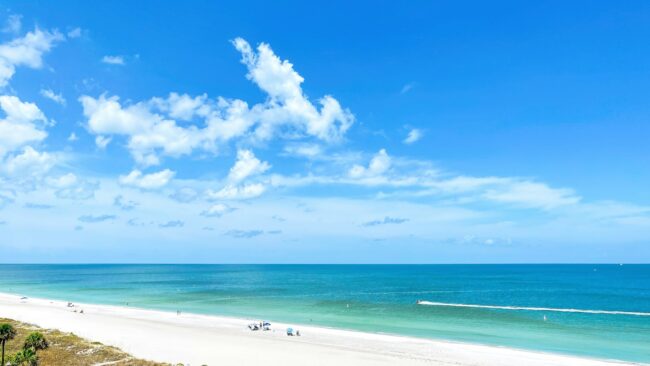
Clearwater Beach in Pinellas County. Photo: Edgar Serrano via Unsplash (Unsplash License).
Quick Answer: Pinellas County collected $88.5 million in gross tourist development (bed) tax from October 2025 through July 2026, up 8.35% from the same 10 months a year earlier, according to Pinellas County Tax Collector figures published by Visit St. Pete-Clearwater (VSPC). The 6% tax is split 60% to destination marketing and 40% to capital uses, and the bigger capital items now include a $125.7 million beach renourishment project and an $85 million commitment to the Phillies’ spring training complex in Clearwater.
After hurricanes Helene and Milton disrupted the fall of 2024, the county’s 6% tax on short-term lodging bounced back in fiscal 2026, which ran from Oct. 1, 2025, through Sept. 30, 2026. Spring brought the busiest high season on record, and summer months that had slipped in 2025 rose by double digits. The rebound comes as a county budget deficit and a new statewide property tax overhaul draw attention to how bed-tax money is held and spent, decisions shaped by the county’s Tourist Development Council (TDC).
How much bed tax did Pinellas County collect in fiscal 2026?
Gross collections reached $88,534,639.71 for October 2025 through July 2026, the latest month published. That is 8.35% more than the same 10 months of fiscal 2025, when the county collected about $81.7 million. Collections for all of fiscal 2025 came to $92,530,686.96 gross, a 4.4% decline from the year before. Much of that drop came in October 2024, when collections fell 28.1% in the month after the storms.
The fiscal 2026 pattern looks like a recovery. October 2025 was up 30.4% against the storm-depressed month a year earlier. November and December were softer. February set a monthly record of $10.8 million, March brought in $14.0 million, and April’s $11.4 million was the highest April on record. VSPC reported $36.16 million in bed-tax collections for February through April combined, the most ever for that period. May, June and July each rose between 12.8% and 18.2% from a year earlier.
| Month | FY2025 gross | FY2026 gross | Change |
|---|---|---|---|
| October | $4.33M | $5.65M | +30.4% |
| November | $5.88M | $5.77M | -1.8% |
| December | $6.68M | $6.21M | -7.0% |
| January | $8.29M | $8.30M | +0.2% |
| February | $9.90M | $10.80M | +9.1% |
| March | $13.78M | $13.99M | +1.5% |
| April | $9.89M | $11.37M | +14.9% |
| May | $8.08M | $9.11M | +12.8% |
| June | $7.48M | $8.58M | +14.8% |
| July | $7.40M | $8.7M | +18.2% |
| August | $6.02M | Not yet reported | — |
| September | $4.81M | Not yet reported | — |
| Total | $92.53M (full year) | $88.53M (Oct.–July) | +8.35% (same months) |
Source: Pinellas County Tax Collector comparative reports; Visit St. Pete-Clearwater Tourism Economic Snapshot. Months are gross collections by month reported.
Is fiscal 2026 on track to set a record?
VSPC and local reporting said in mid-2026 that the county was on pace to beat its annual bed-tax record, which was set in fiscal 2023. St. Pete Catalyst reported that year’s total at a record $98 million. VSPC said fiscal 2024 topped $96 million. August and September 2025 together brought in about $10.8 million. Fiscal 2026 would need roughly $9.5 million from August and September 2026 to reach $98 million. Those final two months had not been published, so the full-year result is unconfirmed.
How many visitors came to Pinellas, and what did they spend?
VSPC’s fiscal 2025 key performance indicators count 14,929,999 visitors to Pinellas County and $6.07 billion in direct visitor spending. The same report lists 5.75 million occupied hotel room nights, 4.82 million overnight visitors in paid accommodations and an average visit of 2.9 days. In January, VSPC said tourism produced more than $10 billion in economic impact in 2025 and supported about 100,000 jobs. The indicators also show $239.7 million in property taxes paid by the tourism industry and $55.5 million in visitor-generated sales tax.
Those 2025 totals were lower than fiscal 2024. That year VSPC reported more than 15.4 million visitors, $6.4 billion in direct spending, more than 6.4 million hotel room nights and $11.2 billion in economic impact.
Visitor counts in 2026 rose with the tax receipts. VSPC reported 4.7 million visitors from February through April, and nearly 5 million for the full spring season. St. Pete Catalyst, citing VSPC data, reported nearly 3.1 million visitors in May, up 9.7% from May 2025. For the first time since 2019, 12% of visitors named a concert or special event as their main reason for the trip.
How did Pinellas hotels perform in 2026?
VSPC’s September 2026 snapshot puts countywide hotel occupancy at 69.6% for the fiscal year through July. Average daily rate (ADR) was $201.35, revenue per available room (RevPAR) was $140.11, and hotel room revenue totaled $950.9 million. The peak months came in late winter and spring. March averaged 83.6% occupancy at a $265 rate.
| Month (2026) | Occupancy | ADR | RevPAR |
|---|---|---|---|
| February | 79.4% | $231 | $184 |
| March | 83.6% | $265 | $221 |
| April | 78.8% | $240 | $189 |
| May | 71.9% | $199 | $143 |
| June | 70.2% | $185 | $130 |
| July | 69.6% | $185 | $129 |
Source: Visit St. Pete-Clearwater Tourism Economic Snapshot (September 2026 TDC meeting), Pinellas County hotel data.
July occupancy fell from 76.3% in 2021 to 67.0% in 2025 before recovering to 69.6% in 2026. July ADR was $185 in 2026, compared with $191 in 2021 and $181 in 2025.
Where does Pinellas County’s bed-tax money go?
How is the 6% tourist development tax divided?
The tax applies to accommodations rented for less than six months. VSPC says the money is split 60% for destination marketing and 40% for capital projects. VSPC is funded entirely by its share of the tax. The capital share pays for beach nourishment, stadiums, museums and emergency reserves. Under a provision adopted in fiscal 2026, half a percentage point of the 6% rate each goes to beach nourishment, traditional capital projects and beach park facilities, and 16% of total collections goes to capital reserves. Florida law limits the tax to tourism-related purposes, and it cannot be used for police, fire or property tax relief.
How much is going to beach renourishment?
On June 17, 2025, the County Commission approved a one-time, $125.7 million emergency beach nourishment project. It was paid for with bed-tax dollars and state grants, including $14.2 million in state grant reimbursement. It received none of the 65% federal cost share earlier projects got through the U.S. Army Corps of Engineers, because not every property owner granted construction easements. The project placed an estimated 2.5 million-plus cubic yards of sand on Sand Key, Treasure Island and Upham Beach. Construction was scheduled for August 2025 through February 2026, and the county reported that dune planting was complete as of May 21, 2026.
Beach nourishment also has a regular line in the budget. The fiscal 2026 budget transferred $7.4 million to beach nourishment, and the proposed fiscal 2027 budget transfers $7.48 million.
Which capital projects are receiving bed-tax money?
In fiscal 2026, the Capital Funding Program awarded $12.45 million in grants: $12.1 million to The Dali Museum and $350,000 to the Florida Holocaust Museum. In January, VSPC said commissioners had approved $153.1 million in bed-tax funding for the largest beach nourishment project in county history, six capital projects and 40 “Elite Events.”
The largest new commitment is for the Philadelphia Phillies. On April 21, 2026, commissioners voted 6-1 for a term sheet that puts $85 million in tourist development tax money toward a roughly $205 million renovation of BayCare Ballpark and the Carpenter Complex in Clearwater. Commissioner Brian Scott voted no. Clearwater is to contribute $30 million and the state about $20 million, with the team covering the rest. The deal would keep the Phillies in Clearwater through 2047. It also raises the team’s annual marketing commitment to VSPC to $850,000, with 3% increases starting in 2032. The term sheet itself does not commit funds, and final agreements still have to be approved. The proposed fiscal 2027 budget shows a $20 million placeholder for the Phillies and another $65 million in a later year.
A new two-year capital grant cycle opened in October 2026 with $30.6 million available, split evenly at $15.3 million for traditional capital projects and $15.3 million for beach park facilities. The TDC endorsed that structure 10-1 on July 15, 2026. St. Petersburg Council Member Copley Gerdes voted no and raised concerns about the effect on traditional capital projects. Funding recommendations are expected in spring 2027.
How much goes to marketing and events?
| Bed-tax budget item | FY2026 budget | FY2027 proposed |
|---|---|---|
| Budgeted TDT revenue | $91.5M | $91.29M |
| Advertising and promotions | $21.87M | $25.77M |
| Digital marketing contract | $5.5M | $1.65M |
| Elite Events | $3.0M | $3.0M |
| Capital Funding Program grants | $12.45M | $19.35M |
| Beach nourishment transfer | $7.38M | $7.48M |
| Total reserves | $212.2M | $204.6M |
| Staff (FTE) | 50 | 50 |
Source: Pinellas County Convention and Visitors Bureau FY26 budget and FY27 proposed budget presentations to the Tourist Development Council. FY2026 column reflects figures as shown in the FY27 presentation where available.
Demand for event money is outpacing the budget. For fiscal 2027, 63 Elite Event applications asked for about $5.1 million, compared with 50 applications totaling $3.59 million a year earlier. Staff recommended funding 46 applications and a five-event bundle within the $3 million budget. The TDC voted unanimously to amend the Tourist Development Plan and raise the fiscal 2027 limit to $3,367,500, subject to County Commission approval.
Why is the bed-tax fund part of Pinellas County’s budget debate?
The fund holds a large balance. The fiscal 2026 tourism budget opened with a $270.3 million beginning fund balance, and the proposed fiscal 2027 budget shows total reserves of $204.6 million. Meanwhile, the county’s fiscal 2027 General Fund faced a deficit of more than $30 million. Proposals included service cuts and higher beach parking, boat-ramp and annual-pass fees estimated to raise about $2.77 million a year.
At the TDC’s Aug. 19, 2026, meeting, County Commissioner Chris Latvala suggested that if Amendment 3 passed, the Legislature could allow more flexible use of tourism dollars. On Nov. 3, Florida voters approved Amendment 3 with more than 60% of the vote. The amendment phases in larger homestead exemptions for non-school taxes and lowers the annual assessment cap on non-homestead property from 10% to 5%, starting Jan. 1, 2027. Any change to how the bed tax can be spent would still require legislative action.
Pinellas tourism at a glance
| Metric | Figure |
|---|---|
| FY2026 gross collections (Oct.–July) | $88.53M, +8.35% |
| FY2025 gross collections | $92.53M, -4.4% |
| 2025 economic impact / jobs supported | More than $10B / about 100,000 |
| FY2026 hotel occupancy / ADR (Oct.–July) | 69.6% / $201.35 |
| Beach nourishment project | $125.7M, approved June 2025 |
| Phillies complex commitment | $85M of $205M project |
Source: Pinellas County Tax Collector; Visit St. Pete-Clearwater; Pinellas County.
Brian’s Take
As a former investment manager and analyst, I look at the trend first, and this one is good. Bed-tax receipts are up 8.35% through July, while July hotel rates are still below where they were in 2021. That points to more stays, not just the same visitors paying more. Still, a single strong spring after a hurricane year does not set a trend, and the county’s own fiscal 2027 forecast assumes revenue stays flat.
The balance sheet deserves more attention than it gets. More than $200 million sits in reserves while the General Fund has a deficit, and the beach project had to go ahead without federal cost-sharing because of missing easements. With the Phillies commitment, the new capital cycle and a growing list of event requests, the question is no longer whether Pinellas has tourism money. It is whether each dollar comes back as room nights. Event producers and other applicants for these funds should be ready to show their numbers.
Frequently Asked Questions
How much bed tax has Pinellas collected in fiscal 2026?
Gross collections totaled $88.53 million from October 2025 through July 2026, up 8.35% from the same months of fiscal 2025. August and September figures had not been published when this report was written.
How is Pinellas bed-tax revenue allocated?
It is split 60% for destination marketing and 40% for capital uses. The capital share includes beach nourishment, capital project grants, beach park facilities and reserves.
Can Pinellas use bed-tax money to fill its General Fund deficit?
Not under current Florida law, which limits the tax to tourism-related uses and bars spending on police, fire or property tax relief. Changing that would require action by the Legislature.
How many people visited Pinellas County in 2025?
VSPC counted 14.93 million visitors in fiscal 2025, with $6.07 billion in direct spending, down from 15.4 million visitors and $6.4 billion in fiscal 2024.
Sources and Further Reading
- Official Comparative Report 2025-2026 (Tourist Development Tax) — Pinellas County Tax Collector, via Visit St. Pete-Clearwater
- Bed Tax overview and collection reports — Visit St. Pete-Clearwater
- Tourism Economic Snapshot, September 2026 TDC Meeting (July 2026 numbers) — Visit St. Pete-Clearwater
- Tourism Economic Snapshot, November 2025 TDC Meeting (September 2025 numbers) — Visit St. Pete-Clearwater
- FY25 Key Performance Indicators — Visit St. Pete-Clearwater
- Tourism Drives $10 Billion Economic Impact, Fuels Nearly $155 Million Direct Investment — Visit St. Pete-Clearwater
- Visit St. Pete-Clearwater Reports Tourism Drives More Than $11.2 Billion of Economic Impact in Fiscal Year 2024 — Visit St. Pete-Clearwater
- St. Pete-Clearwater Welcomed Nearly 5 Million Spring Visitors — Visit St. Pete-Clearwater
- FY26 Budget presentation, Tourist Development Council — Pinellas County Convention and Visitors Bureau
- FY27 Proposed Budget Presentation, Tourist Development Council — Pinellas County Convention and Visitors Bureau
- FY26 Capital Funding Budget Allocation Recommendation — Pinellas County Convention and Visitors Bureau
- Tourist Development Council minutes, July 15, 2026 — Pinellas County
- 2025 Pinellas County Beach Nourishment Project — Pinellas County
- Could booming tourism help ease Pinellas’ budget squeeze? — St. Pete Catalyst
- Record spring fuels Pinellas tourism growth — St. Pete Catalyst
- Tourism officials overcome adversity amid record-setting year — St. Pete Catalyst
- Pinellas approves $85M for Phillies complex, 6-1 — Tampa Bay Business & Wealth
- Florida Amendment 3: Voters pass historic property tax caps — FOX 13